
#On the Eastern District
Of the seven districts of Bastion-Königsberg, the Lake Gate is the one the Bureau of Engineering planned for correctly. I set this down once, under seal, and I don't intend to repeat it where the engineers can hear.
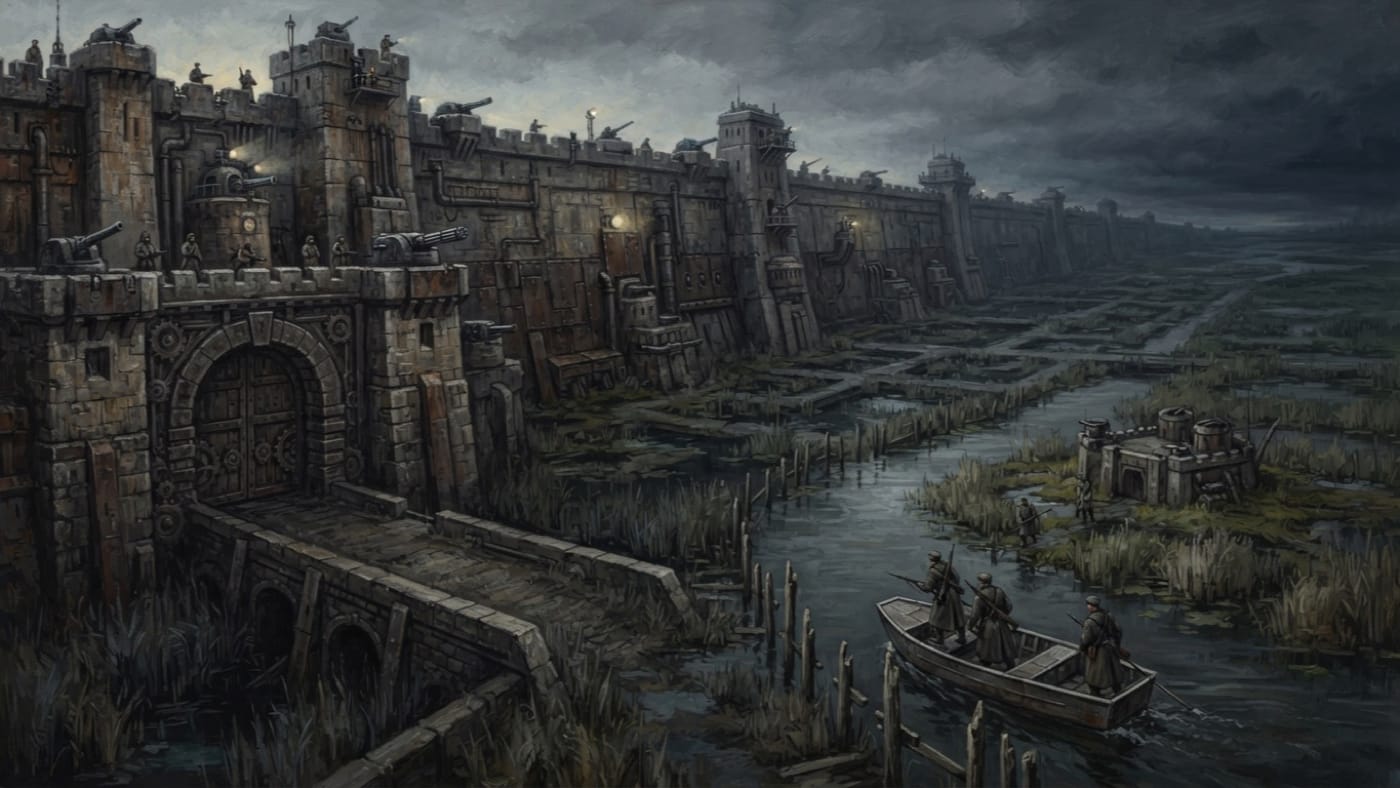
The district lies on the eastern side of the bastion and faces the Masurian approaches to the east and southeast. It is heavily fortified and permanently garrisoned, and it is where the Masurian Watchers go out into the water. Its walls are twelve metres of stone, iron and fill, the thickest anywhere in Königsberg. The bastion is the northern anchor of the Sagittal Line, the end where the Line meets the Baltic. Its southern counterpart, Bastion-Constantinople, lies on the far side of a continent. Between the two runs every grievance the Bureau of War has ever filed about supply.
The Lake Gate's construction date is not on record. Königsberg was greatly enlarged in the Concordat-era rebuilding of A.S. 92–110, and an industrious reader may want to borrow those years and nail them to the eastern masonry. I will not do it, and the reader may not either. The Bureau of Records has never shown me a commissioning order, an architect's name or a foundation-stone for this district, and a Codex that invents a date for its own convenience is no better than a parish register kept in pencil.
What can be said is that the Bureau built the Lake Gate where an enemy ought to come. In more than a century of the bastion's history, none has come that way.
#On the Water Before the Wall
"The lakes defend us. The lakes also confine us. The Bureau sees no contradiction." — Attributed to Colonel-Warden Bruhns, Northern Garrison Command, A.S. 189
East and southeast of the Gate lies the Masurian Lake District: interconnected lakes, marsh, channel, reed-bed and drowned forest stretching farther than any sentry can see on a clear day. Northern days are seldom clear. The Bureau of Engineering calls the region the Primary Hydrological Defensive Zone. The soldiers call it the Drowning Garden. The engineers' name went into the specifications and the soldiers' name went into every song, and the songs have the wider circulation.
An army advancing in order from the east must break formation to cross it. In summer the open water splits any column into channels, and the channels split again. Pack-trains bog in the reed-beds. Guns sink at the wheel-hubs. Some water a man can wade, and some he must swim, and a stranger cannot tell the two apart until he is already in it. Winter changes the problem. Ice can lay hard surfaces across ground that was impassable in summer, and some of those surfaces lead toward the bastion. The garrison therefore keeps two separate doctrines of engagement, one for open water and one for frozen, and the Lake Gate is where both of them end.
None of this means every winter sheet will bear a cart or every summer channel will float a boat. The Drowning Garden makes no promises in either season. The Gate exists because the water can't be trusted to defend the bastion on its own.
#On the Men Who Go Out
The Masurian Watchers are light infantry, recruited exclusively from the lake-district villages absorbed into the bastion's service when Königsberg was requisitioned in approximately A.S. 67. Their ground begins at the Lake Gate, and the Lake Gate exists, in large part, to send them out and take them back.
The entry for Bastion-Königsberg states that "the Synod requisitioned it" in approximately A.S. 67.
The requisition of Königsberg and the absorption of the lake villages, about A.S. 67, were carried out by the emerging Church's provisional frontier administration. At that time the Sagittal Line was defensible but incomplete. The formal Synod was constituted only at the Concordat of Strasbourg in A.S. 90. The villages were absorbed twenty-three years before there was a Synod to absorb them, and they did not wait for the constitutional settlement before learning to carry carbines.
The Watchers know the water as a ploughman knows a field. They know the shallows, and the submerged ridges where a man can stand chest-deep and fire a carbine with his cartridges held above the waterline. They know where the bottom falls away to thirty feet in a single step. They find their way by reed-pattern, by bird-call, and by notched stakes driven into the lake-beds. The Bureau of Records has tried to catalogue the stakes five times and has abandoned four of the attempts. The file does not record that the fifth was ever completed. I record the stakes here as stakes. Whatever system the notches follow belongs to the Watchers, and the four abandoned ledgers belong to Records.
Their commander is Lake-Captain Kaspar Dreyse, a third-generation native of the lake district whose family entered service through the original village requisitions. His title gives him command of men who work in lakes. It gives him no ships, and any clerk who reads "Lake-Captain" and looks for a fleet will find only wet infantry.
The Bureau of Purity has cleared Dreyse nine times. Each inquiry was opened for the same reason: his formation's methods can't be classified as natural skill or as heterodox practice, and Purity will not leave an unclassified thing alone. Each inquiry closed with a clearance. A clearance is not a conviction. Nine clearances are not nine convictions with the paperwork mislaid, though I have met inquisitors who read them that way.
#On the Expected Approach
The Bureau of Engineering's reasoning for the Lake Gate is sound, and I have read nothing that refutes it. The lakes lie to the east and southeast. An enemy who wanted Königsberg by land, and who was prepared to pay for it in drowned men and lost guns, would come through the Drowning Garden. Whatever came out of the water would come up against the eastern wall, so the eastern wall was built thicker than any other. The Bureau built for the threat that made strategic sense.
No recorded attack on Königsberg has come from the Lake Gate's direction.
The thing the garrison calls the Grey has been reported on the northeastern and Baltic approaches, outside the principal coverage of the Masurian maze. It has not been observed crossing the lakes in winter or in summer. The Bureau of War's own designation for it has stood at classification pending since A.S. 190. The Bureau of War, the Bureau of Records and the Bureau of Doctrine together do not know what it is, where it began, or what it wants. It should not be confused with Syrion's time-fog, which is a different matter with its own file, or with the Nameless Tide that Bastion-Brest faces on another coast entirely.
Two errors are popular in the officers' messes, and I prohibit both. The first holds that the Lake Gate stopped an eastern assault. The record contains no assault for it to have stopped, and I won't credit a wall with a victory nobody saw. The second holds that the Grey cannot cross the lakes. The record shows only that nobody has seen it cross them, and nobody has seen the Grey in transit anywhere, which the garrison does not find comforting. The water to the east may be impassable to it or merely uninteresting to it. On present evidence nobody can say which, and the honest entry leaves the question unanswered.
What remains is a district built thickest on its eastern face against the enemy reason predicted, while the anomaly the bastion actually lives with appears along the coast. The engineers were right about the geography. Nobody in the Bureau can yet say whether they were right about the enemy.
#On the Present Condition
In the bastion's present assessment of A.S. 201, Königsberg is unbreached and operational. The Lake Gate is still garrisoned. Its twelve-metre walls are intact and stand facing the reed-beds as they always have. The Masurian Watchers still keep their lake-posts and still go out through the Gate under whichever of the two doctrines the season demands: in summer, wading channels where a misstep means a thirty-foot drop, and in winter, testing ice that may or may not take their weight. Castellan-Warden Ingrid Halvorsen has commanded the bastion as a whole since A.S. 191. The record names no separate commander of the Gate, and I will not supply one.
The Lake Gate's function has never depended on the enemy arriving where the wall expects it. The district holds the eastern approach shut and keeps the men who know the water on the bastion's side of it. If the anomaly ever moves inland, the Lake Gate is where it will meet the thickest walls Königsberg has. The garrison stands its watches on that assumption. So do the Watchers, and so does Purity's open file on Dreyse.