
#On the Post and the River
Observation Post Kestrel-11 survives in the archive as a designation, a patrol and a single report. Its builders left no plan with the Bench. Its garrison left no roster that has reached my desk. Its numeral explains nothing at all. The Bureau numbers its posts the way a sacristan numbers candles, so that afterwards it knows which one went out.
The post watches the Drava, and that is the whole of its documented purpose. The river once carried grain through the southern plain. It now crawls through Kargath's province, the Blightmarsh, yellow-grey and thick with sediment, grease and the froth that gathers where corpses ride a current longer than corpses ought. Banks rise in a night. Channels go missing between matins and vespers. The marsh eats its own edges and files the result as shoreline.
The Bureau of Records still lists the Drava as navigable. I have read the entry. It is correct in every particular that ink can govern. A barge master who trusts it will find the river navigable in the sense that a grave is habitable: one may certainly enter.
#On the Earlier Loss
Kestrel-11's report would be a curiosity for the chaplains' table had the river not already taken a surveyor. In A.S. 174 (1884 CE), the Bureau of Cartography sent Adept Harlen to reconcile the Drava's western course with its charts, after patrols reported bends that no prior survey admitted. Harlen went into the water and did not come out. The surviving witnesses agree that he went in standing.
The first loss notice stated that Adept Harlen fell into the Drava.
Corrected by Cartography on the objection of two surviving witnesses, who deposed that he was standing when the river took him. The correction concerns his posture. The river's conduct remains unamended.
The file entered him as deceased by exposure. Exposure is the Bureau's universal solvent. Fever, drowning, bad air, sucking mud and the plainly inexplicable all dissolve into one noun narrow enough for a ledger column, and the noun certifies no mechanism whatever. The expedition came home with three maps that disagreed and without Harlen's notebooks. The Cartographic Bench sealed the maps separately and declined to choose among them.
Any later report from this stretch of river must be measured against a baseline. The Bench has seen to it that there is none.
For twenty-six years Harlen stayed dead on paper. His pay ceased. His instruments were written off. The river kept its own counsel, as eastern rivers have learned to do, and the Bureau kept its peace.
#On the Figure in A.S. 200
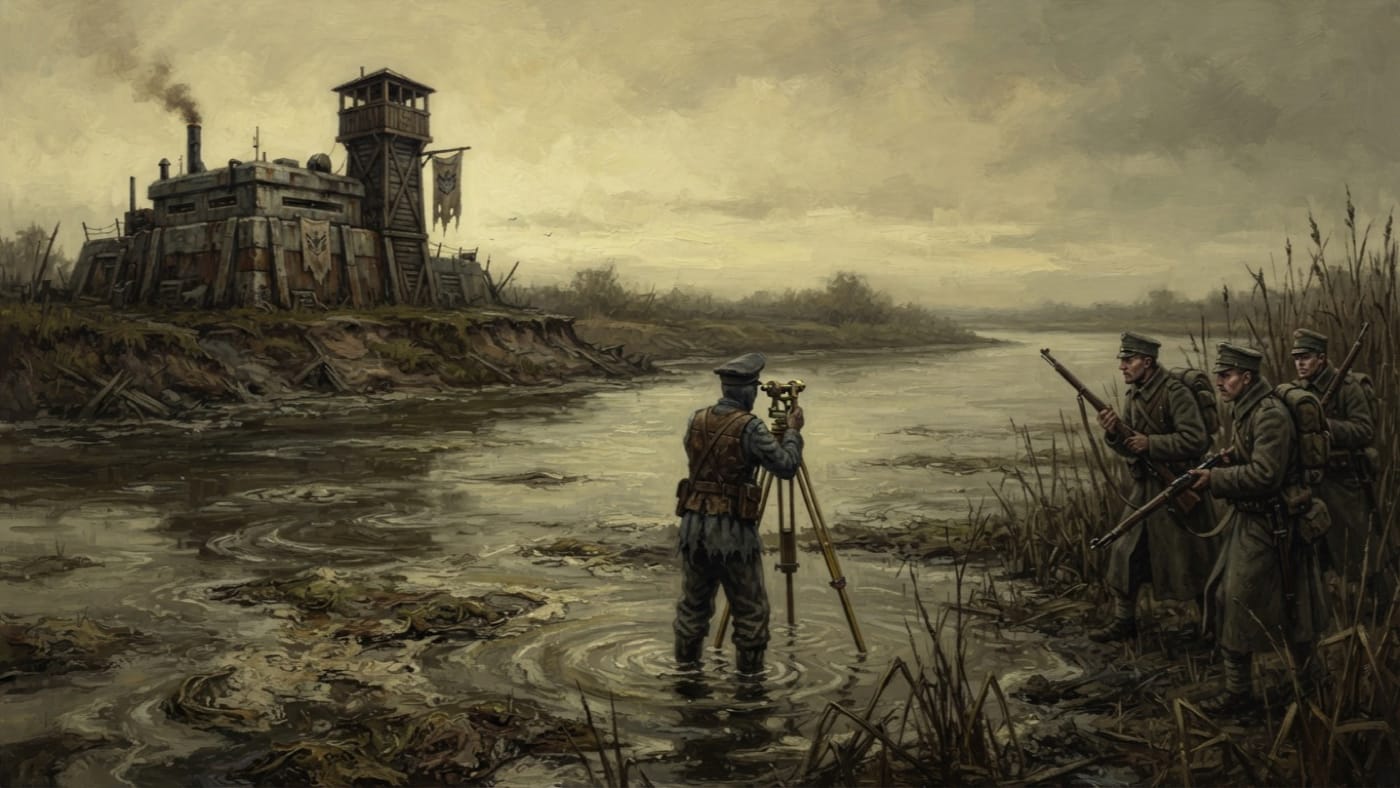
In A.S. 200 (1910 CE), a patrol at Kestrel-11 observed a figure in the Drava. The archive does not say whether the patrol watched from the post itself or was working the bank nearby. It says what they saw. A human shape stood waist-deep in the current, facing east, holding what appeared to be a surveyor's transit.
The patrol hailed it. It gave no answer. The patrol did not approach.
The commander, whom the report leaves unnamed and whose judgement I would gladly hang in a chapter-house as an icon of soldierly theology, ordered withdrawal. The patrol withdrew. The commander then filed the sighting, which is the rarer virtue. Many officers on the frontier have seen things in the water and written up a quiet watch, because a quiet watch draws no inquiry, no auditor and no visiting confessor with a long memory and a short temper.
What the report records is resemblance. The figure matched Harlen in height, in posture and in equipment. It also had the lean of the left shoulder that his colleagues knew from years of the transit case riding there. The patrol further estimated that the figure looked unchanged, as though the twenty-six years since A.S. 174 had been filed in some other cabinet. That is the whole of the evidence: a silhouette, a kit, a slouch and an estimate of age, all taken across moving water by soldiers who had decided, correctly, to leave.
It is enough to trouble a Bureau and too little to name a man. Resemblance identifies no one. An estimate of apparent age proves neither survival nor arrested time. An instrument held up in the Drava proves only that someone, or something, still had the use of hands and an interest in angles.
The Bureau of Doctrine has not authorized me to say whether the Great Deceiver lends out the shapes of drowned servants of the Church. It does let me say that the patrol did well to leave the question unasked.
#On the Report's Passage
The sighting entered the Harlen file and set five Bureaus moving at five different speeds.
The Bureau of Medicine asked to examine the sighting. Denied. The Bureau of Rites asked for authority to decide whether Harlen's death rites needed amending, since a man commended to the Creator as dead and later reported standing in a river is a liturgical irregularity of the first water. Deferred. The Bureau of Records asked whether the sighting created any pension liability. It was answered within the hour: none, and the subject remains deceased for fiscal purposes. Cartography kept the file unamended. Doctrine ordered silence until further contradiction.
Mark the order of speed. The body went unexamined, the soul's paperwork is waiting in a tray, and the purse was shut before the ink on the request had dried. I make no complaint. A Church that answered its theological questions as promptly as its fiscal ones would have no use for Hieromnemons, and I should be teaching the catechism to fishwives in some parish with a leaking roof.
No record shows that any of these offices kept a desk at Kestrel-11. The post produced the report, and the Bureaus disposed of it from their own chairs, under their own lamps, at their own leisure. The post sent one sheet of paper into the archive. Nothing the file preserves was ever sent back.
#On the Unamended Record
What the archive holds on Kestrel-11 can be counted on one gauntleted hand. There is a designation and a patrol. There is a figure with a transit, facing east and giving no answer. There is a withdrawal, a report, and the answers that came back. The post's condition in A.S. 201 is undocumented. So is any later sighting. So is any attempt to go back and look, and I suspect that last omission is the most disciplined entry in the file.
The Harlen dossier gathers the explanations already in circulation. I repeat them here as suggestions on record and endorse none: a demonic mimicry wearing Harlen's form; a temporal fold along the Drava; a cartographic echo; a preserved corpse moved by Kargath's appetite for routes; or Harlen himself, still at his survey. The fold was proposed because the river already carries a timing complaint from A.S. 130, when clocks and crew disagreed. A shared river is not a shared cause. The Harlen file does not join the two, and no seal of the Bureau of the Hourglass stands over the joint.
Patrols on this perimeter serve under Standing Order 77-K and under the older order that needs no number: look, decline, and write it down. Kestrel-11 obeyed both. Whatever stands in the Blightmarsh water is free to go on facing east, toward everything the Synod would prefer not to survey.