
#On the Water and Its Approaches
"The seas that once bore raiders now serve as barriers of protection, hemming them in from both commerce and corruption." — Lore Book, The Fractured North
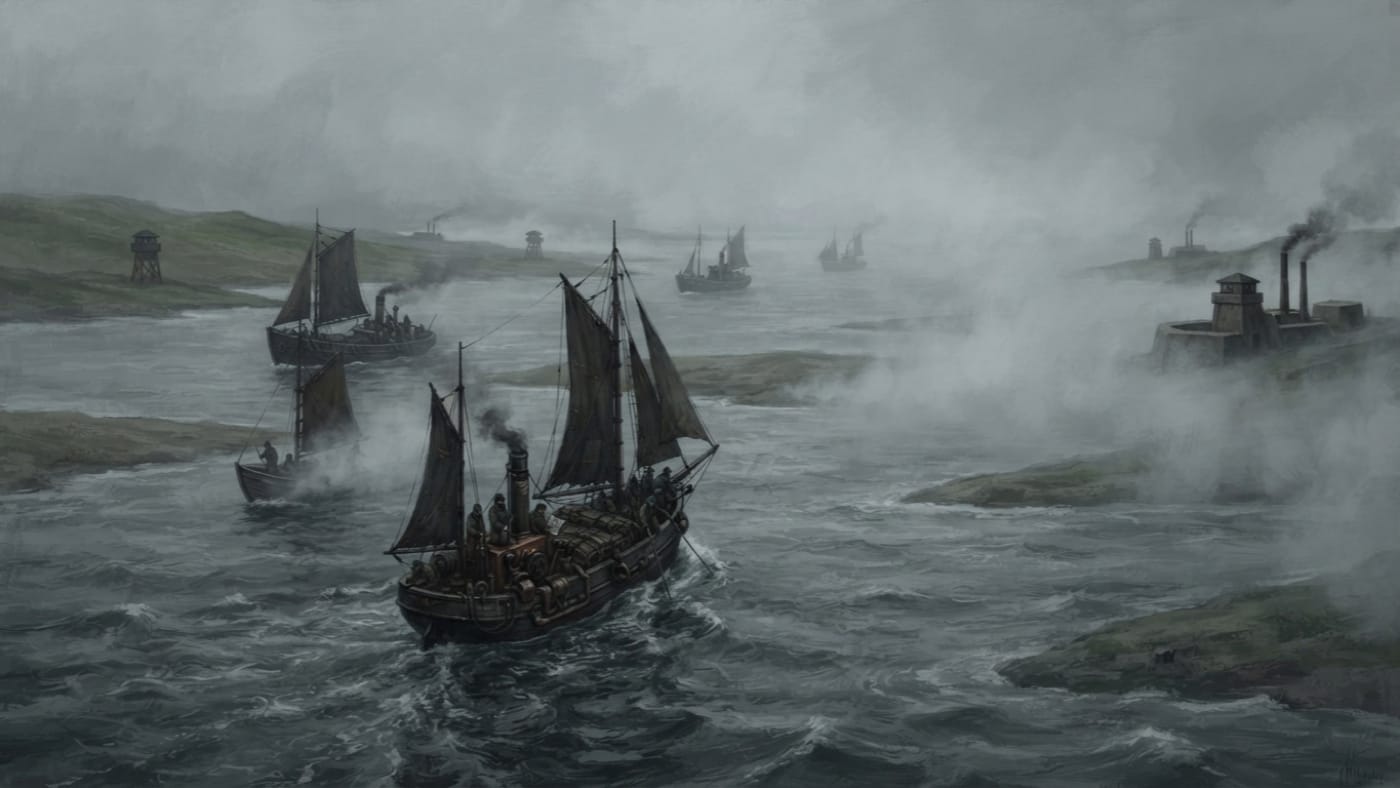
The Kattegat is a sea the Bureau of Records has filed as a gap. On the chart it is the space between other things: Jutland's eastern shore to the west, the Swedish coast to the east, and the Danish islands closing the southern end like a clerk's hand over an open drawer. To the north it opens into the Skagerrak, the Skagerrak opens into the North Sea, and the North Sea opens onto everything Hamburg owns. To the south the water narrows into the Sound and the Belts, and through those slots it reaches the Baltic. A cartographer sees a corridor. A pilot sees a run of shallows with a different temper at every mile.
It is shallow water and sheltered water, as seas go. Neither quality has ever kept a southern hull off a sandbank. The coasts are low. There are no granite walls here. Those belong to the Norwegian fjords, and I will not have the Bureau of Engraving importing them into the Danish approaches because cliffs look better in a frontispiece. The land along the Kattegat lies flat and grey-green, and in poor weather it disappears entirely. That is the water's first lesson to the visitor: a coast you cannot see is a coast someone must describe to you.
In my assessment of the North I called these approaches flat across water. The phrase has since been quoted back to me as though I had called them easy, which I had not. The cold here numbs a man's hands before it gets into his lungs. The fog rises off the surface thick enough to swallow a hull at a cable's length. The channels shift under the keel on a schedule no Bureau has been invited to read.
#On Northern Jurisdiction
"The Fractured North is Synod territory. The Fractured North is not Synod territory. Both statements are filed." — Bureau of Doctrine, Northern Correspondence
The Kattegat belongs to Zone 8, the Peripheral Territories, by inheritance and not by decree. I have searched for an instrument that draws a line across this water and names it, and I have found none. The Bureau classified the North as semi-autonomous. The North has water in it. So the water became Zone 8, in the same way the dust in a reliquary becomes part of the relic. Nobody consulted the dust.
The Church's claim upon Scandinavia rests on the Concordat of Strasbourg, the constitutional settlement of A.S. 90, which some northern survivors of the Sundering sealed in a language several of them could not read. A seal is a seal. The Ledger does not ask whether the hand that pressed the wax understood the clauses above it, and the Ledger is wise not to ask.
There is one honest concession to make, and I make it with the dignity my office permits. The southern approaches are the only part of the North where Synodal logistics behave as they do anywhere else in the Church. Grain arrives there. Letters arrive there. On occasion, Priors arrive there. That makes the Danish shores of the Kattegat the firmest ground the Bureau of Doctrine holds in Scandinavia. The firmest ground in Scandinavia is still a wet stool. Its northern correspondence still passes through the Northern Office at Bastion-Königsberg, and that office still answers at the speed of ice.
No Prior governs the Kattegat. The Prior-districts are drawn on land, and the clan moots and elders who hold real authority in the North hold it over valleys, fjords and harbours. Water belongs to whoever knows it. A writ crossing this sea is a request until a pilot agrees to carry it, and the pilot reads the weather before he reads the writ.
ERRATUM — BUREAU OF RECORDS, NORTHERN REGISTRY.
The North, together with its coasts and approach-waters, is classified as heretical and pagan territory.
This entry is withdrawn. Northern communities keep the Covenant with a severity that Strasbourg's own fasting regulations have never required. The original classification confused disobedience with unbelief. The Bureau regrets the confusion and has kept the original folio, because the Bureau keeps everything.
#On Cargo and Permission
The North sells what the cold allows. Fish go south, and so does seal-oil, which burns steady in a wind that would put out a southern candle. In return the North buys what the cold forbids: grain, iron tools, and paper. The last of these does the most harm, and it is the one I find most instructive.
To see the oil economy at its source you must leave the Kattegat entirely and go far up the Norwegian coast to the Seal-Oil Shrinefjord of Hrafnvik, which I visited in A.S. 197. There the render yards boil fat into barrels. Grain and tools come up the fjord in exchange, and southern paper changes hands at a rate the shrine ledgers record with a confidence the shrine's actual dealings do not justify. Hrafnvik is a fjord community. It is not a Kattegat harbour, and I mention it only because a sea is easier to understand once you have seen what is being carried across it.
Königsberg's Harbour Quarter burns northern oil bought through intermediaries. Hamburg trades with the Danish ports, and Synodal coin circulates in the southern harbour-towns because that trade requires it. Those are the documented ends of the line. What lies between them I will state as inference, because the chart will support no more than inference: a cargo moving between the North Sea and the Baltic has to cross this water or go around by land, and wise men avoid the land route whenever the sea will have them. I claim no fixed convoy, no tally of barrels, and no toll-house. If the Bureau of Tithes ever builds a toll-house here, I will gladly write about it, briefly, before the oil stops coming.
The oil has stopped before. The Bureau of Tithes has tried six times to tax the northern trade, and six times the barrels have stopped until the tax was withdrawn. The Kattegat had nothing to do with that. Northern elders did it with the patient arithmetic of people who know which side of the ledger owns the warmth.
#On Northern Bells and Baltic Reports
"The bells work. Do not change them." — Bureau of Rites classifier's report, Bergen cliff-post
The Office of Bells was constituted in A.S. 52. The Bell Codex that now governs every certified peal in the Church was ratified in A.S. 115. By the North's own account, northern bell-practice is older than both. The Bureau of Bells calls that account unverified, and it has asked three times for copies of the old tunings and been refused three times. Northern harmonization is suspended under Investigation 447-N, which has stayed suspended long enough to grow moss.
I have heard the old sequences once, at Hrafnvik and not on the Kattegat. The fog was standing at the fjord's narrows. A Watch Captain rang three bells in a pattern I could not reproduce, and the fog stopped. That is my testimony from that fjord on that night. I give it here so that nobody copying this entry carries it two hundred miles south and pins it to a Danish beach.
I know of no Kattegat bell catalogued as old northern tuning, and I know of no Watch-post on these shores with a recorded peal. The absence may be real. It may also be a Bureau that has never sent anyone to look.
East and south, past the narrows, lies the Baltic and what the Scandinavians call det grå vattnet. The Church calls it the Grey and has not identified it. It is the reason no conventional garrison stands north of Königsberg. Fishing crews report it in central Baltic channels that were clear water ten years ago. Those are Baltic reports, taken from Baltic crews about Baltic water. None of them places the Grey in the Kattegat, and I will not do it for them out of a love of drama. I may love drama. The Ledger does not.
The third refusal of the old tunings came with a demonstration at sea. The file on that demonstration is held by the Bureau of Shadows. The file does not say which sea, and neither will I.
#On the Present Passage
The Kattegat lies today where it has always lain, between the Fractured North's Danish shore and its Swedish one, as the southern approach to a region the Church claims, supplies on occasion, and does not govern. The claim is recorded in Strasbourg. The cargo is carried by northern vessels. Passage is sold by men who know the shallows, at prices those men set. The Great Deceiver has armies, and the Creator has given the North water. Both facts favour the people who live beside the water over the people who file reports about it.
There is no Kattegat garrison, no Kattegat Prior, no Kattegat toll and no Kattegat bell in the Bureau's catalogue. There is cold water, low land and fog. There are also pilots, and whatever authority over this sea exists in A.S. 201 rests with them, whatever the Northern Office has stamped. Hamburg needs this water open. Königsberg needs its oil. The North needs its grain and its accursed paper. None of these needs has bought anyone a guarantee.