
#On the Square and Its Status
A square is a place where the Church permits people to stand. What they stand for requires a separate application. — marginal note, Vienna censorial digest
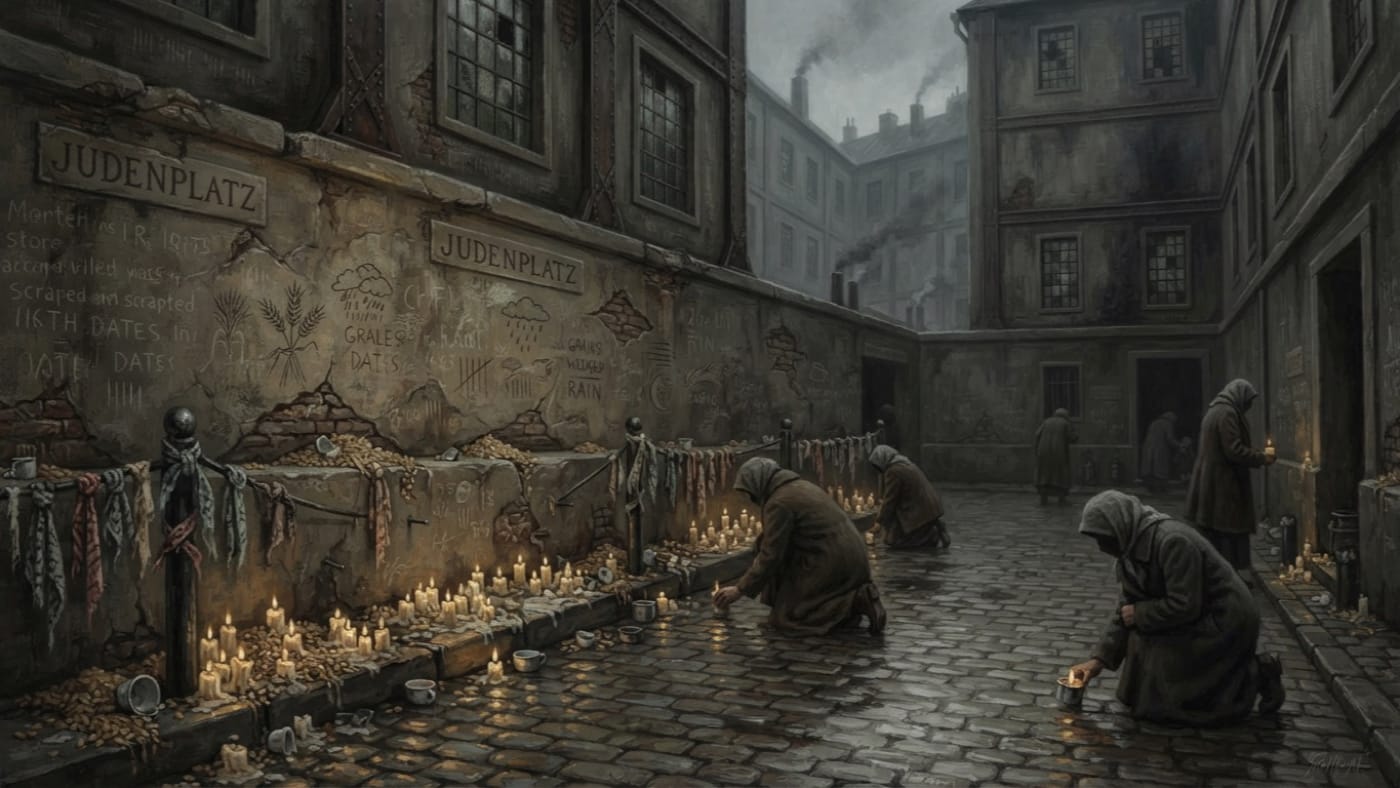
Judenplatz is a square in the inhabited shrine-ruins of Vienna. The Codex is interested in it for one reason: a memorial the Church has never licensed. The memorial is small. It consists of candle stubs, scratched mortar, barley, cups of rainwater and strips of cradle cloth. Pilgrims who expect basalt and blood-warm stone have come to the wrong square. They want Heldenplatz, which has a guide, a schedule and a gift shop. Judenplatz has a wall.
The memorial commemorates the mothers punished in the Vienna Incident of A.S. 112. Its legal status is settled: unauthorized. Its physical status is in dispute. The Bureau of Orison and Song holds that the accumulation is "material participation in a suspended cadence cult." The Bureau of Purity has removed it four times. Engineering has been asked to remove it more thoroughly. The memorial remains, and that is the whole dispute.
I will give no dimensions, approaches or neighbouring façades for the square. The Bureau of Records has not supplied them. A Warden who measures a heresy with his own feet becomes a witness in its file.
#On the Mothers Remembered Here
In A.S. 112, exhausted mothers in Vienna's pilgrim quarters near the Donaukanal began singing an unlicensed lullaby about rain and barley. It quieted their children, which the approved Mercy sleep phrases had failed to do. Orison classified the tune as "an unsanctioned cadence exhibiting potential for doctrinal contamination." Tone Inquisitors went into the stairwells while Purity cordoned the alleys. Within a month five thousand mothers had been branded, their tongues charred black with hymn-fire. The iron marked the tongue and left it in the mouth. Every sentence those women spoke afterward announced the charge before it reached its subject.
The Bureau of Mercy took their children into its orphanages under the rubric of protective transfer. No copy I have been permitted to read gives the number of children taken. Five thousand counts the branded mothers. It is no roll of the dead. Anyone who carves it on a wall as a roll of the dead has changed the arithmetic in a direction the Bureau would never have chosen.
The prosecution in full belongs to the Incident's own entry. Here only its inventory matters, because the inventory is what people bring to Judenplatz. Records preserved some of the words before Orison sealed the file, and as far as they go the lullaby's matter was rain, barley and a cradle. The memorial's matter is the same. The song was seized. Its nouns escaped, and nouns can be set down on a pavement without a breath leaving anybody's lips.
A previous edition of the Vienna shrine-ruins entry dated "the Vienna lullaby purge" to A.S. 94.
Corrected. The purge belongs to A.S. 112. A.S. 94 is the year of the Orison Licensing Acts, the law that made the lullaby prosecutable. The clerk who merged the two dates confused the statute with its harvest. Vienna itself was reclaimed only in A.S. 95, and the Church does not brand mothers in a city it does not yet hold. It waits for the paperwork.
#On Offerings and Inscriptions
The memorial began as candle stubs set around a brick marked with five strokes. Nobody knows who scored the strokes or what they signify. Purity removed the brick, and no register I have seen records where it went. The candles came back anyway. Orison then had the wall scraped clean, and names appeared in the mortar.
The names are where Judenplatz quarrels with Records. Some belong to women who were branded in other places. Some match no file at all. Some are bare initials, two letters scratched with a nail or a key, which Records can neither confirm nor strike out. Records wants a register. What the wall holds is closer to a parish.
The offerings are ordinary enough to be insolent. Barley grains are pressed into the cracks between the stones. After storms someone sets out cups of rainwater. Strips cut from cradle sheets are knotted and left on the ledge and the pavement. The local Orison notice lists "inscribed bricks" and "cradle knots" among the prohibited materials. The Bureau has catalogued this shrine more carefully than it ever catalogued the children.
I can find no rubric governing any of this. The wall has no officiant and no feast day in any calendar I keep. One person brings grain and another brings water, and the wax runs down into the mortar beside the names.
The wax raises a further difficulty. Vienna's households must burn a prescribed number of candles each week, no more and no fewer, and inspectors tally the drippings in the gutters. A candle on Judenplatz sits on no household's tally. The inspectors have never stated in writing whether it counts against the quota of whoever lit it. I have never been foolish enough to put the question to them on paper.
#On the Four Clearances
The memorial has been removed four times and has returned four times. Each return came within the week, with the candles already lit and the names already carved. Purity carries out the removals with the speed of men who have done it before and the faces of men who expect to do it again. Orison issues the prohibition, Records files the clearance, and then the square waits.
No file I have seen names whoever restores the memorial. I record that the returns happen. I do not say how. The Bureau has not said how, and when the Bureau is silent a Warden of the Ledger is wise to keep his own silence.
After the fourth return Orison consulted the Bureau of Engineering about structural options. That is the Bureau's phrase for removing the wall itself. No fifth clearance has been carried out. Engineering has sent no reply that I have been shown.
The arithmetic offends every department involved. Purity has cudgels, cordons and carts. Orison has tuning forks, resonance boxes and the Licensing Acts. Opposing them is a scatter of grain that pigeons could clear in an afternoon. The grain has won four times. Each clearance is entered in the file as a success, and the file now records four successes at a site that still exists. Records sees no contradiction in this. Records also signed the arrest warrants.
#On Silence and Licensed Devotion
The Bureau of Pilgrimage keeps its Central Corridor headquarters in Vienna and licenses the city's devotion like any other trade. Pilgrims cross the Kärntner breach on their knees while the guides walk upright. The miniature columns in the gift shop are sold cold. Most devotion in Vienna comes with a price, a route or a quota. Judenplatz appears on no licensed itinerary I have seen, and no guide's fee is charged at its wall.
The square offers quiet instead. Orison's notice orders citizens to "report all humming," and the people who come to the wall have obeyed it more strictly than Orison intended. Of everything left there, melody is the only offering a tuning fork can hear, so it is the one people mostly keep at home. I say "mostly" because I claim nothing about every visitor on every night of eighty-nine years.
Rain, barley and a cradle reach the wall without their tune. A Tone Inquisitor can test a throat. He cannot test a cup of water for intervals. Vienna has perfected this particular insult, and the Bureau owns no instrument calibrated to detect it.
Unauthorized melody smugglers trade in fragments: a cadence carried in a knot, a phrase hidden inside an approved line, a bar passed from hand to hand and never sung whole. The fragments of the Vienna tune that survived the seizure disagree with one another, and no seized plate holds a complete original. Judenplatz keeps what the seizure could not hear, the nouns without the notes. No file establishes the square as a smugglers' station, and I will not make it one to please Orison's budget.
The Church later gave Mercy's wards the Dormition Canticle of A.S. 134. It is a licensed sleep-line, written twenty-two years after the irons were cooled and filed. The wall predates it, and the wall has not been revised.
#On the Present Condition
As of A.S. 201 the memorial remains unapproved and recurrent, and every department has catalogued it. The candles burn. Barley sits in the cracks. Rainwater stands in its cups after the storms, and Vienna has no shortage of storms. The names in the mortar remain unreconciled to any register. The women they name, or fail to name, remain branded in the Incident files, whether or not they are still living.
Orison's position has not changed: the accumulation is subject to removal. Purity's position is that it has already removed it. Engineering's position is unknown. Records' position is a folder that grows thicker with every clearance and has never once grown thinner.