
#On the Recorded Reassignment
This is a documentary survey, conducted in A.S. 201, of one phrase in one file. The year belongs to the survey. No surviving record dates Vell's retirement. His death is dated twice, and the two records disagree.
The phrase is Instructional Silence. It appears in the file of Master Cantor Vell, senior Iron Choir Brand-Singer of the Strasbourg penitence halls under the Bureau of Purity's Directorate of Acoustic Enforcement. His retirement is filed there as "voluntary reassignment to Instructional Silence." The word voluntary is the file's. I reproduce it the way I reproduce all Purity adjectives, with tongs.
In the corridors the phrase gets used as if it named an order, a school, a pension scheme for ruined throats or a vow taken by the exhausted. The record supports none of these. It describes one arrangement for one man. Under it, Purity kept the master's judgment and took away his public voice. What remains is a cell, a list of prohibitions, a queue of nervous pupils and a stone floor that answered for him. No vow appears anywhere in the file. Vell was forbidden certain kinds of performance, and the clerks recorded nothing about his tongue beyond that.
#On the Profession That Waited Outside
The Brand-Singer's trade is breath law. The Singer sets the tone of the room, governs the lungs of the condemned and cues the Brand-Smith to the iron. Each rite closes with a silence clean enough for the scribe to certify the mark. Beauty is optional, and legibility is required. A brand laid half a beat late is a clause the Bureau of Records cannot read. An unreadable confession has to be performed again, on the same body if the body permits.
Vell held senior tenure at Strasbourg from A.S. 130 to A.S. 147 (1840–1857 CE). In A.S. 141 he conducted the Seven-Rite Session: seven chambers held in one cadence, without a single misaligned inscription. The profession has measured itself against that afternoon ever since, mostly to its own discomfort.
By A.S. 147 his annual throat inspection recorded cord ridging, the onset of soot-lung, salt lesions and the indicators of bell-sickness. Purity marked him fit for continued service. The instrument was damaged and the ear was intact, and that is all the practical logic the ledger admits. I will not furnish the Bureau's private reasoning for it. The file gives no date for the reassignment. The end of his active tenure marks the end of his active tenure and does not mark when the reassignment began.
#On the Cell and Its Decisions
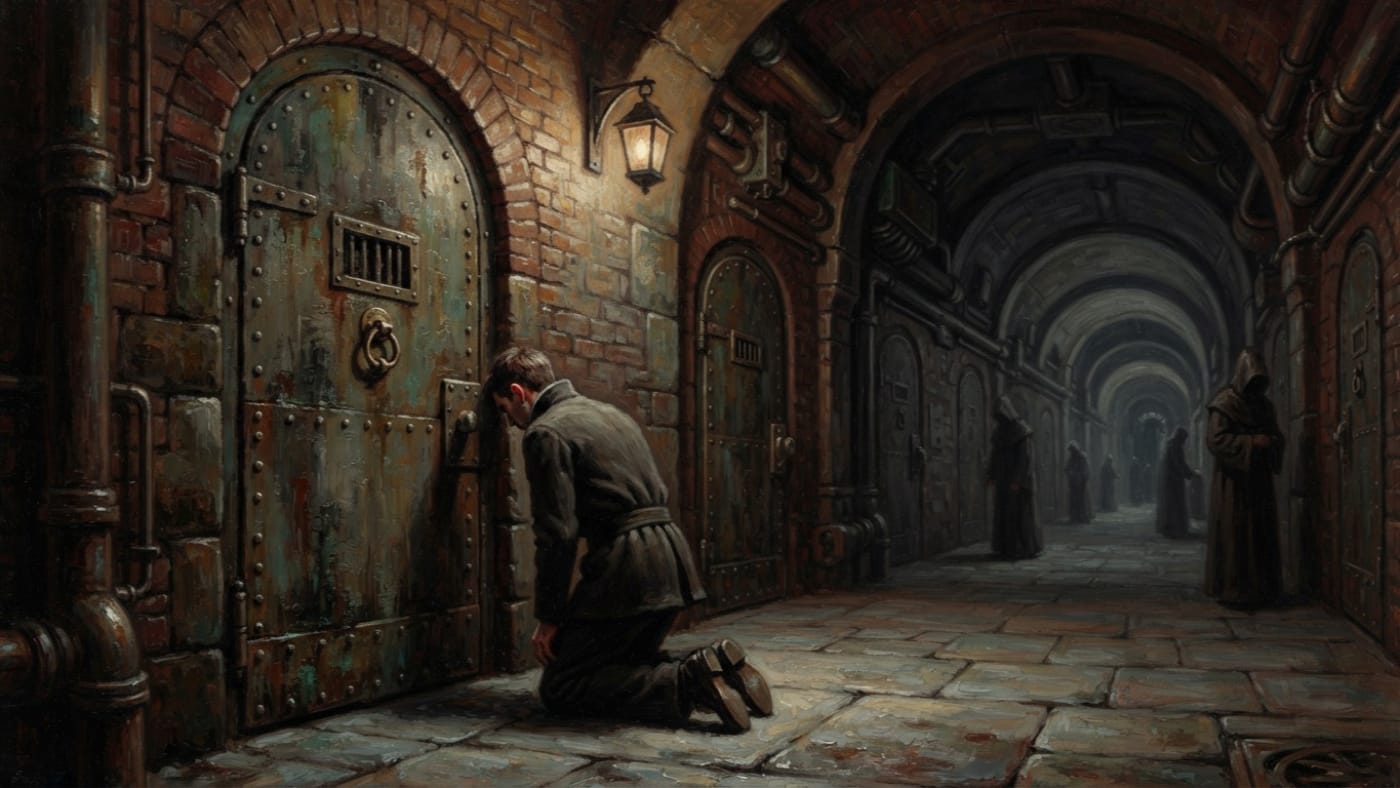
The file places Vell in a small cell under the western penitence annex. It records no dimensions, furnishings, warden or neighbours. Pupils came singly, sent one at a time, and the file admits no other kind. Brand-Singers visited before their examinations and sat outside the door until he tapped on the stone.
One tap meant proceed. Two meant retune. Three meant leave the profession.
The file does not record what passed between master and pupil before the taps. I decline to supply a curriculum the man refused to write himself. The waiting is easier to reconstruct, because the corps trains its people to hear intervals in heartbeats. A Singer outside that cell would have counted the gap between the first tap and the second as a span long enough to end a career. I have watched tribunal prefects await a verdict with less composure, and their necks were not the ones in question.
The prohibitions are as plain as the signals. Vell was to give no public singing, no Orison recitals, no feast-day appearances and no hagiographic interviews. The second item will interest the Bureau of Orison and Song, which keeps finding its own fingerprints on every useful voice in the Church. The fourth item explains why the Strasbourg bookstalls hold no edifying pamphlet titled Conversations with the Tuning Fork. Purity reserved his ear for pupils and withheld his voice from everyone else.
The file attaches no appeal to the third tap. It sets out no procedure for revoking a licence and offers no retraining. It does not record whether any examining board honoured the stone. It does record the master's own gloss on the third tap: the departing Singer might become a cobbler, if Providence had granted him enough intelligence to obey stone.
#On Permission and Imitation
Vell left no treatise. His instruction survives as corridor imperatives, repeated by Singers who sat outside that cell or claim to have done so: keep the bell in your ribs; do not chase the scream; never let pity pull pitch; log the crack before the auditor hears it. There is no Instructional Silence manual. Anyone selling one is selling paper.
The older maxim "Pain opens. Hymn orders. Truth seals." is not his, because it predates his licence. His confirmed contribution is a marginal correction warning that truth slips if the second note is late. That is less elegant than the maxim and considerably more useful.
The arrangement produced one formal instrument.
Read the three lines as they were written, separately. The first concerns his method and requires authorisation in writing. The notice does not name the office that grants it, and I will not appoint one. The second concerns his name. It applies to unscheduled rites, so a Singer who calls a sanctioned double session in a crowded hall has broken no line of it. The man it catches is the one who calls an unsanctioned session and points to a silent master as his warrant. The third concerns the number seven and the vanity of men who count.
The trade explains why the Bureau wrote all three. A Singer who drifts half a beat in one chamber spoils one inscription. A Singer who drifts across three chambers spoils three, and in every one a Brand-Smith lays the iron to a cue that was never sound. Vell's timing was exact enough that it left nobody an excuse. His name carries no cadence with it. A man who borrows the name without the ear has borrowed only the audacity, and the scribes will certify that in his file.
#On the Schools That Claim Him
Every faction in the corps has tried to file Vell under its own seal. He used Mercy Tone intervals when the subject's survival served legibility, and Judgment Tone cuts when speed did. His survival rates embarrassed the Judgment men and his coldness offended the Mercy advocates. Neither party can turn his cell into a verdict on the other.
The Cantor-Marshal's Handbook, Sixth Revision, stated that Vell "ultimately vindicated Judgment Tone against Mercy laxity."
Withdrawn. He used every school as a tool and treated faction as a novice's disease. His reassignment settles no quarrel between the schools. Any Judgment primer that quotes the stone taps will be returned to its author along with the primer.
The Silentists offer a subtler temptation. Their school refuses the full hymn and works through minimal cues, and here is a master who ended his career signalling with knocks. The resemblance is cosmetic. The Silentists' own published account withdraws the tale that Vell converted after East Hall. He lowered his volume for a season, and that proves caution rather than membership. A Purity-licensed cell and a school of rite technique share nothing except an absence of song.
The arrangement is also unrelated to the Circle of Mute Radiance, whose hand-code and mirror-shard commands govern Lantern Brotherhood hush-zones in the streets. Their silence is enforcement. Vell's was assessment, given to one pupil at a time through one wall. Anyone who confuses the two may explain the error to a Lantern warden, in sign.
#On the Unclosed Record
A Records abstract gives Vell's death as A.S. 151 (1861 CE). A Purity throat-seal ledger lists his licence as active until A.S. 153 (1863 CE). The dossier offers two explanations, clerical delay or posthumous usefulness, and chooses neither. I follow it. Two Bureaus have filed what amounts to two men under one name, one dead and one licensed.
Stories have grown in the gap between them. One places him among the road cages near Mainz, correcting the dead by tapping his cane against a stanchion. Another has him give up speech for breath marks on cold glass. The Bureau of Doctrine preserves both and accepts neither. Neither story places him in the cell after A.S. 147, and nothing on file places him there in the year of this survey. The records reviewed here cannot say whether the western annex still holds a master, a pupil or a broom.
Those who want to attempt a seventh chamber on his account should first obtain the writing. Failing that, there is always leather.