
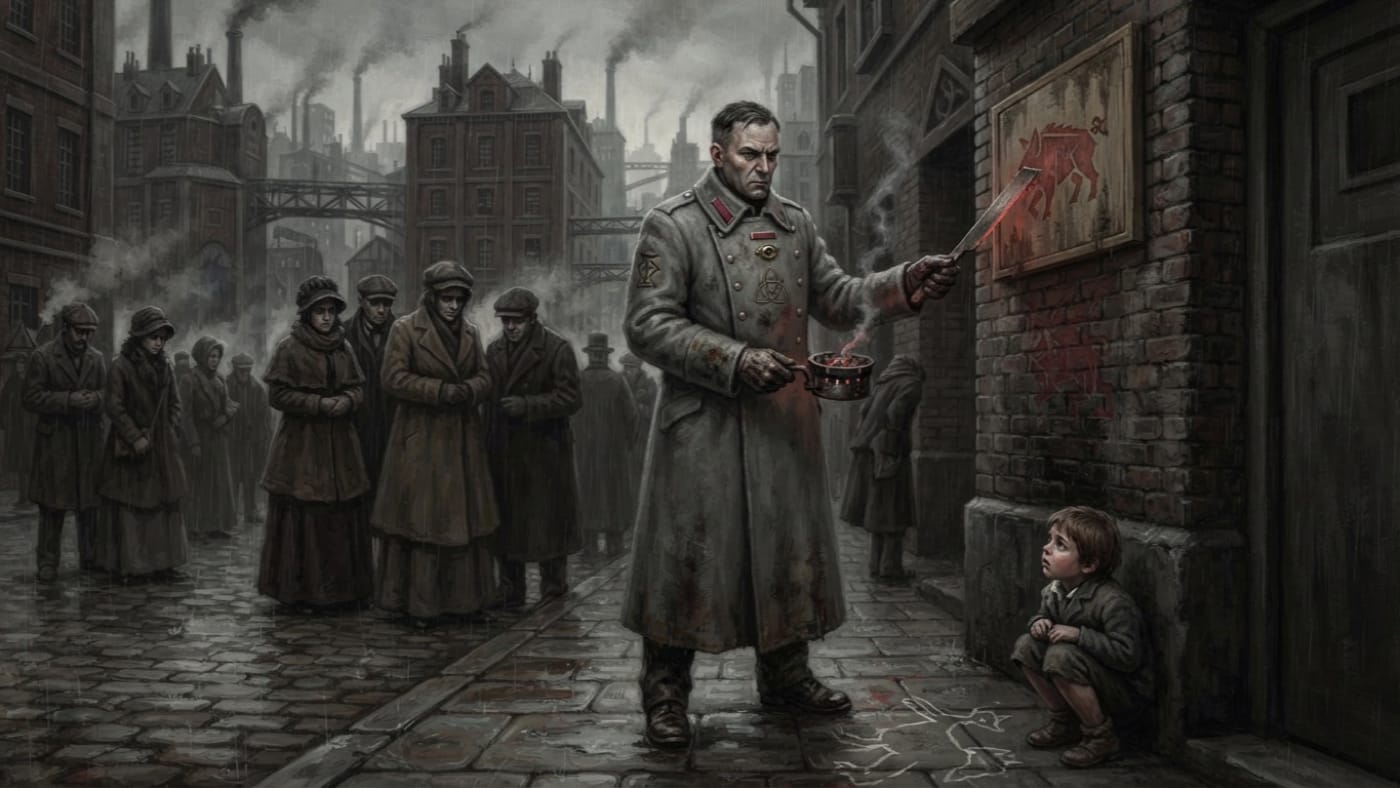
#On the Inspectorate's Commission
The Inspectorate of Visual Compliance is the enforcement body of the Bureau of Heraldry. Everyone shortens it to the Inspectorate, because the full name takes as long to say as most citations take to issue. Its officers are licensed Heraldic Examiners. The street calls them Sigil Inspectors, among other names I decline to put into a sealed folio.
The division of labour is exact, and provincial clerks get it wrong constantly. Heraldry decides what a mark may mean. The Bureau of Masks and Seals cuts the instruments that prove a mark has been permitted. The Inspectorate goes out into the rain and applies the first judgment with the help of the second.
Its jurisdiction covers anything displayed with an implied claim: banners, guild crests, shop signs, uniform patches, gate and threshold marks, funeral devices, masks and children's drawings. A crest asserts allegiance. An unregistered assertion is a rumour with paint on it. In the heartland every surface either holds a clearance or will receive a visit.
#On the Founding and the Beast Tables
Before the Inspectorate there were functions without a body. Clerks checked convoy crests against ledger entries, copyists kept the heraldic rolls, and garrison officers squinted at strange banners. Then came the Crimson Gate Riot of A.S. 106 at Essen, now Essen-of-Hymnsteel. A crimson boar revived on supply wagons left eighty-seven confirmed dead in four hours. The secondary losses are still disputed, and I do not count corpses that the clerks have not yet agreed upon.
The Beast Proscription followed in A.S. 108. A decree is ink, and ink needs legs. In A.S. 110 / 1820 CE the Bureau constituted the Inspectorate. Its forty-three founding examiners came from the heraldic clerks and from discharged Bureau of Purity field agents. They were issued the first Codex of Permitted Symbols, swatch sets and scraper blades. Early enforcement reached Worms, Cologne and Augsburg. The first Chromarch appointments are recorded at Cologne, Essen and Strasbourg. Forty-three was the founding cohort. Any pamphleteer who quotes it as present strength should be made to count the current muster by hand, on his knees.
The first Codex ran to forty-seven pages and contained eleven errors. They were identified by A.S. 114, after guilds had already been wrongly fined on their authority. For four years the Inspectorate enforced eleven laws that did not exist, and it did so with perfect diligence. Diligence was never the defect.
The Beast Tables sort the animals rather than slaughter them. Lions, eagles and stags survive in stylised canonical form, shaved into geometry and emptied of fur and appetite. Wolves and serpents are prohibited. Bears remain suspended pending review, which in Heraldry is a kind of taxidermy. The crimson boar of Saxony is condemned, the first device to earn the phrase heraldic heresy.
Earlier field summaries state that the Beast Proscription banned animal heraldry and that the Inspectorate was raised to scrape every beast from the banners of the Faithful.
Corrected. The Inspectorate was raised to enforce a classification. A lawful lion may stay on its banner once it has been reduced to the angles the Armorial permits. The guilds of Worms found the distinction academic.
#On the Ranks and Instruments
The ladder is short and steep. A Swatch-Runner, or Junior Examiner, carries replacement sets and copies the Codex longhand until permitted geometry lives behind his eyelids. A Gate Inspector works the threshold traffic. A District Crest Adjudicator runs a hearing-room and the examiners who feed it. A Chromarch commands a city's inspectorate and reports to Heraldry's central office in Strasbourg. Above the Chromarchs stands the Seal Prefect. That post is a political appointment, which is the Bureau's way of saying it is filled by conversation. Above the Prefect stands the Archon.
Specialists hang off the sides of the ladder. Muster verifiers read the stitch direction on soldiers' patches. Beast-Proscription examiners argue the precise angle of a stag. The few examiners trained in demon-icon analysis are paid no more than the rest and sleep considerably less.
Each instrument decides one thing. The Armorial of the Faithful is the master registry. Its A.S. 200 audit reported 347,211 entries, a figure I report without vouching for what was counted. No examiner carries the Armorial. He carries the Codex, its portable field abridgement, now in its ninety-first edition at 412 pages before urgent inserts. Supplements and corrections circulate between editions at a frequency I will describe only as devout. The Codex decides whether a form is permitted.
The swatch set decides whether a colour is permitted. The Chancellery of Colors replaces it every quarter, because sweat, sunlight and the Chancellery's own revisions blur the margin between a sanctioned red and a fined one. The measuring cord decides proportion. The eye-lantern, fitted with true-glass, decides the pigment. The wax stamps and seal-book record what has been decided, and the numbered citation tags tell the offender. The scraper blade and the portable brazier that heats it decide nothing. They carry out the decision.
The uniform is a grey coat with a narrow rank-coded colour bar, a brass eye-badge set above the Triune Knot, and gloves stained to the knuckle. An examiner smells of solvent, wax, chalk grit and hot metal. Crowds smell him coming and begin to hate him early, which saves time.
#On Inspection, Audit and the Mark That Moves
The procedure runs in the order the manual prefers. The examiner compares the mark's geometry and colour with the issued reference. He tests pigment and authentication with the solvent cloth, the true-glass and the impression of the licensing seal. He considers where the mark is displayed, because a stag on a cleared guild charter and the same stag chalked on a barracks wall are different offences. He rules: clearance, warning, fine, repaint order, confiscation or citation. He enters the ruling in the seal-book. Serious matters go up to a tribunal or to whichever other Bureau can stomach them. A citation opens a file, and a file can end anywhere, most often in a fine that a widow pays in instalments.
The work achieves something real. At gates and muster yards a stolen patch hides a deserter and a false crest hides an infiltrator, and the examiner catches both. A faction is strangled while its whole army still fits on a tavern sign. The same blade also scrapes away grandfathers. A cobbler's stag, a parish banner and a family lintel now survive at a clerk's pleasure. In the heartland, a lawful identity means an identity on file.
Clearance is a commodity. Tolerances sell for wax, paper, lamp-fuel, favours, and now and then a name lifted from a citation. A quiet district gets informal accommodation, because a quiet district is the Bureau's idea of a tidy desk. Disorder ends the arrangement at once. Auditors rebuild the examiner's seal trail from wax residue, impression depth, and a seal-book pressed more often than its entries admit. Exposure brings a stripped badge and punishment severe enough that every examiner learns the paperwork he imposes on the city is also coiled beneath his own chair.
Some marks will not stay still. Reports of a mark that moves, restores itself after scraping or sings suspend ordinary procedure. The Class Seven rule, settled by the Sibiu standing order of A.S. 191, is to observe briefly, record, hold the perimeter and send for a Bureau of Relics assessor. Scraping a suspected anomaly is forbidden as routine practice. If the mark sings, the street is evacuated. The Inspectorate does not explain these marks, and neither shall I.
#On Casselius's Present Inspectorate
Archon Casselius of Mainz holds Heraldry and Masks and Seals in personal union. The Bureau of Records calls the arrangement irregular but not prohibited. The instruments of A.S. 92 kept the two offices separate, and no later decree has merged them. One man simply sits in both chairs. For the Inspectorate, this means the authority that defines a lawful mark and the authority that cuts the die proving it now share a single inkwell. He is documented addressing the Seal-Cutters' Guild as Archon of Masks and Seals by A.S. 194. The year he took that chair is not established, and I will not invent one to flatter him.
The Inspectorate's fondness for him began before the union. During his Heraldry years he reduced a forty-one-page dispute over a guild chevron to a single sentence: the angle offends. His superiors called the ruling severe. The Inspectorate called it clarifying. Field officers love a ruling they can carry in one hand.
Then came the Doorbell of Mainz. A cooper named Ewald Fenn kept a chime-plate cast with three descending marks. Fenn said they were barrel hoops. Casselius identified an unregistered chime-mark. The bell was confiscated, Fenn was fined, and the fines grew with each objection. The case entered Sigil Inspector training under Acoustic Heraldry, Minor Civic Instruments, and examiners have been bending over knockers, handbells and shop gongs ever since. The precedent shows how the Inspectorate grows: wherever a claim can be heard as well as seen. It did not give Casselius the Bureau of Bells, which keeps its own inspectorate at Liège and its own grudges everywhere. Fenn's appeal remains active.
As of A.S. 201 the Inspectorate serves under him. Chromarchs report to Strasbourg, a Seal Prefect stands above them, the Archon stands above all, and the braziers stay lit.