
#On the Span
"Bridges do not absolve or accuse. Bridges only carry the papers." — Drax, margin of this survey
This is an A.S. 201 (1911 CE) survey of the Inkhouse Bridge's attested use and administrative setting. It assigns no construction year or historical engineering seal to the span.
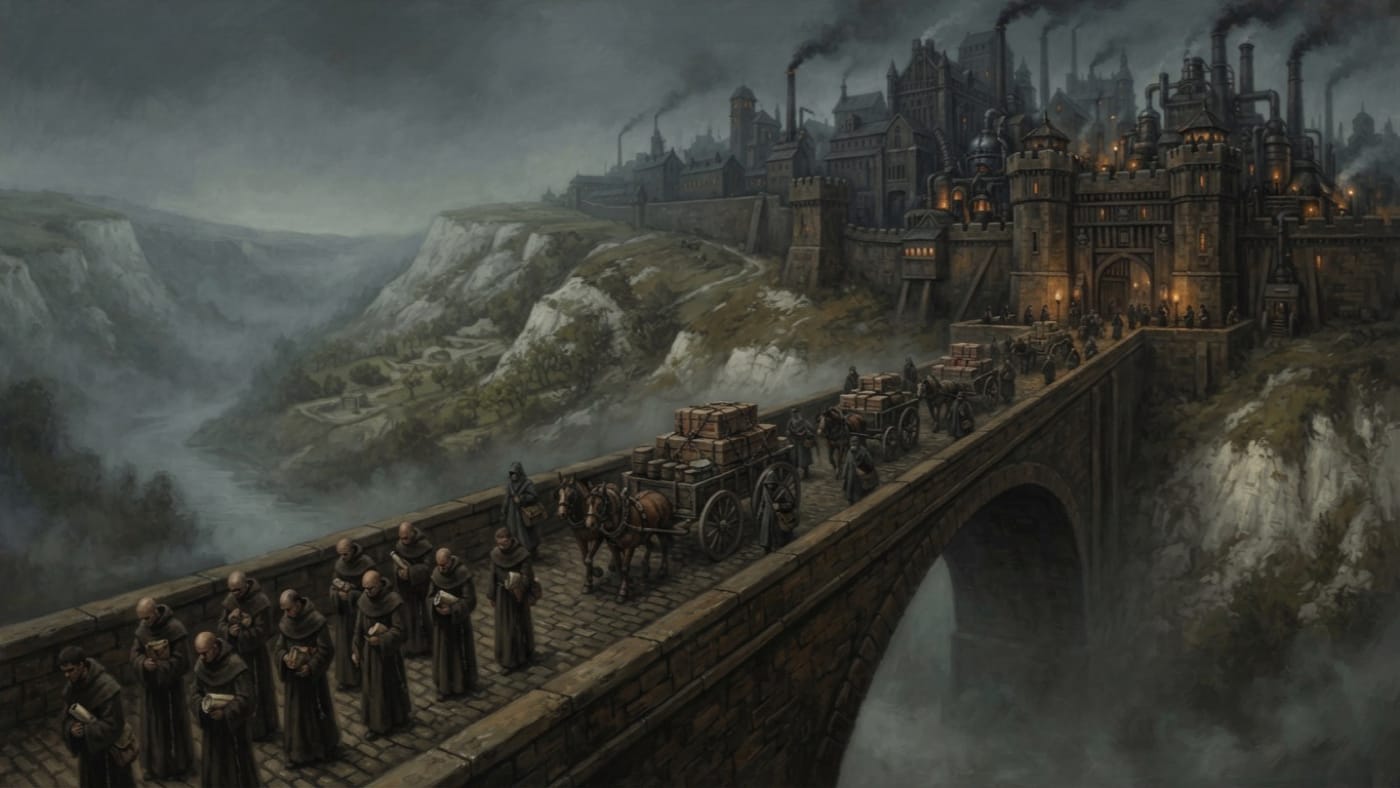
Below the chalk ridge of Nemea, a river crawls through its gorge so slowly that the fog can settle on it twice in one morning. No register I hold gives the river a name. Only one crossing over it matters, and that is the Inkhouse Bridge. It is a single span of stone between the road and the town, and the Bureau of Records has arranged that everything Nemea eats, burns, copies and sells must pass over it.
The arrangement was deliberate. This Codex's assessment of Nemea says so, and the Bureau has never bothered to deny it. All freight, every courier and every novice in the intake columns cross the one span. The town keeps a single road gate and a single courier rail spur, and the men who laid it out wanted no more. An archive on a ridge is hard to storm but easy enough to starve. The Bureau decided that if anyone was going to starve Nemea, the hand on the ration would be its own.
I give no measurements. No engineer's drawing, quarry docket, load table or year of laying has reached my desk under seal, and I do not certify masonry I have only heard described. The town was raised in A.S. 96, six years after the Concordat. The Chapterhouse has not recorded whether the span is older than the first copying hall, younger, or the same age, and in Nemea a thing not recorded is a thing not yet decided.
The approach road runs in from the heartlands between the Rheinscarp supply corridor and the southern tributaries of the Queue Road. Lime pits whiten its verges. Burnwood ash orchards stand along it in rows. The fog swallows the noise of the cartwheels halfway across and gives none of it back.
#On What Crosses
Outward goes the product: sealed copies, corrected decrees, certified identities, confession abstracts, and ash-ink pressed into stamped bricks for every Records office on the continent. A cartload of it would not trouble a mule. It would trouble a province.
A certified absence crosses the stones one morning, and some days later a gate-court turns away a man who has used that gate all his life. A corrected decree reaches a bastion registry, and a soldier's pay moves to another roll. When the Great Ledger strikes a name on Nemea's recommendation, the recommendation has crossed here first, in wax and paper, at a weight a child could carry.
Inward comes everything the town cannot make for itself: blank paper, lamp oil, rags, grain, lime and glass. Two of these govern all the rest. Without paper there is nothing to correct. Without oil there is no lamplight, without lamplight the Collegium cannot test a page, and a page that has not been tested is a rumour bound in wax. The grain feeds the novices and the paper feeds the Synod. The Chapterhouse counts both, and it counts the paper twice.
From there it is simple bookkeeping. Every load going out depends on a load that came in over the same stones. Shut the span for a season and the archive would not fall. It would dim. Hall by hall the lamps would go out, copying would slow to the pace of daylight, and the carts would stand loaded at the Courier Spur with nothing certified to send. This is the bottleneck's strategic vulnerability, not a recorded closure episode. No closure date or signed bridge design is supplied.
#On Passage and Verification
The bridge itself makes no judgments. No available bridge-specific account supplies a tollhouse, tariff, plaque or rite of crossing. The documented admission and verification machinery belongs to Nemea's gatehouses and testing rooms. A crossing carries the applicant to that machinery; it does not grant admission.
Entry to Nemea requires one of three papers: a courier summons, novice intake papers or a licensed trade permit. A carter without one has crossed the river for nothing and will cross it again on the way home. Some cargo is refused outright: unstamped ink, unsealed memoirs, and bodies without death papers. That the list needs the third item says how often someone has tried.
Every document entering or leaving Nemea goes before the Silence Test Collegium in its gatehouses and verification rooms. The testers work with lamplight, mirrors, observation of breath, and a reading protocol whose steps are classified. All the span contributes is the guarantee that no sanctioned road reaches those rooms by another way. A sealed decree standing on the deck in the fog has not yet been tested, and until it has, it is not yet a fact.
The novices cross on foot, carrying their intake papers. At the Silence Gatehouse they give up their birth-names and receive archive designations in exchange for what the Chapterhouse calls archive safety. That makes the bridge the last stretch of road on which a novice still owns a birth-name, though nobody on the deck says it aloud. I have watched the columns from the bank. They look down at the water. There is nothing written on it.
The gate clerks take their bribes in clean paper, lamp oil and blank leaves, so the town's two shortages have become its currency. The bridge's imports set the price of the gate.
#On the Hands That Govern
No named bridge warden or separate bridge office is established by the available sources. The span sits within the town's administrative setting, where three powers overlap and resent it.
Abbot-Registrar Maelen Voss holds the Chapterhouse seal and the vault keys under Records writ. Nothing he certifies does anyone any good until it leaves Nemea, and there is one way out. Silence-Master Rhu Tern commands the local Collegium and has failed documents that Voss certified, so the Abbot-Registrar's seal reaches the far bank only with Tern's leave. Voss keeps the originals. Tern decides what passes. The Courier Spur Brotherhood owns the carts, the relay horses and the wet rope that lashes sealed crates down for the climb, and it has a strong say in routes and timing. The street accuses the Brotherhood of skimming and swapping packets. I record those as accusations and nothing more.
Others press in on the official traffic. "Sister" Halvein trades in redaction drafts and blackmail, and any draft that reaches her has been carried by someone at some point. The Second-Draft Circle is a heretic cell, separate from the Brotherhood, that preserves originals and moves them through the crawl-shelves and along the courier routes. Its reasoning is sound. An original that gets across the river is much harder to burn.
#On the Limits of Control
The Bureau that Archon Veyrault consolidated in A.S. 78 came out of the wartime networks with a firm belief that whoever holds the road holds the record. Nemea puts that belief to the test every night.
Holding the crossing means holding the carriage, and that power ends where the ink begins. In A.S. 198 the Chapterhouse classified the Night-Rewriting Contracts: in the vaults, obligations lengthen overnight, guarantors slide into the debtor's line, and witnesses become parties. When the rewriting actually began has never been established. The countermeasures are salt-lamp circles, mirror checks and the standing order to burn the second draft, described for the vaults and verification rooms. No bridge-deck testing station is established. Outbound pages pass Nemea's verification system; the available accounts do not establish whether or where a further test occurs after departure. Changes in transit remain unproven.
The Bureau of Doctrine has ruled the theology on this point heretical. In the copying halls they still whisper that the ink is trying to become true. I have signed the ruling. The whispering continues on both banks.
There are also the roads that do not appear on any return. The Courier Spur Stables hide a tunnel whose course, builder and age are all unrecorded, and no certifier has stamped a passage through it or confirmed that it ever reaches the far side of the gorge. The ford below the old Benedictine ruin belongs to the founding history. It is not a road anyone can use today.
Earlier Nemea material in this Codex, in a Courier Spur margin, said that "every bridge has a toll" and invited the reader to work out what an inquisitor's freight would cost at the Inkhouse crossing.
CORRECTED. No tariff, tollhouse or crossing rite is on record for the Inkhouse Bridge. Nobody is erased by crossing it. Admission and refusal belong to the gatehouses and the Collegium. The bridge carries the freight to them, and all reckoning is done on the far side.
#On the Present Condition
Contemporary dispatch records show the span in use. Ink bricks cross it outbound under the Spur's chain seals. Paper and oil cross inbound and are counted twice. The novice columns are still arriving. Voss holds the seal, Tern holds the mirrors, and the Brotherhood holds the horses, with the stone between them answering to all three.
Inquisitor-Corrector Sel Durn was dispatched from Strasbourg in A.S. 201. The town and Courier Spur accounts record the dispatch without an arrival or findings. Voss's more specific published dossier records Durn's A.S. 201 arrival, the witnessed handshake at the Silence Gatehouse and an inspection with the provisional judgment "custodian competent; custody unstable." This survey retains that positive record without claiming that the older dispatch accounts contain it. No final purge or completed judgment is established, and no source identifies Durn's particular journey over the bridge.
The sources establish the span's use and the Chapterhouse's logistical control. They do not supply a current engineering certification of soundness or a rated capacity. Administrative confidence can be stamped without making it an engineer's finding.