
#On the Provision
"Bureau hands are counted hands." Said in the extraction wards by men whose own hands nobody counts.
The Injured Laborers' Provision of A.S. 160 is a small instrument, and I mean that as praise. The Synod had been the formal government of the Church for seventy years by the time it was enacted, and in those seventy years it had learned that a law should promise only what a Ledger can pay. The Provision promises one thing to one class of person. A worker employed directly by a Bureau who is injured has a recognised standing before the Synod. Whatever follows from that standing follows through the proper offices, in their own time and by their own forms.
I will not paraphrase its clauses. A statute paraphrased is a statute half-rewritten, and I have not been asked to rewrite it. Its year is A.S. 160, which is 1870 by the reckoning of the old calendars. Every argument about it turns on its condition of coverage, so I set that condition down here in plain words: employed directly by a Bureau.
That one word, directly, decides more about a man's old age than his piety, his record or the state of his lungs. The Synod has never been embarrassed by this. A law has to stop somewhere, and the Provision stops at the edge of the payroll.
#On the Employer
A Wound-Site Prospector spends his working life inside Synodal machinery. The Bureau of Tithes runs the charter system and sells extraction rights to licensed houses. The Bureau of Engines & Furnaces sets the industrial requirements: a current charter permit, an escort assignment and a purity declaration filed before the tap. The Gasket Choir prescribes the hymn that seals his drums. Synodal wax goes onto every drum, and the Fuel Monopoly Acts of A.S. 112 make it a crime for him to do any of this without the licence.
His wages, though, come from the charter house.
That is the whole matter. The house is a private enterprise operating under Synod licence. It hires the crew, sets the shifts and advances money against wages. When a respirator fails, the house replaces it and adds the cost to what the man owes. A prospector can kneel on consecrated ground, sing the Synod's cadence over a drum stamped with the Synod's seal and travel home under a Synodal escort, and still the ledger will show that he works for a Baron in Budapest. The Bureau licenses the Baron. The Baron employs the man. Neither the licence, the hymn nor the escort turns him into a Bureau employee.
Engines & Furnaces governs what he does. Tithes collects on what he pulls out of the ground. Neither Bureau has ever claimed him, because neither has ever paid him.
#On the Injured Laborer Outside the Provision
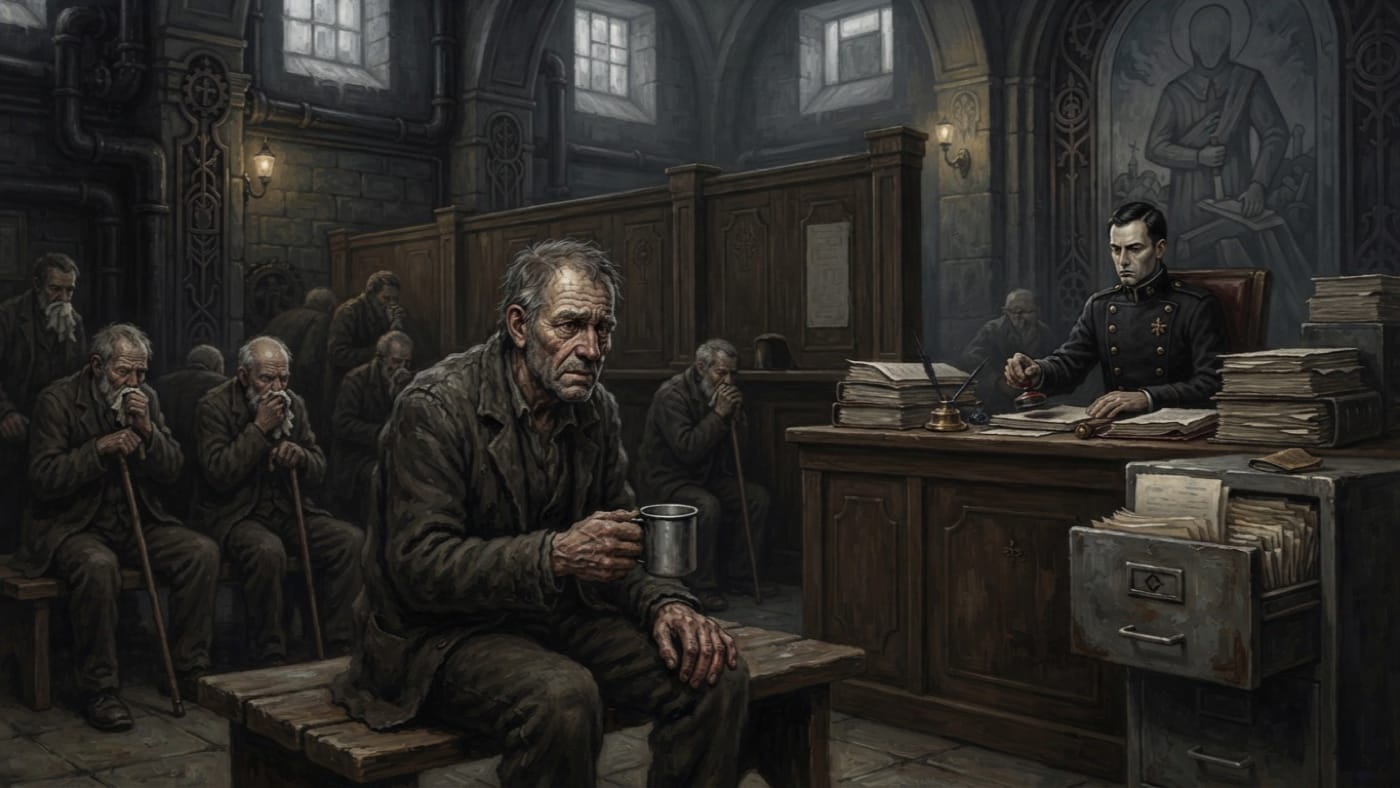
The work damages the body in a fixed order. Most crews start coughing in their second season. By the fourth, the cough has a rhythm the prospectors call "singing back," and by the sixth a man can only speak in the gaps between fits. The hands give out next. Holding vibrating drums, bracing augers against resistant stone and steadying gasket clamps through the sealing hymn leave a tremor in the fingers that only gets worse. Old prospectors cannot hold a pen, and some cannot hold a cup.
I mention the pen on purpose. Most of this Codex is written for men who hold pens without thinking about it, and they should picture an old prospector sitting at a desk in front of a form. He could not sign it even if there were a form for him to sign. There is none. The Provision does not reach him, so there is no Provision paperwork to put in front of him.
The Bureau of Mercy examined the tremor in A.S. 194. Its assessment calls the condition "consistent with prolonged exposure to sub-harmonic oscillation, origin: theological," and recommends "retirement to environments of minimal acoustic disturbance." It recommends no treatment, because it knows of none. I admire the phrasing. Mercy found a cause, named it in the Synod's language and prescribed silence for men who learned in the pits to fear a seam that goes quiet. The assessment is a medical finding. It has nothing to do with whether the Provision covers anyone. A man whose tremor is fully theological and fully documented is still, under the Provision, employed by his charter house.
The Codex entry on the Wound-Site Prospector previously stated that prospectors are eligible for Synod pension under the Injured Laborers' Provision of A.S. 160.
The Provision applies to workers employed directly by a Bureau. Prospectors are employed by charter houses, which are private enterprises operating under Synod licence, and so they fall outside it. The A.S. 160 reference stands. The claim that prospectors are eligible is withdrawn.
The Provision does not cover the debt either. A prospector who quits the seams usually leaves owing his house for equipment, advances and the cost of the replacement he wore out. A few retire with money. The Codex has recorded such men, and the profession tells their stories the way other trades tell stories about saints. Most die owing. The charter entry calls the employment distinction administrative and deliberate, and it calls it the reason for those debts. I see no reason to change any of those words.
#On Requests Filed
Since A.S. 180 the Bureau of Tithes has been asked seven times to close the gap between the Provision and the charter crews. Each request was received, and each was filed. I find nothing in the record after that. I have looked for a decision, a ruling of inadmissibility or a draft amendment sent back for revision, and found none of them. I have only been able to establish that the requests exist and that each went where Tithes puts papers it has received.
Nobody should mistake this for neglect. Filing is how the Synod takes notice of a request, and Tithes has given these seven exactly that and nothing more. Who submitted them and on what days, I cannot say. The folio I was allowed to see gives the number and the outcome, and the outcome is the same seven times.
Tithes also controls the numbers that any eighth request would need. Casualty data from the extraction trade sits under a classification Tithes administers, and Tithes has judged that data "commercially sensitive." Someone arguing that the crews deserve the Provision's protection would have to say how many men are hurt, and that figure belongs to the Bureau the request is addressed to. I see the circle in this. As far as I know, Tithes does not see it as one.
The Bureau's own charter assessment offers one remark that people quote too freely. When it reminds charter holders that yield quotas are calculated against projected seam capacity, and that a shortfall caused by losing crew is the holder's liability, Tithes adds that it "does not insure flesh." That sentence is about yield quotas and charter shortfalls. It is not a ruling on the Provision, and nobody should cite it as proof that the Synod pays no injured worker anything. The Provision exists, and Bureau workers fall under it.
#On the Present Application
In A.S. 201 the Provision works exactly as it was written. A worker employed directly by a Bureau who is injured has a standing that a prospector does not. People who argue that the Provision protects nobody are wrong, and people who argue that it protects everyone are wrong too. I have heard both arguments in the same week, in the same refectory, and both came from men who had never read the statute.
At the end, the prospector gets care. The Hospices of Departure run by the Bureau of Mercy take in retired prospectors in numbers that keep a ward full, and the ward is always full. Being admitted to a hospice is not the same as being entitled to a pension, and Mercy's records and the Provision's never refer to each other. A man taken into Mercy's care has been taken into Mercy's care. He has not been granted the Provision, and he has not been granted anything in its place. The Bureau of Records keeps these two facts in separate registers.
The charter houses keep hiring. The seams keep giving up fuel. The drums are sealed with the Synod's wax. Seven requests lie in the Bureau of Tithes, and an eighth would find room beside them.