
#On the Scandal and Its Official Correction
In A.S. 200 part of the Bead Vault's shelf knowledge was found circulating beyond the walls of the Cloister of Miscounted Beads. As a result, the Cloister Chapter of the Second String had to amend a sentence. The Chapter would prefer the scandal remembered in exactly those terms: one adjective struck out, a three-word phrase approved in its place, and everyone home before Vespers.
What escaped was a fragment of the index. The record shows no string leaving its case. What crossed the wall was a finding aid, a partial list telling its reader where to look and what kind of misery waited there. In the economy that crouches beyond the eastern drain wall, knowing where to look is worth more than most things a thief could carry.
The accounts released to my office do not say how the fragment left the Vault. The thief is unnamed. The published narratives speak of copies, buyers and one seller, but none of them describes the hand that first carried the leaf out. I will not supply one to satisfy the reader's appetite for a culprit. Selling to appetite is the Market's business.
The Cloister Chapter assessed the risk of theft from the Bead Vault as "minimal."
Revised following the A.S. 200 index-fragment scandal. Theft risk is now classified as "contained by vigilance." The revision certifies no recovery of copies and names no thief. It certifies only that vigilance is required, which the Chapter has always maintained.
#On What the Fragment Could Find
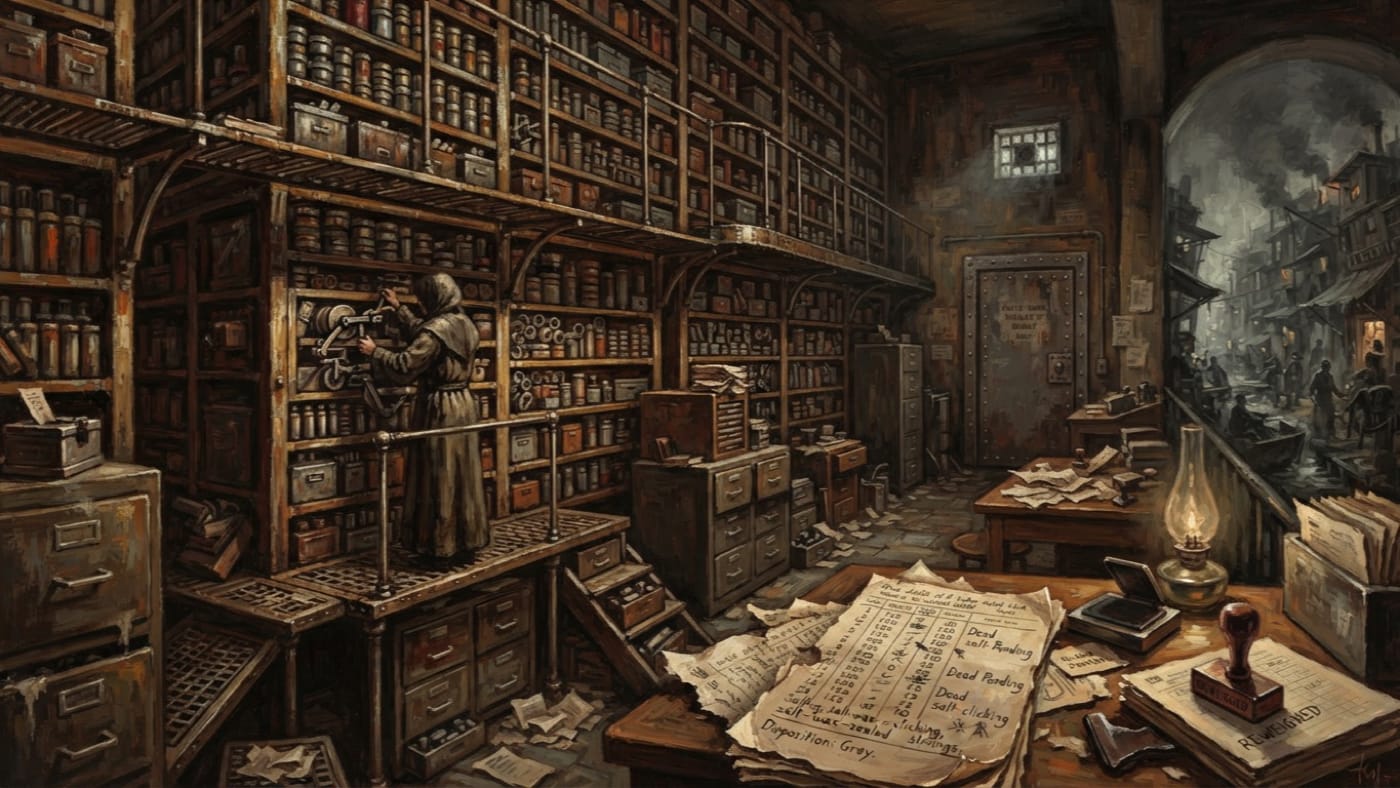
The Vault is shelved by year, intake quarter, route class and discrepancy family. Each case carries a disposition cord: white for ordinary evidence, blue for route contradiction, yellow for sponsor challenge, black for suspected counterfeit, red for Purity referral, and grey for a dead claimant. Archivist Keth never meant the arrangement to be legible to strangers. Given enough strangers, any arrangement becomes legible.
According to the Grave-Name Market account, the escaped fragment listed cabinet family, intake quarter, route class and disposition colour. It also held two names marked Dead Pending, set beside strings that had kept clicking under salt-wax. It held no intake slip, no recount card and no sealed disposition. A buyer could not carry that leaf into the Supplementary Entry Office and walk out as somebody else.
With it, though, a buyer could learn which grey cases existed and roughly where they lay. He could learn which route classes the Vault had already judged contradictory, and so which pasts the Church itself had stopped defending. A broker holding that leaf did not need to forge a life from nothing. He needed only a gap the Ledger had already admitted to, and a customer willing to stand in it.
Dead Pending deserves a paragraph of its own. The Counting Hall invented the mark for bodies whose papers arrived before the corpse-cart, and the Hall now applies it to living persons with unsatisfactory regularity. Two such names on a sold leaf prove nothing about two corpses. They prove that the Great Ledger had placed two persons between its columns, and that someone outside the wall wanted to know which two. Both names are withheld here. My office has not been shown them, and I would withhold them if it had.
#On Copies Beyond the Wall
The Grave-Name Market trades in the rubble lots past the Cloister's eastern drain wall, between the refuse canal and the gravefields. The Ninth Count tavern serves as its unconsecrated chapter house. Its stock is dead identities, clearance traces, route fragments and sponsor scraps, along with the commodity my colleagues in Records least like to name: usable uncertainty. A pilgrim whose file has gone grey is a pilgrim whose past can be rented.
The fragment entered that market, and copies followed it at once. Some were copies of copies. Others were made from overheard recitation by men who could not read and sold to men who could not check. The Market's own Codex account reports that the lots fought over these copies for three nights and that three men were dead by the end of it. I record that figure as it was reported. I do not add the knife fights and poisonings the Ninth Count has hosted over index rumours in general. Those belong to the tavern's long and varied career of disgrace, and they are filed elsewhere.
The same account reports that a woman bought her husband's return and received him in the wrong body. Nothing released to the Bureau of Doctrine explains this. I cannot say whether the account describes a resurrection, a possession, a fraud with a convincing face, or a widow who wanted him back badly enough to forgive the jaw. It remains in the record as an allegation, and I leave it there, unexplained, with more reluctance than I enjoy admitting.
The Sponsor-Seal Brokers denounced the trade, as they denounce every trade that undercuts lawful sponsorship. Their interest in usable pasts is a matter of public commerce. No published account names them as buyers or sellers of the fragment, and I will not make them either for the pleasure of a sentence.
#On Moth-Eye's Readings
One seller acquired a name. A sealed note of A.S. 200, of which I have been permitted the published excerpt, records the following:
A.S. 200 INDEX-FRAGMENT SCANDAL — SEALED NOTE Recovered scrap contained █████ case families, █ route marks, and one lower-cabinet sign. Broker called Moth-Eye sold three readings before capture. First reading produced a valid clearance. Second produced a corpse summons. Third produced ███████████████████████ from beneath the buyer's tongue. Keth ordered all grey cases reweighted.
The note says Moth-Eye sold. It does not say Moth-Eye stole, copied or first carried the fragment, and the lots hold many brokers who sell what other hands have lifted. It does not name whoever made the capture, and it says nothing of what became of the broker afterward. The recovered scrap might be the original leaf or one of its many children. The note does not say which.
Prior-Scribe Erem Vale should be kept awake by the first reading. A valid clearance means a buyer passed checks that rest on the Prior-Scribe's own counterseal authority, with the Vault's shelf knowledge doing the work an honest past should have done. The note will not say whether this was a miracle, a clerical lapse or the system working exactly as built. The second reading produced a corpse summons, which is either an administrative instrument or something worse, and the note declines to specify. The third reading lies under ink. Let it lie.
#On Keth's Corrections
Keth's first recorded act is the one in the note: every grey case reweighed. Weighing has been Vault practice since the A.S. 187 revision to the Pilgrim Reconciliation Statutes, because a string's weight reveals what its count conceals. Reweighing the whole grey rank answered a narrower question. If the fragment had sent buyers hunting for dead claimants, Keth wanted to know whether any dead claimant had moved, lightened or been touched. The results are not published. Circular 881-R, issued the previous year, would have supplied the approved vocabulary for any discrepancy: handling deviation. Records denies bead drift. The grey rank was reweighed anyway.
Next, the shelf marks changed. The Market account credits Keth with rotating shelf marks, splitting bone keys and planting false index leaves. The Vault's own article lists rotating marks, false case numbers and divided keys among her standing methods. I cannot certify which measures she invented for the scandal and which she simply tightened. She has kept the Vault since A.S. 182, and an archivist with that tenure does not wait for a scandal to distrust her own shelves. The effect, at least, is plain. Half of whatever leaf the brokers held now pointed to cases that had moved, and the other half to cases that had never existed.
Then came the rag list: three pages of cleaning-rag inventory, enciphered with real care in a hand handsome enough to be worth stealing, released into the lots. The Market bought it twice. By the account's report, one broker sold identity passage under the name Vinegar Cloth, deceased. The buyer was rewarded with laundry duty under the name he had paid for. Records classified the matter as contained, and I find no fault with the classification. The man was contained among the linen, where he could do no harm.
#On Containment in A.S. 201
As of A.S. 201 the Vault is operational and crowded, its lower cabinets at capacity and its salt-wax stores in need of monthly supplement. The Market's hunger for the index has not eased. Intake pressure has climbed since A.S. 198, and five anomaly weeks are projected for the year. I decline to blame any of this on the scandal merely because the dates sit close together. The calendar is not an accomplice.
Keth still holds the keys, and Vale still holds the counterseal. Beyond the drain wall, copies of a leaf that no longer matches any shelf still change hands at the Ninth Count, sold by men who have no means of learning that the cabinets have moved beneath them. Some of those buyers will find nothing. A few will find laundry.
The thief remains unnamed, and no public account claims that every copy has come home. The Chapter's phrase is "contained by vigilance." Like all good Bureau language, it is accurate in a narrow way: something is contained and someone is vigilant, though no one has promised they are in the same room.