
#On the Imperial Theatre
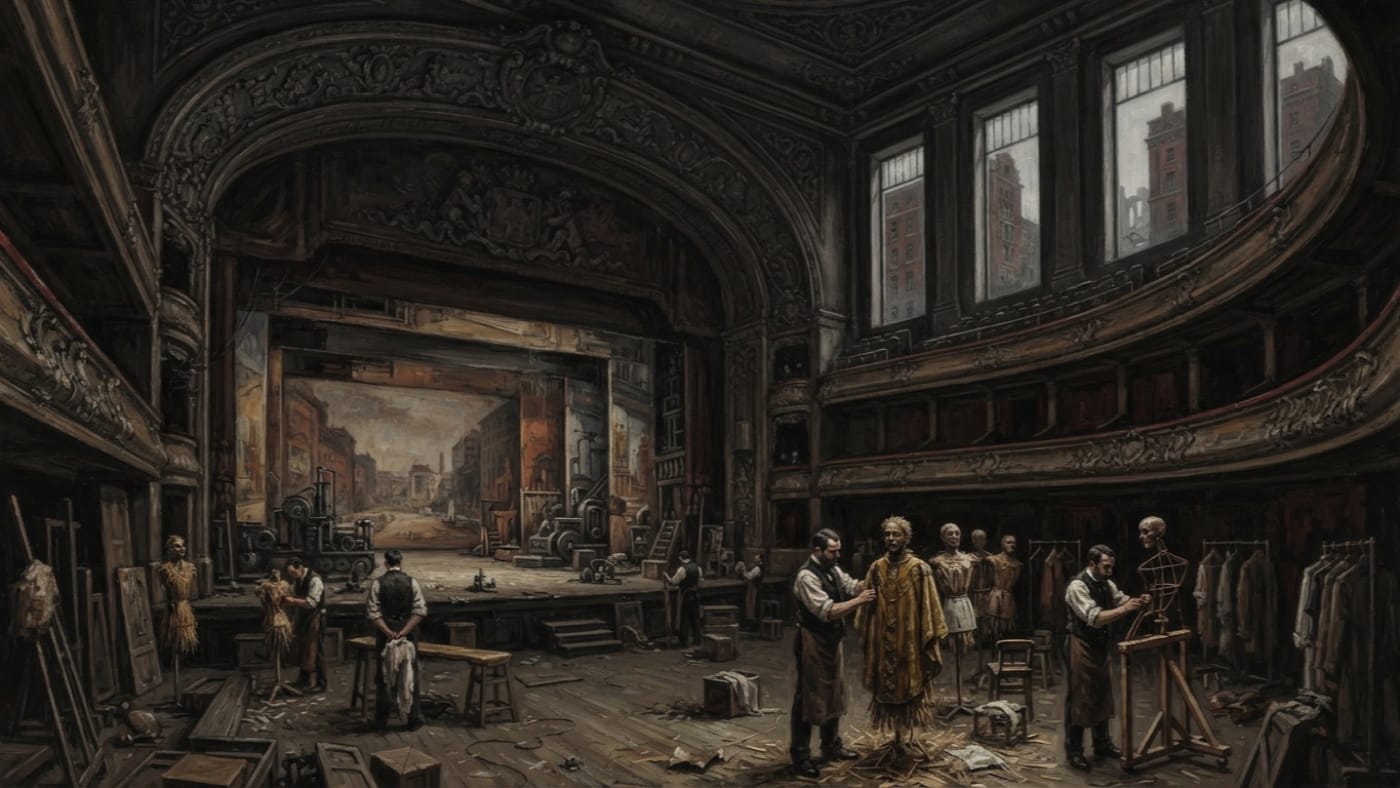
The Sacred Ledger holds the Imperial Theatre of Vienna by one cord, and that cord is a list of a few craftsmen's earlier work. When the Rationalists wanted saints they could burn, they looked for men who could make a body out of straw, and the men they found had previously dressed opera singers and built stage sets for this house. That is the whole entry. The Ledger holds nothing on the building's boxes, patrons, seasons or debts, and I will not supply them from imagination, though I am told mine is one of the better-furnished rooms in Strasbourg.
The name still deserves a moment. Imperial. I make no claim about which crown first lent the word or what charter it carried. I read only the word, and it tells me the house was built to flatter an authority larger than the audience in its seats. Opera does that. A tenor in borrowed ermine sings of kingship to a room of grocers, and for three hours the grocers agree to believe him. The Rationalists said they despised belief obtained by spectacle. Then they hired the men who made it for a living.
#On the Costumiers
A theatrical costumier is a forger licensed by the box office. His work is judged at a distance, under lamplight, in motion, by a paying crowd that wants to be fooled and resents being fooled poorly. He learns which details the eye grabs and which it forgives. He learns that a hem seen from the gallery matters more than a seam seen by no one. The scene-builder learns the same lesson in timber and plaster: a column only has to be a column from the front.
The account of the Black Procession calls these men the city's finest theatrical costumiers. It says their effigies were so lifelike that they disturbed even sympathetic observers. I believe it. Theatre trains a man to make a stranger recognize a figure at once from forty paces off, and that was exactly what the Prefecture needed. A crowd that had watched feast-day processions along the same boulevard would know a saint by his attribute before it could read his name. The costumiers knew this as well as any sacristan, and better than most bishops.
I have stood before reliquary-work commissioned by the Bureaus, made by men who were paid well and supervised closely, and seen less conviction in it. Admiration for the craft is no sin. It is a professional courtesy, and I extend it as I would to a well-made thumbscrew.
The record does not say what these men believed. A carpenter can build a scaffold without having voted for the hanging. He has still built the scaffold.
#On the Forty-Seven
There were forty-seven effigies. Each was built of straw and plaster on a wooden frame, dressed in vestments confiscated from the churches of Vienna, and draped in black mourning cloth.
The difference matters, so I will be exact about it. The costumiers supplied the frame, the form and the illusion. They did not supply the cloth. The chasubles, copes and stoles came out of sacristies, taken from the city's churches by order. They were never opera wardrobe. A Rationalist clerk stripped the altars, and a theatre craftsman fitted the stolen garments to a straw body so they would hang the way they had hung on living priests. The two jobs met in one object. Neither man needed to know the other's name.
Three of the forty-seven are entered by attribute. Saint Rupert carried his salt-cellar. The Blessed Adalheid carried her crozier. Saint Leopold wore the ducal crown. The Ledger names those three, and I will not invent the other forty-four to fill a page. A cataloguer who makes up saints to complete a row deserves the same pyre.
The attributes were the cruelty. An effigy nobody recognized would have burned as straw. An effigy everyone recognized burned as an insult to the crowd, to the saint, and to every grandmother on the Ringstrasse who had once touched a salt-cellar like Rupert's for luck. The costumiers' skill made the effigies recognizable, and that was what made the insult work. The better the likeness, the deeper the wound. The Prefecture understood that. So, I suspect, did the men holding the plaster knives, though the record keeps their thoughts to itself.
The number had a reason, and the Rationalists supplied it: one effigy for each year of what they called "the Superstitious Epoch." I record the claim and decline to check the arithmetic. A regime that measures the life of faith in forty-seven years has told you everything you need to know about its arithmetic. A Rationalist broadsheet printed the morning of the Procession described the effigies as "instructive representations of defunct mythology, suitable for public contemplation and subsequent incineration." It is a theatre bill written by an undertaker.
#On the Performance in the Street
The date was the fourteenth of Novembris, A.S. 30 (1740 CE), three days after the Treaty of Regensburg gave the Rationalist Republic its formal standing. The Republic wanted a triumph, and the Prefecture of Public Instruction staged one.
The effigies left the hands of their makers and went onto wheeled platforms drawn by draught-horses along the Ringstrasse. Behind them marched students of the Academy, the institution the Rationalists had installed in the Cathedral of Saint Stephen. The students wore black gowns and carried printed programmes. Each programme set out a saint's claimed miracles beside a "rational correction," the way a pamphleteer sets a sermon beside its rebuttal. Dr. Albrecht Klemm gave the principal address. The burning was set for the Heldenplatz.
The roles should be kept separate, because the Rationalists took care to keep them separate. The Prefecture gave the orders. The craftsmen made the figures. Klemm gave the speech. The students carried the paper. The Imperial Theatre itself appears nowhere in that chain as a party, a sponsor or a venue for the day. It enters this file through the men it had once employed, and through nothing else.
#On the Fire Beyond the Stage
Every theatre keeps buckets in the wings. Fire is the oldest enemy of painted canvas, and stage hands learn to fear it before they learn their cues. The costumiers had spent their working lives keeping flame away from their work. In the Heldenplatz their work was built to be handed to it.
There were seven pyres, stacked and fed with pitch. For about ninety seconds they burned as fires burn. Then the heat stopped. The flames went on rising and giving light, the effigies went on blackening, and the warmth went out of the square. The crowd had stepped back from the radiant heat and now pressed forward, confused, into cold. People suffered frostbite standing beside burning pitch. Three citizens died of exposure. The full account belongs to the Procession's own entry, and I will not make my readers pay twice for it.
The Rationalist authorities explained the cold as a chemical or atmospheric event and filed it on that basis. Long afterward, writing retrospectively in A.S. 92, the Bureau of Doctrine classified the event as a First-Order Portent. Doctrine holds that the Creator withdrew His sustaining warmth from an act of desecration and let the fire keep its light while denying it heat. That is Doctrine's reading, and I have read nothing that tempts me to prefer the chemists'.
Here the stage and the street part company. A theatre controls its effects. The house lights dim when the prompter says so, and the thunder sheet shakes on cue. The Prefecture had planned its spectacle like a première, with programmes, a procession, a lecturer and a climax. The climax refused the script. The Rationalists cancelled the second day of celebrations, and no reason appeared in the notice.
#On the Theatre's Recorded Association
What remains is narrow, and I leave it narrow. Men who had dressed singers and built scenery for the Imperial Theatre took that skill into the Prefecture's commission and made forty-seven saints that a city could recognize and then watch burn. The Ledger holds the house's name, its link to opera, and its scenery workshop's hands. Beyond that it is silent on the house: no director, no repertoire, no ledger of receipts, no entry for what became of it in the years that followed, when Vienna had worse to answer for than its stagecraft.
I make no claim about whether it stands, burned or sings. Such a claim belongs to whoever next inspects the place, under a seal I have not been shown.
Stamped Erratum — Sacred Ledger, Chronological Tables: Earlier chronological tables in this Ledger entered the Black Procession under A.S. 124 and grouped it with later Vienna incidents. Strike that entry. The Black Procession belongs to A.S. 30 (1740 CE), three days after Regensburg. The later incidents keep their own entries and do not borrow its name.