
#On the Registered Person
"No record, no right." — notarial maxim, Black Seal annexes
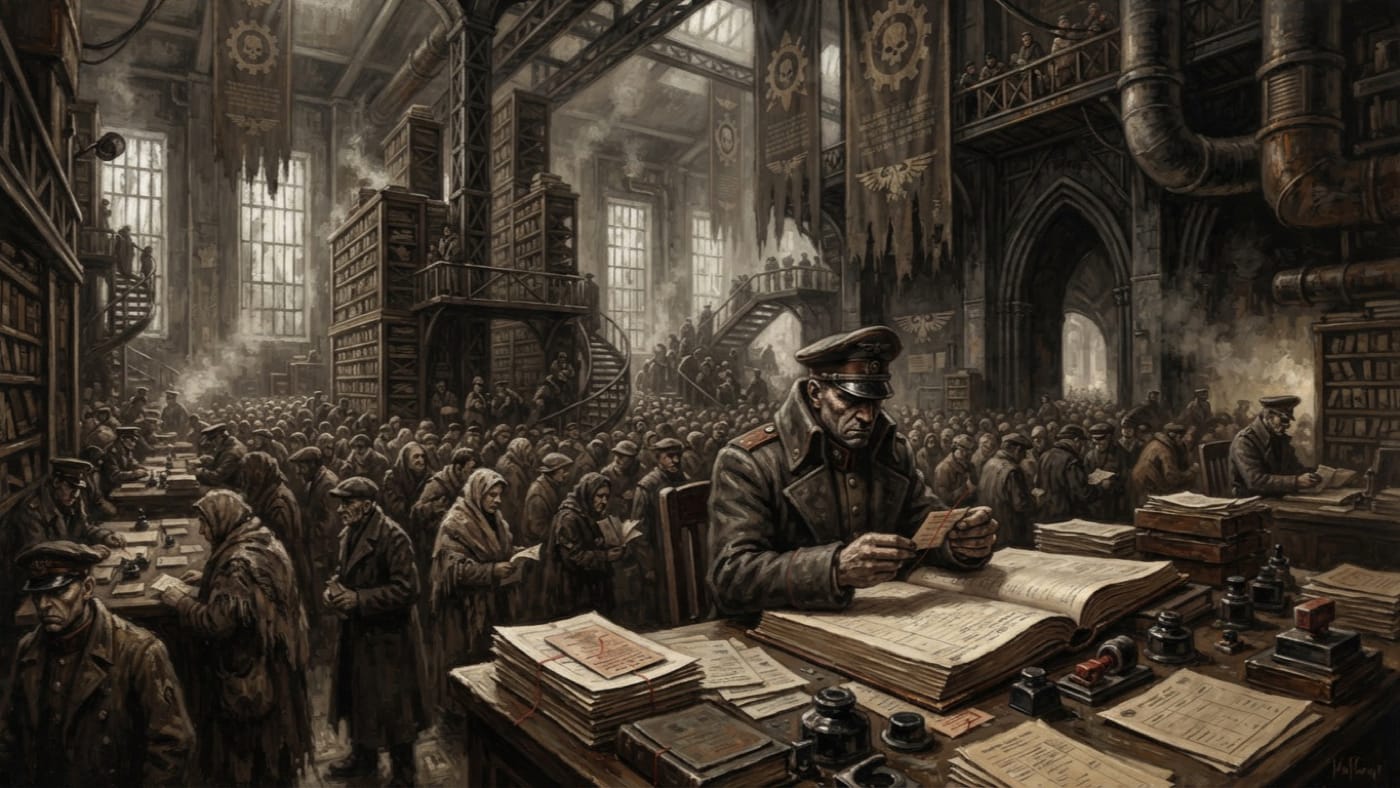
In the eyes of the Church a person has two bodies. The first one eats, coughs, kneels late at curfew and eventually goes to the ossuary in pieces. The second lives in the Great Ledger of Souls. There the Bureau of Records keeps births, deaths, confessions, tithes, condemnations and pardons, and copies them to the vaults beneath Strasbourg. The Bureau says the Ledger forgets nothing. I have signed that statement in three colours of ink and believe it in all of them.
Only the second body has rights. A Records Scribe at a district desk works from a pencil slate and a supervisor's initial, and produces everything the first body needs: a ration entitlement, a passage permission, standing to inherit, a labour assignment, and in the end a clean burial in place of a ditch. Bread follows the line. So does the spade.
Identity Fraud is the offence of using that second body in a way the Ledger never authorised. You can claim it, lend it, sell it, make one from blank paper, or alter a genuine one with solvent and a steady hand. Doctrine calls this an assault on the Church's authority, and that is accurate. Doctrine also calls it sacrilege against the Ledger, which is how Doctrine likes to describe any assault on itself.
#On Names Put to Another Use
The commonest fraud is also the least imaginative. A grandmother dies in the night and the household does not report it. Her ration line goes on drawing bread for a woman whose mouth is already in the ditch. Scribes see this every week. The dead make excellent claimants because they never complain about the portions.
Above that sit the trades. The Seal-Forgers produce travel writs, ration slips, burial permits and convoy clearances. They cast wax, cut punches, age paper with ash and oil, and bribe clerks for authentic blanks. Some of them make papers for refugees, children and the unburied, and call themselves Mercy Forgers. Others make fuel permits and titles and need no name, because the money does their talking. Doctrine preaches that forgers are the Great Deceiver wearing human hands. In my experience they are mostly the hungry with good eyesight. The Church hangs both kinds with the same rope, on principle.
At Bastion-Przemyśl a ration tag records the life-days its bearer may eat. In the Underwire galleries forged tags are sold next to antibiotics and tower passwords. Wearing another person's tag string is called grafting there. Touching someone else's string is taboo, and grafting one is a living. Clerks on the Taghouse Steps are said to skim life-days themselves. I mention this only so that nobody can accuse me of leaving it out.
On the Queue Road the market under Clerk's Mile sells identity overlays and rents out witnesses by the hour. The Road's clerks answer with bell-marked timestamps, so a man who claims to have stood in two queues at once is caught by the clock. The Road's best product is the ghost pass, a forged permit carrying a real seal. This puts the doctrine of the seal to the test, and the doctrine holds: a hard seal on a writ is proof of the writ.
#On the Clerks Who Confirm Them
Verification is honest work and I will defend it. A scribe checks identity against papers, witnesses and earlier entries, and a supervisor initials or refuses. At the end of the day comes reconciliation: deaths are checked against ossuary intake, births against midwives' attestations, confessions against penance attendance. When the audit arrives, inspectors smell the wax, scrape the seals, test the ink, compare the handwriting and count the pages. They start with the margins, because that is where the secrets are.
No test catches everything. A borrowed witness, meaning the paid old man who will swear to anything, beats the witness test. A genuine blank beats inspection of the paper. A clerk who has been paid in "lamp oil" beats the clerk. A Seal-Forger's most valuable tool is a registrar with debts.
The law separates a discrepancy from a fraud, and it has to. A misspelled middle name is a discrepancy. A death marked "pending" for one convenient month is also a discrepancy, until someone proves who left it pending and why. Fraud needs an act, and an act needs a hand. I insist on this distinction. I also note that nobody asks for the hand behind the "corrections" that couriers deliver to Registry Houses at night under seal, to be entered without question.
The same Bureau employs the Erasure Notaries. With a proper warrant, a Notary strikes a name from the birth, ration, marriage, passage and burial rolls in a single session. The person struck leaves the annex alive and owning nothing, not even a name. The street calls this a paper-grave. What the Notaries fear most is the wrong-name strike: the identity anchors get checked once when they should be checked twice, and the warrant falls on the neighbour. When a forger does this, it is fraud. When the Bureau does it, it is a regrettable error, currently under review.
#On the Uncounted
At Przemyśl the unregistered are called Blanks, and Blanks are prey. A heretic mutual-aid cell called the Gleaners shelters them in safe pits along the ditch edge. The Gleaners sing false hymns that carry instructions, and they sabotage the harvest lists by swapping tags, so that the provost's dawn lists no longer match the necks they were written for. The Gleaners are heretics, and their swaps are Identity Fraud in its plainest form. I condemn them in the standard language and with all the usual seals.
I also record what a swapped tag gives a Blank: bread on a Thursday, and one more dawn. The Underwire charges for the same service and the Gleaners do not. That makes the Gleaners more dangerous, because a criminal who wants payment can always be outbid.
The fraud does not belong only to the poor. One of Przemyśl's provost cliques, the Dawn Harvesters, runs a bounty economy whose methods include staged captures and planted tags. A tag hung on the wrong body at dawn is, by any reading of the statute, a false identity fixed to a living person for gain. The Harvesters collect a bounty for it. Not every patrol does this. Enough of them do that the street has a saying, "They take whoever balances the week," and a word, pruning, for the quieter version.
#On the Sentence
In A.S. 97, during the Ration Plunder Winter, a supply clerk at a Rhineland depot diverted three barrels of flour and was walled into the depot's east wall by writ. His charge was Resource Betrayal. He stole bread, and he stole no name. Anyone who has since cited him as the first identity fraudster has a career's worth of reading ahead of them.
Seven years later, in A.S. 104, the Bureau of Doctrine issued Standing Order 14-M. It sanctioned immurement for Spiritual Sabotage, Resource Betrayal, Identity Fraud and Doctrinal Contamination "of sufficient degree." Identity Fraud had existed for as long as rations and names had. The Order gave it a wall. The phrase "of sufficient degree" does the Judge's thinking for him, and it costs less than brick.
The Immurement Mason does not pass sentence. He checks that the seal imprint matches the writ and confirms the chain of custody. He checks the name and charge against the plaque slip, lays the courses, and sets the plaque with name, charge, hymn-line and seal imprint. Then he enters the completion in a log, which Records copies into the plaque registry. Air is left to the presiding Judge. The Bureau recommends none.
Here, at the end of the procedure, the system meets its own offence. The plaque must carry the right name, and the writ must describe the right man. A court that walls up a forger under a name he bought, or walls up the neighbour struck in his place, has committed on the plaque the same fraud it met to punish. It has done so in stone, where solvent cannot reach. Masons have a term for a plaque set so that the wrong name is remembered. They call it plaque drift, and they do not say it in front of Judges.
A hard seal on a writ is proof of the writ.
Withdrawn. A hard seal proves that a seal was pressed. The Queue Road sells ghost passes that carry real ones, and every Seal-Forger who ever bribed a clerk for a genuine blank has proved the point at a profit. Masons should read the seal on an immurement writ with the same caution, after the Judge has left.
#On the Corrected Record
At Bastion-Brest on the Bug, the right to cross depends on confession receipts and seals. Its Crossing Bureau sells identity corrections and reclassifications as a licensed service, along with "identity harmonization," the polite term for forced reclassification. Outside the licence, counterfeit absolution tokens are sold from a stall in Ribwalk Market, and a tribunal judge is rumoured to keep a private ledger of name trades. An edited sin that leaves the counter with a stamp is a correction. An edited sin that leaves by skiff in the fog is a fraud. Quite often they are the same sin.
The scribe's red line is altering the Master Roll without authorisation. Read the clause carefully. The crime is the missing authority, and the alteration itself is daily duty: couriers bring the orders by night under seal, and clerks enter them without question. Whoever holds the authority holds the forger's power. The Bureau of Records has arranged to hold it.