
#On the Hymn-Drive
"A machine that prays is still a machine. It simply files its complaints with a higher court." — Drax, to a Litany-Engineer who had asked him for a second opinion
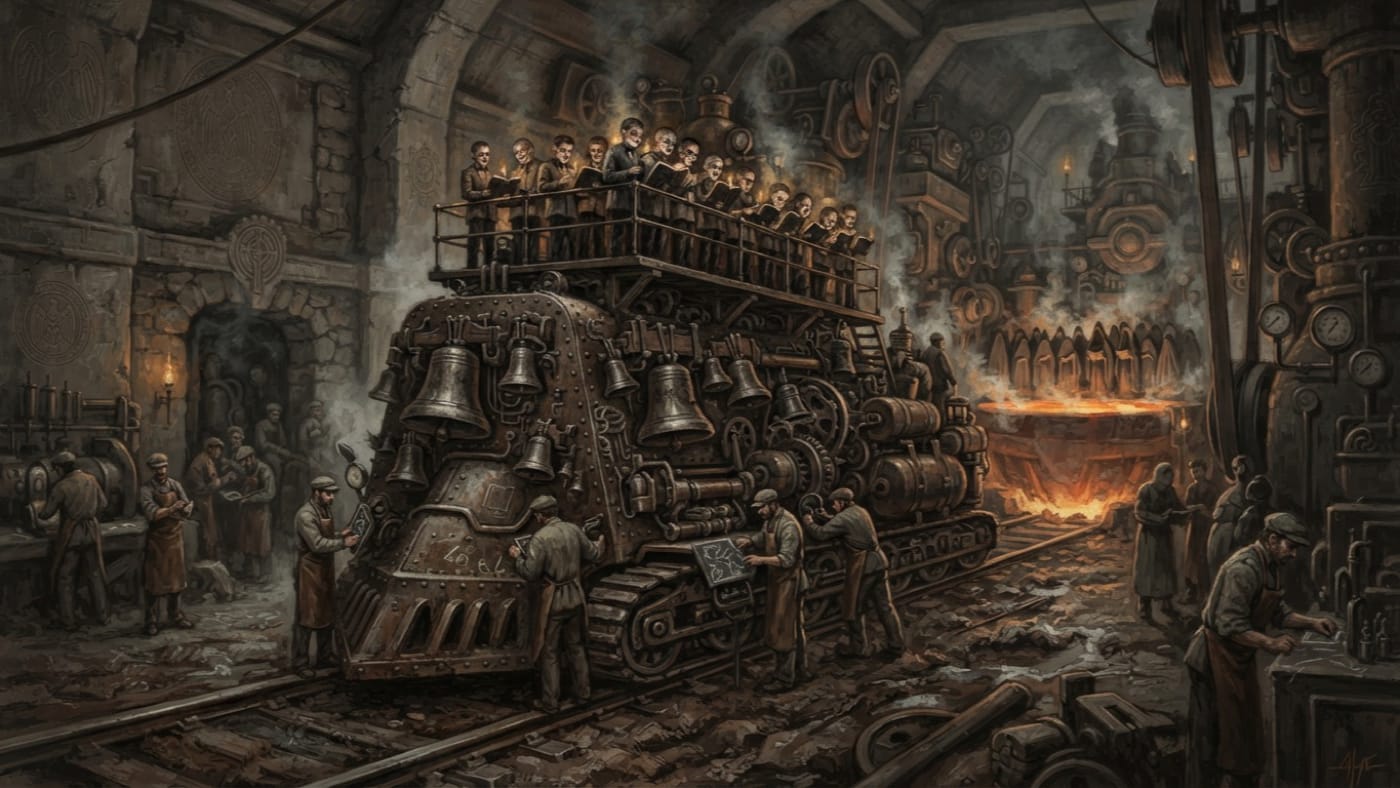
The war-offices, the Essen ledgers and the latrines of the Line all use the word hymn-drive for one class of Synodal siege machinery: engines in which prescribed song, calibrated metal and plain apparatus are made to work as a single body. The Bureau of War sends them against breach-waves. They lumber forward broadcasting psalm, and the enemy's works come apart in front of them. As a definition this is serviceable. It is also all the Codex will certify.
No inventor is recorded. Nor is any prototype, or any first battle. The Bureau of Records holds no folio of origin that it will admit to holding. I have asked twice, the second time in writing, and received a receipt for my enquiry and nothing else.
The vulgar reading of drive holds that the song pushes the engine along like wind in a sail. The vulgar are wrong in this as in most things. Screws and pistons can be found bolted to these hulls. There are boilers to feed, bearings to grease, and bolts that must hold. The voice is part of the mechanism, and the iron is the larger part. According to the Bureau of Doctrine, the hymn carries the Creator's permission into the metal, and the metal does what is permitted. The Codex records this position with the respect owed to anyone who keeps the branding irons.
#On the Housing and the Pour
Every hymn-drive the Bureau of War deploys runs on a housing calibrated at Essen-of-Hymnsteel. The housing is the casing that holds the voice and the works together and absorbs the punishment of both. It comes off the same furnace floors as the bell-cannon throats and reliquary fasteners. The record supports nothing more ambitious than this. Essen supplies the housings, and the Codex has found no proof that Essen builds every component or assembles every finished engine. Anyone who tells you otherwise is selling Essen shares.
The housing is cast in Hymnsteel. In the Hall of Measures, two calibration choirs face each other across the crucible and sing prescribed stanzas through the entire pour. The Bureau of Orison and Song holds that these vibrations align the grain of the cooling metal. Whatever the cause, the observed behaviour of the product is on file. Hymnsteel holds its pitch under stress. It does not sing back wrong frequencies when struck. It tolerates consecrated relics nearby without cracking or bursting its rivets. The behaviour is a measurement. The cause is a doctrine. I keep the two in separate drawers.
The Essen dossier gives a blunt warning: a hymn-drive housing forged without calibration will shear its bolts in a fortnight. Treat this as a foundry warning and not a service schedule. Conditions on the Line vary, and the dossier does not say which model failed, under whose hand, or in what mud. The warning is still repeated in every Essen work-hall, and the repetition is a fact in itself.
Three Bureaus hold custody of each casting and none of them trusts the others. The Bureau of Engines and Furnaces owns the fuel, the schedule and the quota. Orison owns the stanza and the calibration. Records owns the certificate, and without the certificate the other two have produced scrap. Under the Tri-Bureau Compact, a housing leaves Essen under three seals and reaches the Sagittal Line under four. The fourth belongs to the War quartermaster and certifies that he has received an object he is not qualified to inspect.
#On the Work Beneath the Line
The only engine the Lore Book names outright as a hymn-drive is the Sunken Choir, and the Codex sets it out here as an example of the class. It does not define the class.
The Sunken Choir is a Covenant burrow-engine. Its armoured hull is studded with iron bells, and a pressed choir is wired into its throat. It crawls through mud and clay beneath the enemy's works and then sings. The clay trembles, trench timbers split along the grain, and saps, tunnels and bunkers fold down into the ground. Men standing above it say their teeth shake loose and their blood beats to a rhythm that is not their own. The soldiers call this earth-sickness. The Bureau calls it sub-harmonic salvation. Both terms are filed.
The singers inside are made for the work. They are deafened on purpose so that they cannot hear their own voices drift, and they take their cues by reading lips by candlelight in the fumes until the soot ruins their eyes. The Lore Book also describes boys whose throats have been surgically fused into resonant chambers. Those who survive a tour come back up with half-songs on their lips that never resolve. The Bureau of Engines and Furnaces has issued approved phrasing for these men: transfigured into harmonic instruments. This Codex uses the phrase because it is approved, and for no other reason.
All of this describes the Sunken Choir and its crews. It does not describe every hymn-drive crew. It certainly does not describe the calibration singers of Essen, who lose their voices in a slower and better-documented way.
The engine is dangerous to its own side. A tone that brings down an enemy sap can bring down a friendly one. More than one Choir has collapsed under its own voice and buried itself in consecrated mud. The enemy has learned to answer it as well. The recorded counter-measures are tremors forged by Wrath, fogs out of fissures associated with Lust, and Envy's mirrors, which throw the machine's own hymn back at it. This is why the Choirs are rarely deployed. Wet clay holds an engine down with no regard for its rank.
#On Keeping the Measure
Keeping a hymn-drive running is a matter of paperwork, and the paperwork matters more than the hymn.
The Litany-Engineers diagnose by ear. Before they touch a tool they listen to the casing through a stethoscope probe for a knock, a flutter or a sour note. They adjust the engine back into its sanctioned operating bands, the "clean notes," and recite the approved cant during the adjustment. They verify seals and load-test the work. A job ends only when the ledger is closed with the figures, the cant code and a witness signature. An engine with an open ledger is legally still broken, however well it is running.
The Gasket-Hymn Mechanics are stricter. They torque in a star pattern with each turn of the key timed to a line of the sequence, and they chalk witness marks across every bolt head so that the next inspector can see whether anything has moved. They pressure-test the work and file a rite sheet. Their trade saying is two witnesses or none, since an audit will tear apart any repair signed by one person alone.
The Codex knows of no standard crew size for a hymn-drive and no mandatory start-up rite common to all of them, and it will not invent either to fill a column. The cost to the voice it does know. An Essen calibration singer works for about nine years before the pitch drifts and Orison reassigns them to the slag hills. Battlefield singers have no comparable career length on record, because battlefield singers are not counted that way.
#On Discord and Attribution
When a hymn-drive fails, the Compact wants a heretic to blame. Usually there are several ordinary causes ahead of him in line.
Calibration goes wrong. A stanza sung a quarter-tone off ruins the pour, and Essen has paid for that lesson before in molten steel and in singers. Components are counterfeited. The Shard Markets of Essen sell counterfeit seals and stolen tooling, and a gasket from those stalls will hold until the moment it is needed. Metal tires. Pours are rushed, especially in quota season. Sabotage is also on record, and it takes a quiet form: an altered stanza sheet, or one changed syllable in a calibration hymn sung at the right moment in the right pour. The Bureau of Rites keeps a further category for resonance it cannot classify and will not discuss.
Bell-cannon throats sent back from Bastion-Przemyśl arrived cracked along an identical grain-line, although they came from different pours sung by different choirs off different approved sheets. They were throats and not housings. They do, however, come from the same supply of hymnsteel. The Codex records the shared metal and draws no further connection.
Compact Report 447-E (A.S. 198) attributes all Resonance Bloom events at Essen to the Mirror Choir, and earlier Codex filings repeated that attribution.
Investigation by the Bureau of Rites has since established that Resonance Bloom activity predates the Mirror Choir's earliest documented operations by about forty years. The Codex retracted the attribution in its Essen entry. It is retracted here as well, so that no quartermaster blames a hymn-drive failure on the Mirror Choir by habit when the bolt was simply bad.
The Mirror Choir uses altered stanza sheets, and it would be negligent to forget that. Blaming it for everything is a different negligence, and Records charges by the folio for every one of those blamings.
#On the Present Demand
A procurement mandate from Strasbourg demands tripled output of hymn-drive siege engines. The figure is a demand. Nothing in any ledger I have read shows it being met.
Master-Calibrator Sister Rauth refuses to speed up the calibration tempo without "liturgical stability guarantees." In her case this means she will not wear out another generation of throats in the Hall of Measures to meet a quota set by clerks who have never heard a pour go wrong. Furnace-Marshal Kord reckons in tonnage and threatens forced conscription from the Ash Warrens. Arch-Notary Veyl gains from both positions, since every refusal and every threat needs a stamp, and every stamp passes through Ledger Row.
The Line wants more engines. The engines need more housings, and the housings need more pours. Each pour needs two choirs singing correctly in the heat, and Essen runs short of throats long before it runs short of iron.