
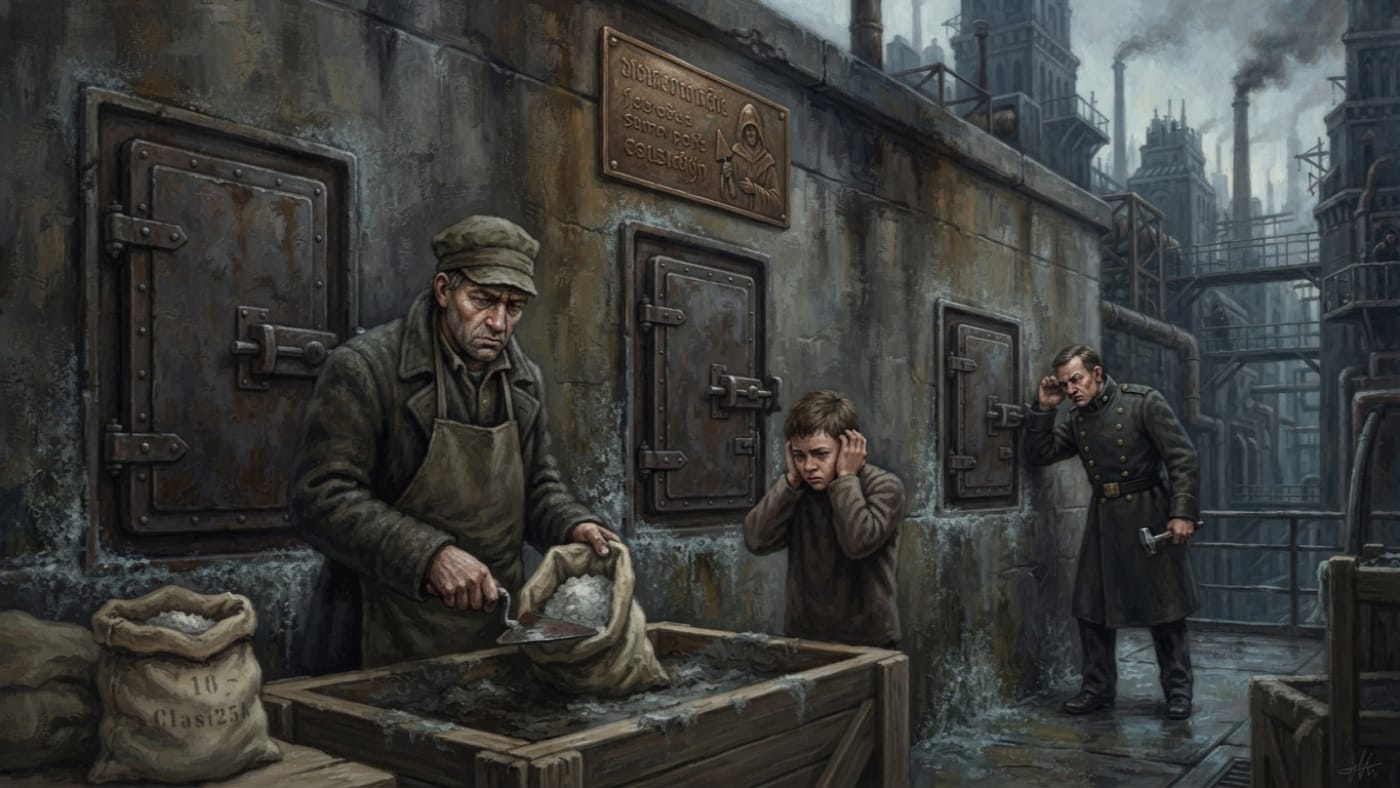
#On the Name and the Mix
“Into the trough, then cap over your ears.” — yard instruction, Zone 4, attributed to no one and obeyed by everyone.
A Lime Boy learns the word before he learns the weight. The sack comes up from the quartermaster with an Engineering ledger number on its flap and a class mark he is not permitted to read aloud. The mason who cuts the twine calls it hush-powder. From then on the boy calls it hush-powder too, and the ledger never hears him.
In the books of the Bureau of Engineering, hush-powder is a doctrinally specified mineral additive, entered into the binding mix of the Immurement Masons after the Demon-Listening Incidents of A.S. 158. Its specification is classified under Seal Obsidian. No page I am permitted to sign records its mineral name, its proportion to the trough, the quarry or kiln that yields it, the clerk who first proposed it, or the road its carts take east. I have asked. I was thanked for asking, which in the Bureau's grammar is the full stop.
The mortar it enters is older than it is. Lime, ash, bone ash, and doctrinally sufficient calcium silicate: that is the binding mix as the southern curtain knew it before Przemyśl, and as most of the Line still knows it. The powder goes into the mix. It is not the mix. Apprentices who confuse the two are corrected with the flat of a trowel, the only teaching method the trade has never had to revise.
The public notice gives the additive's purpose as improved winter durability. That is true in roughly the way a hymn-line on a punishment plaque is true. Every mason who has worked a treated seam also knows the second instruction, which travels without paper and has never needed any: do not listen during curing.
#On the Przemyśl Revision
The incident needs only a short account here. The full file has its own entry and its own seal, and I will not repeat a horror merely because the reader paid for it once already.
Three condemned men had been sealed in three separate niches along the southern curtain of Bastion-Przemyśl, the old punishment face that guards the western Carpathian passes. Six to fourteen months after sealing, those niches tapped First Peal, Third Peal and Fifth Peal. The Bureau of Bells measured the cadence and pronounced it metrically exact. No mercy channel was found in the work. The Bureau of Doctrine took custody of the assessment, sealed it, and sent its assessor west to the Paper Mines of Ulm, where he could reflect on the matter with no audience but dust.
Within the month, the binding formula was revised.
The revision notice calls the change the third formula revision. The first two do not appear in the public file, and the curious are asked not to go looking for them in Standing Order 14-M, whose revisions have their own count and their own clerks. The trade did not invent binding mortar in A.S. 158, either. It already had lime, bone and a saint. In A.S. 158 it acquired an ingredient that came with no explanation attached.
Doctrine memorandum, retained until A.S. 201: “The Przemyśl phenomena are adequately explained by auditory hallucination among front-line personnel, aggravated by shell-concussion. The binding-mix revision is precautionary and pertains to winter durability.”
Withdrawn in A.S. 201, forty-three years after the fact. The Bureau of Bells confirmed metrical exactitude, and hallucinations do not keep time. The revision's durability clause stands. Its precautionary clause is reclassified as Seal Obsidian, and no one is to ask what the precaution was taken against.
#On the Treated Seam
Three things can be observed about a treated seam, and an inspector may write all three down without hurting his career.
First, it answers the mallet dully. An untreated lime seam rings faintly when struck at the joint. That is the clean, high note a mason learns as an apprentice and then trusts for the rest of his life. A seam bound with hush-powder returns something closer to a cough. Inspectors on the tap-walk have had to relearn their ears, and older men complain that every wall now sounds as though it is lying.
Second, it takes up less damp. Treated work holds its colour through the wet months better than plain bone-lime, and the durability clause in the notice rests on this fact.
Third, it blooms. A fine grey efflorescence gathers along the edges of plaques, most heavily where plaque metal meets mortar, and apprentices take it for ash until they are told. Where the bloom comes from, what it is made of, and whether it means the seam has failed or succeeded are all questions without filed answers.
Beyond those three observations, I am handling doctrine and not stone. I have written elsewhere that hush-powder teaches walls discretion. I stand by the phrase as a figure of speech, and the Bureau will kindly not enter it in any ledger as a finding about the inner life of masonry. What the powder suppresses, if it suppresses anything, has not been established by Engineering, by Bells, or by any mason willing to sign his name to it.
The powder fits into inspection practice that already existed. The tap-walk now listens for the dull answer. Bright gloves still come away clean or dirty. The mix test now checks the mix grade against the treated-seam specification, and completion records must show that the additive went in. Plaques and stamps are read as they always were. The division of labour holds: Doctrine decides what a sound means, Engineering records what went into the wall, and Bells counts. None of them listens to the curing.
One confusion should be removed here. Contraband quick-set hush is a different sin from the approved additive. It speeds the cure so that an inspector arrives too late to test what was put in the wall, which makes it the opposite of the approved additive in purpose, whatever the masons call it.
#On the Two Hands
Saint Karron the Trowel-Hand is said to have sealed a heretic whose screams drew demons, and his binding mix is said to have kept the wall shut. The trade tells this story at every trough. Hush-powder came centuries of legend after him, and he is not credited with inventing it. Both of the trade's tendencies nonetheless took up the additive in his name within a season of its issue.
The Pure Sealers took to it fastest. Their faith is that a wall closed correctly owes nothing to anyone. The Przemyśl niches had no vents, and they tapped anyway, and that was an insult to the faith. The powder gave the Pure Sealer an answer he could mix. He adds it with the same flat discipline he brings to the three locking bricks, enters it in his completion record, and refuses to draw any comfort from it. His yards have stopped claiming that every answering wall hides a Breath-Giver's reed. They have not stopped tapping their own finished work before sleep.
The Breath-Givers got trouble from it. The powder chokes narrow reed channels. A breath-thread angled through treated mortar can close up within days. Behind the plaque, that means the air runs out sooner than the mason intended or the family paid for. Breath-Giver crews answered with steeper channel angles and baffles packed with ash. Whether the adaptation keeps a channel clear past the first wet week is a yard argument, and nobody records it in any ledger.
The powder changes no judgment. Where a presiding Judge has specified air provision under Standing Order 14-M, the writ governs, and the writ says nothing about mineral additives. Hush-powder closes concealed channels by being what it is. It has no authority to close authorised ones, and an inspector who treats a Judge's slit as a defect will learn about jurisdiction the hard way.
The two hands share more than either admits. Both use the powder when the quartermaster supplies it and steal it when he does not. Both curse it when it clots in wet air, because damp turns it to grit, and grit cannot be mixed evenly through a trough. Both swear by Karron while they do it. The saint has said nothing on the matter, which suits everyone.
#On the Present Application
As of A.S. 201, treated binding mix is standard in Zones 4 and 5, from the western Carpathian bastions to the contested ground east of the Line. It went first into punishment niches, then into trench dampening protocols, and then into whatever seam had been entered in a report as acoustically troublesome. A seam does not have to tap to qualify. A sentry only has to write that it did.
The additive brought a body of paperwork with it. Procurement opened three new ledgers. Inspection gained two offices. Punishment masonry in both zones now carries a surcharge, so a frightened administration has fear as a standing line in its budget. Inspectors carry Form 14-M(c) in their satchels and fill it in at the wall.
The powder cannot cure lime scarcity. In Zones 4 and 5 the quartermaster sends what he has not already sold. Mud-calcium blends crack. Inferior ash blooms on its own account. Bone-lime goes bad if it is stored wet. An inspector must keep two failures apart on his form. A seam that weeps because the mortar was poor is a structural failure. A seam that went in gritty because the powder clotted is a supply failure. Hush-powder makes bad mortar quieter. It does not make it sound.
Doctrine's A.S. 199 classification still governs how sound is filed. Prayer-adjacent sound is Residual Devotional Emanation, non-prayer-adjacent sound is Demonic Interference, and sound during business hours is Administrative Noise. The powder appears in none of these headings, and none of them gives a cause.
The three Przemyśl niches remain sealed, and their seams are treated. Since the first application the full cadence has not been repeated in public. I report the sentence exactly as filed, and I advise the reader to give the words in public their full weight.