
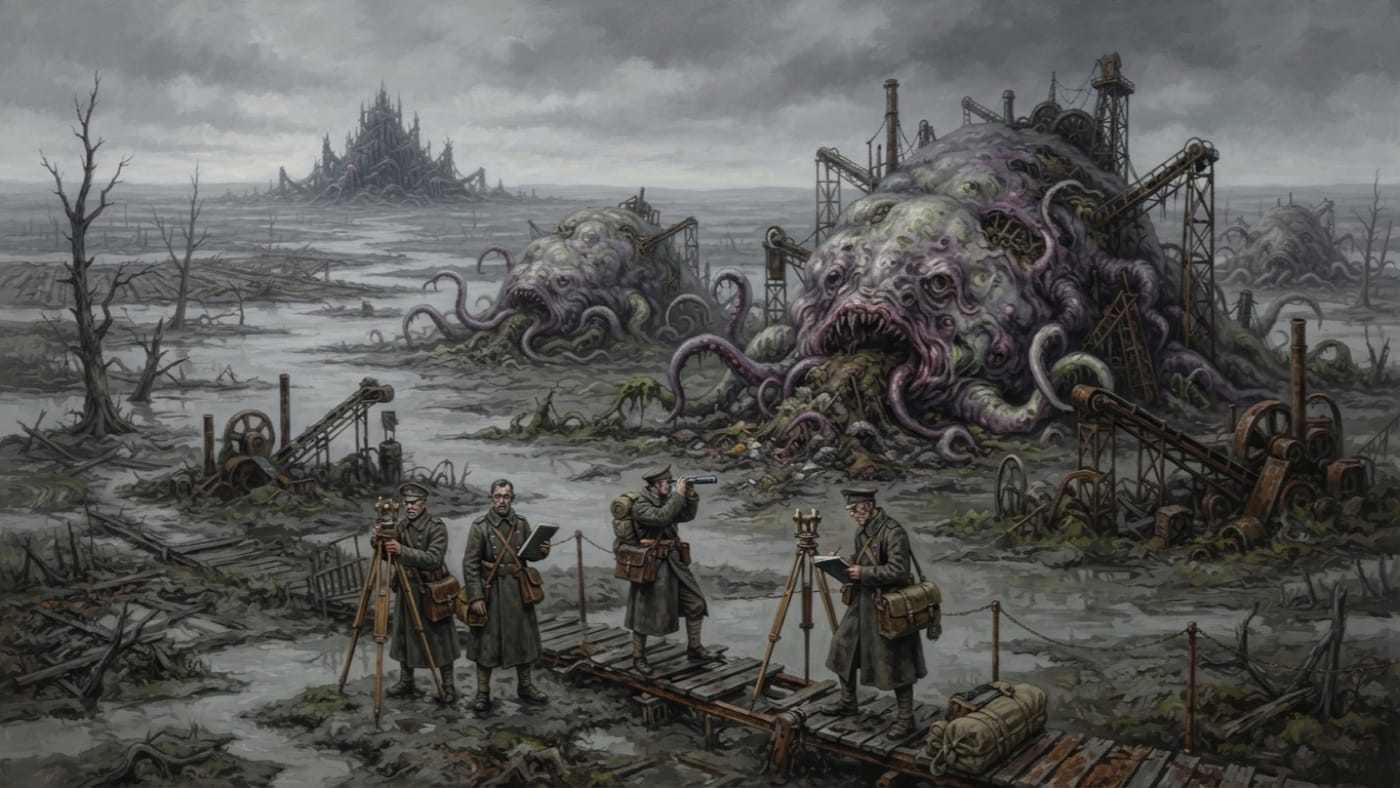
#On the Country That Fed the Armies
Being the Bureau of Doctrine's geographical entry on the former grain country of the Hungarian plains, written because the Gorged entry names the place and field personnel have asked where it is.
Before the Sundering, the Hungarian plains were the sort of country that bores an archivist. They were flat, and sown from one edge to the other. They produced grain in such quantity that the older chroniclers called them the breadbasket of empires, and they carried herds the same chroniclers never troubled to count, because nobody counts a thing he expects to keep. The barns of Pannonia were full. The cattle were fat. Armies marched across that country without a thought for it, the way a congregation forgets the floor beneath it.
That is what such country is for. A mountain can be held and a river can be bridged, but only a plain like this one feeds the men who do the holding and the bridging. Its worth was never in its towns. Every other place in the East was fed from it.
The Ledger uses "the Hungarian plains" as a farmer would, to mean the flat grain country, and does not run a surveyor's line around it. The phrase does not mean all Hungary. Western Hungary lies within the Forward Heartlands, Zone 3, and serves as a supply staging ground. Budapest's west bank is Synod-held; its east-bank districts were abandoned after A.S. 120 and are contested. Readers who wish to speak of "all Hungary" as lost may take the matter up with the garrison there, which is busy.
#On the Loss of the Plain
The omen years belonged to the whole continent. The Year Without Dawn, A.S. 32 / 1742 CE, killed crops across Europe within its first week. The Red Flood boiled the Danube crimson in A.S. 34 / 1744 CE. The Eastern Silence of A.S. 38 / 1748 CE stopped the Balkan letters. Each was a warning served on everyone, and the plains were still answering to the plough when the Sundering came on 1 November A.S. 45 / 1755 CE.
The loss belongs to the Sundering and to the years the Ledger enters as the Collapse of Reason, A.S. 45–48 / 1755–1758 CE. The first reports did not mention demons. They described grain rotting in Pannonian barns and herds falling bloated in the fields, and the Rationalist administration of the day entered all of it as pestilence. Then came Debrecen. There, by the accounts the Church later gathered, a hundred thousand men broke and fled after Kargath devoured their rations in a single night. The same accounts say whole regiments starved without a battle, gnawing leather, then dirt, then one another. That was when men understood that a will was guiding the famine.
The Battle of the Iron Plains is often entered beside Debrecen, and the Cartographic Division lists its site as probably on the Hungarian plain. Divisions there were swallowed by fire that fell from a cloudless sky. I set the two entries side by side so that no clerk confuses them. Wrath's country to the south is slag and furnace. Kargath's country was never burnt. It was eaten.
#On the Ground Now Occupied
The plains are now the Blightmarsh: grey mud, grey water and a grey sky over both. Nothing grows there. Exhausted soil can be rested and limed and sown again. This soil has been consumed. The Kargath files say it was eaten by something that lives beneath it, and the files have not been contradicted by anyone who returned. Vast shapes move under the surface. Mouths open in the mud and swallow whatever crosses them, and so a patrol that keeps to the firm ground is choosing its route. It is not safe.
The marsh also advances. It eats farmland at its edges, slowly, and famine reaches each new district before any of Kargath's armies do. The Lore ties his spread to the Drava and Sava valleys and to the Carpathian marches. The Drava, once a navigable river through grain country, now runs yellow-grey through the marsh. Somewhere above the Blightmarsh of the Drava stands the Cauldron Citadel, a fortress built from drowned cities fused together like bones in a mass grave. None of this amounts to a map. The Ledger holds no supported acreage, no rate of advance and no complete perimeter. I will not supply one to make a clerk comfortable.
The plains have been closed to the Vigil Arks since A.S. 147, when the Sanctissima Vox went out to reconnoitre the consumed plain and did not come back. Forty-one men flew out and three were brought back. The three declined to describe what they had seen, and the Bureau of Doctrine sealed their testimony. Survey has been done on foot ever since.
Fire does not clean the ground either. In one recorded case, reliquary flame turned against a Flesh Litany in the Blightmarsh burned away the overgrowth and left the soil sterile for a season, a white desert of husks where even gnats would not breed. The Bureau called it a clean victory. I call it costly bookkeeping.
#On the Eleven Positions
The Bureau of War Cartographic Division's survey of A.S. 200 recorded eleven confirmed Gorged spread across the former Hungarian plains. At least three of them had stayed in substantially the same positions since A.S. 155: forty-five years at the time of the survey, forty-six now. No census has been taken in A.S. 201, and I have not invented one. Eleven is the number the observers saw, and the register says plainly that it is incomplete. Ground that no team can reach may hold more.
A Gorged does not march, raid or retreat. It sits where it sits, its attendants keep bringing it food, and it stays hungry. This makes it a fixture of the terrain, and the Bureau of War classifies it under area denial.
Our earlier catalogue of Kargath's demons described the Gorged as "barely mobile under the weight of their consumption."
The Gorged are stationary. The Cartographic Division's register records their mobility as none, and the Bureau of Engineering found in A.S. 192 that once the body outgrows the limbs, movement is structurally impossible. The limbs still grasp and pull food toward the mouth. They do not carry the body anywhere. Personnel planning a route around a known position may treat it as fixed.
The denial works in several ways at once. Within about four hundred yards of a specimen's outermost boundary, the mucor fames coats the ground. Rations spoil within hours, leather cracks and wood loses its grain. The four hundred yards are measured from each demon. They do not measure the Blightmarsh, and they do not certify the ground at four hundred and one. The cry carries further. The Bureau of Medicine's study at Observation Post Eleven-West, A.S. 195–197, recorded appetite rising by the week until sentries were eating boot-leather and candle-wax. Rotations have been fourteen days since A.S. 198. Watch long enough and a man begins to envy the demon its supper, a condition the chaplaincy calls invidia famis. So each position costs the Synod its sight lines as well as its acres, along with every road through the radius and every ration carried within it.
The obvious remedy has been tried. Concentrated artillery can kill a Gorged, and what it leaves behind is a fovea: a depression of consumed and contaminated ground for which no recovery period has been established, where survey soldiers report hearing the cry, muffled, for weeks afterwards. Current doctrine advises against destroying a Gorged unless the tactical situation requires it. Shelling has emptied a seat at the table. It has not given back a single field.
#On the Harvest and the Ledger
Two further hazards keep the question of food from being settled by anything a scout can see. The first is the Abundance Fields. They are lush and heavy with grain and fruit, and the harvest never ends. Refugees run toward them, eat and keep eating, and waste away with full bellies. The Bureau of Relics maintains that properly blessed provisions cannot carry Kargath's curse. Food blessed from the Abundance Fields is cursed regardless. The second is the Famine Pits: mass graves of the Sundering's starved, where the hunger of the dead now reaches into living bodies, so that a well-fed man standing near one feels his stomach cramp. Green crops on a horizon tell a patrol nothing, and neither does a full haversack.
The Church must therefore feed the Sagittal Line from other ground. The Bureau of Tithes holds the ration as discipline, and the Bureau of Doctrine teaches the Doctrine of Enough: contentment with the ration is holy, and hunger for more is sin. Mandatory fasts are meant to harden the faithful against Kargath's whispers. In practice they weaken the body and sharpen the ear for promises of food. The ration keeps order and makes men hungry, and hungry men are exactly what Kargath works with. Whatever the Great Deceiver whispers through his Maw, the man who reaches for the bread still makes the choice himself, and the Church punishes him for it whether or not the demon is hungrier than he is.
Nor is the plains' hunger to be mapped onto the southern front. Bastion-Constantinople, which anchors the Line at the Bosphorus, faces its own Gorged on the eastern road and its own pressures from Kargath and from Wrath. The Hungarian plains are not at its gates. They are simply missing from every granary it draws on.