
#On the Ribbons
"You'll be through soon." — the one courtesy the Queue Road counts as a curse
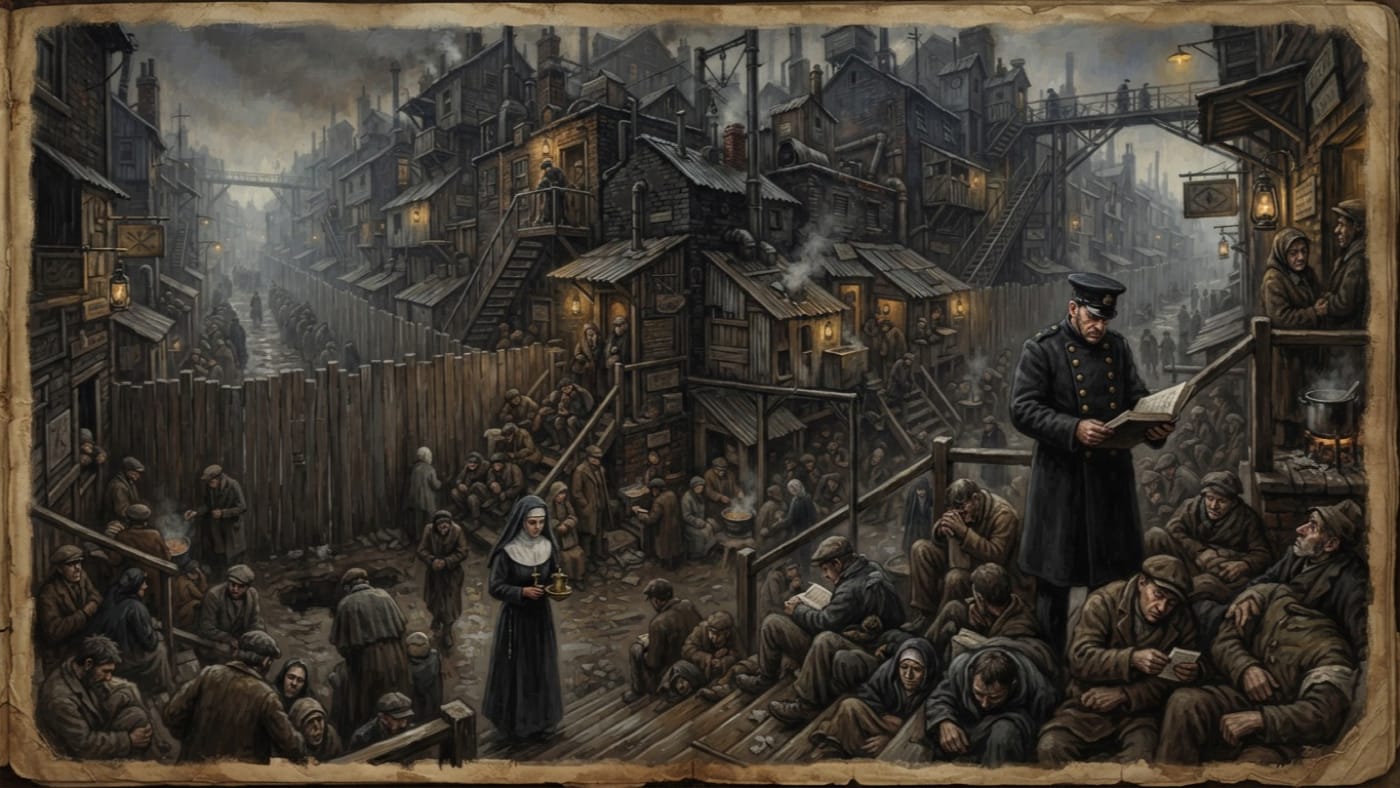
The Hostel Ribbons are the lodging district of the Queue Road. They are one of its nine named quarters, and the only one whose main trade is unconsciousness. They line the road where its service sprawl presses against the fenced lanes. Bunk-houses, dormitory sheds, lean-tos and anything else that can hold a plank above wet ground stand so close together that from the lanes they look like one shanty wall. I give no count of the buildings. The Consortium gives none either, and on this point alone we agree completely.
You smell the place before you can read its signboards: damp wool and disinfectant. The wool belongs to blankets that never fully dry, to coats hung on bunk-rails, and to travellers who walked through rain to reach a queue and then stood in it. The disinfectant belongs to the management. They use enough of it to announce hygiene and too little to achieve it.
The road is blocked on purpose. A traveller may stand for days before a clerk lifts a hand to call him forward, and each of those days has to end somewhere. They end here. The wait is sold long, the sleep is sold short, and the difference is called hospitality.
The hostel steps serve the district as parlour, chapel and exchange. Travellers sit there because a bunk costs money and a step costs only the warden's patience. Rumours of gate closures, rate changes and audits travel along the steps faster than any runner could carry them, and with less accuracy.
#On the Purchase of Sleep
Sleep in the Ribbons is sold by the hour. Residents call that hour a sleep-slice, and it is the most honest noun on the road: a portion cut from the night, weighed against a purse and wrapped in a Hostel Receipt. Some wardens cut thinner and rent by the quarter hour. They found the hour indulgent. The hostels take minute credits, bell-marks, stamped paper, ration chits and oath-notes. They accept coin with the faint courtesy one shows an elderly relative.
I record no tariff. Prices change with the day, the season and the warden's reading of the sky and the queue. The receipt is the only fixed point. It states which slice was bought. It does not state whether the buyer slept.
Hostels may lawfully deny sleep. I admire the economy of the rule. It says nothing about refunds.
Curfew is the district's market hour. The booths shutter, the fences lock, patrols squeeze the lanes, and the hostel auctions begin. Walking a fence lane after dark is one of the few offences on the road that cannot be bargained down. A traveller still outside when the bars drop therefore has three choices: the auction, the alley or the open ground. Only the auction issues a receipt.
The First Frost Lock makes the sums harsher. The hostels fill. Fights over lane-jumping break out more often in the fenced queues outside. Exposure in the open lanes kills, as it always does, without paperwork. In that season the bunk sells itself.
The kitchens serve what the whole road eats: thin broth, hard bread and pickled scraps. In the doorways, steam from the broth pots meets the wet wool of the bunks, and the two agree on a climate.
#On the Consortium
The Hostel Ribbon Consortium is a charitable compact of lodging-keepers devoted to sheltering travellers.
The Hostel Ribbon Consortium is a charitable compact of lodging-keepers devoted to sheltering travellers.
Corrected. The Consortium is a trade compact, and shelter is its public purpose. Its income rises as the queue grows longer. The words "charitable" and "devoted" are withdrawn because no receipt supports them.
The compact controls the district's bunks, kitchens and guards. It works through fixed prices, rumour and bribed marshals, and each of these does a plain job. Fixed prices spare neighbours the inconvenience of competing. A rumour that a gate will close costs nothing to start and fills the bunks before dusk. A queue marshal paid to hold a lane for one more hour has sold the hostels an hour of custom. The road's own list of its corruptions includes hostel kickbacks and deliberate slowdowns before holy days, and it lists them as routine.
None of this needs a conspiracy. A traveller who passes the gates quickly sleeps somewhere else. A traveller who is held sleeps here. The Permit Directorate profits from minutes spent waiting, and the Consortium profits from nights spent waiting. The two share an interest in delay without having to share a table. I have found no written pact between them, and I record none here.
Two names keep appearing. Warden Kess is named in every account of the compact I have collected, but my sources do not say which hostel Kess keeps or what rank Kess holds. Sister Broom counts breaths. That is everything reliably said about Sister Broom, and I will not improve on it. I cannot say which office, if any, granted the title of Sister.
What alarms the compact is disease. Fever spreads through packed bunks as quickly as rumour spreads along the steps. An outbreak hurts the Consortium twice: first in lost custom, then in the attention of the sanitation officers who arrive afterwards.
Debt is where the hostels connect to the larger machine. Minute debt compounds on the road. An unpaid debt may be turned into forced labour at Gate Nine or into erasure to the Null Verge. The road lists that labour with admirable candour: hauling barricades, cleaning latrines and copying ledgers until the fingers bleed. A lodging bill is a small debt, and the road's large ledgers are built out of small debts.
#On the Account That Outlasts the Night
In my tract on the Minute Drift I recorded one sentence of testimony from these hostels. I repeat it here without ornament. A wagoner slept one night in the Hostel Ribbons and woke owing nine days of stall rent. The landlord produced stamped proof. The wagoner's horse was dead of age.
The account does not name the wagoner, the landlord or the hostel, and it gives no year. I have added none.
Note what was charged: stall rent. The bill was for the horse's lodging, and the horse is the party whose body agreed with it. The wagoner's account of the night disagreed. I cannot tell the reader whether nine days of billing match the animal's ageing, whether the stamps were honest, or whether anyone in the Consortium knew what the night would cost before it was spent. The sources answer none of these questions.
What I can say is that the Drift produces exactly this kind of dispute. In the Barricade Maze and wherever else it has reached, bells ring twice, ink dries before the wax cools, shadows fall at the angles of other hours, and hunger comes early, late or not at all. Stretches of time go missing, and bodies age faster than their papers allow. Clock, receipt and flesh all give testimony, and they seldom agree. A hostel that sells sleep by the slice calls all three witnesses every night.
The Bureau of Rites classifies the Drift as a Category Two Localized Temporal-Scribal Disturbance. The Bureau of the Hourglass classifies it as Class II-Extractive, sub-designation Alpha. Both labels apply to the Drift. Neither applies to the Hostel Ribbons, which every ledger I have seen treats as a lodging district with ordinary bunks and extraordinary invoices. No survey has drawn the edge of the anomaly through the bunk-rooms. The wagoner's account proves the hostels were exposed to the Drift. It does not show where the Drift begins or ends.
The Apparatus lies beneath Gate Nine, and the road feeds it. Delay goes in at the lanes, and something comes out below. The Consortium profits from delay, which places the hostels on the same incline as the wheel. That does not prove any warden has seen the chamber, built any part of it, or understood what the stall-rent ledger recorded that night. Profiting from a wound is a different sin from inflicting one. The Church, which commits the first, takes care to prosecute only the second.
#On the Present Condition
In A.S. 201 the Ribbons remain full, damp and lawful. Curfew still opens the auctions, frost still fills the bunks, and the hostels may still refuse sleep, which they do. Minute pricing began in A.S. 104, became policy by A.S. 110 and still governs the road around them. The Directorate doubled minute prices in the spring of A.S. 200. I find no record that hostel rents were formally changed at the same time. The Consortium needed no decree, because a longer queue raises the rent by itself.
Gate Nine closed for sanitation in the autumn of A.S. 200. A shut gate is the road's version of a siege, and the lodging district is the part of the besieged city that charges admission.
Hostel Ribbon 14 has earned its line in the register. Its name comes up wherever the district is described, together with hourly sleep, damp wool, disease and extortion by ledger. The number identifies the house and nothing more. It does not tell the reader how many hostels stand in the Ribbons or where this one stands among them. I record its reputation and decline to predict how it ends.
There are unmarked pits behind some of the hostels. No one knows how old they are, what they hold or who dug them. I know of no Bureau of Records entry on any of these points. In a district that issues a receipt for a quarter hour of sleep, that silence is a form of testimony.
The district will be inspected again when disease forces an inspection, and audited again when revenue falls. Until then it does what it was built to do. It shelters the delayed, bills the sleeping, and keeps its doors open while the queue grows.