
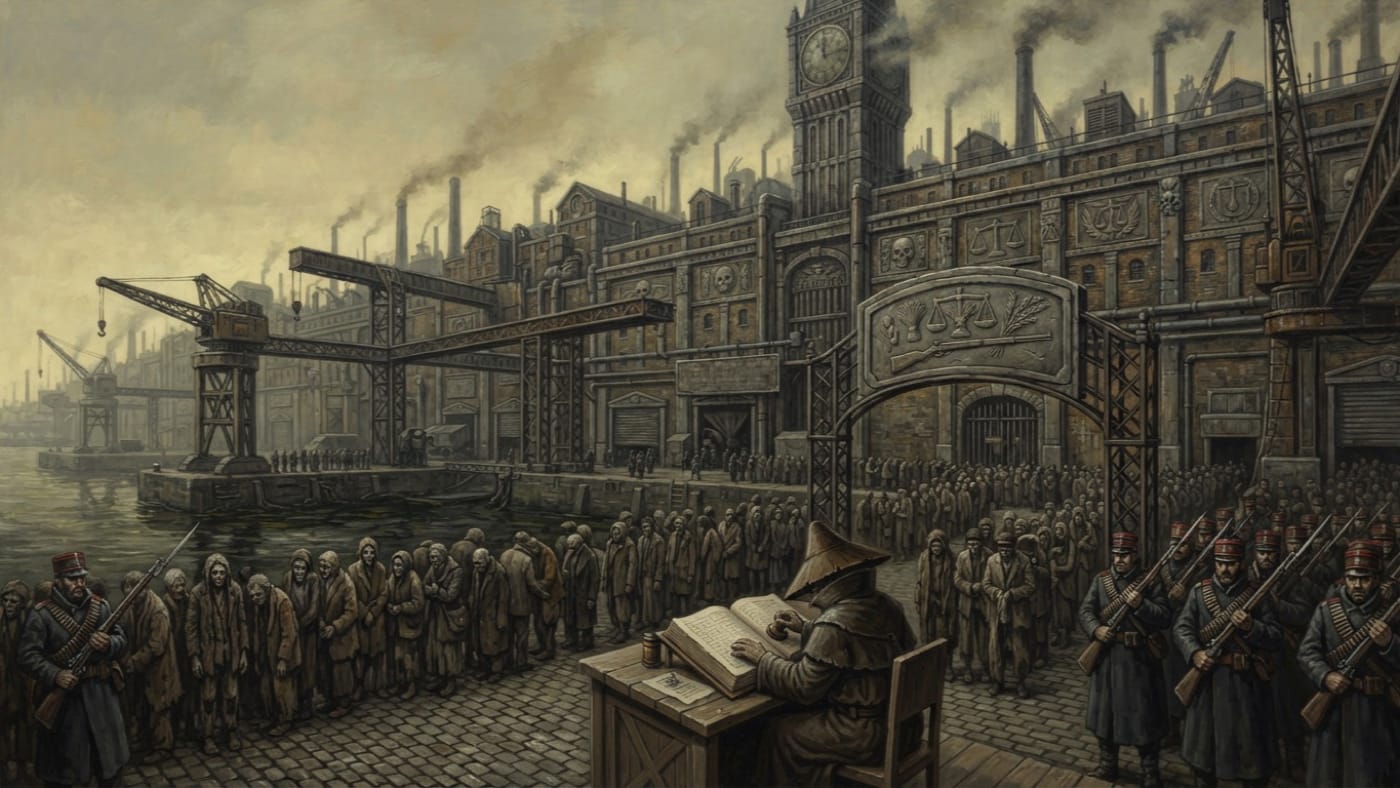
"Civic abstention from compromised grain, undertaken beneath corrective authority." — Entry of the Bureau of Records for the Varna harbour, A.S. 129
#On the Name
The Church teaches its children that a holy fast is hunger offered upward. The faithful set down the spoon and the bells mark the hours. The belly empties so that obedience may fill it. Hunger is the material and consent is the offering. The Bureau certifies the transaction, and the soul is credited.
The Codex must now enter Holy Fast as something narrower and far better documented. It is the approved name for what happened to the people of Varna in A.S. 129. A grain fleet sat sealed in their harbour for nineteen days, and the bread under its canvas went soft, then green, then over the side. The full sequence belongs to the Ledgers of Varna, and I will not copy it out again for readers too idle to turn a page. This article concerns the name. The name has outlived the grain by seventy-two years, which is a better record than most saints manage.
A fast is first proclaimed and then kept. At Varna the order ran backward. The keeping came first, enforced by seal and stay and finally by musket. The proclamation came afterward to explain that everyone had meant it. The Bureau calls the result voluntary. I record that as the Bureau's claim, with all the reverence owed to any claim the Bureau makes about the inside of other people's stomachs.
#On Abstention and Its Witnesses
The vocabulary was waiting at the harbour long before the fleet arrived. Synodal life runs on a calendar of feast and fast. Under the Fast of Strength, whole districts abstain together. Their kitchens are cold and their tables bare, and the bells toll across the rooftops to mark each hour of endurance. Afterward the proclamations praise the sharpened faces as "the visage of faith incarnate." The Fast of Silence takes the tongue rather than the bread, and it should not be confused with the present subject, though the two share a talent for emptying streets.
Other offices keep the vocabulary in good repair. The Bureau of Rites standardizes fasts and audits their compliance. The Penitents' Guild organizes the public ones, so that suffering may be watched and learned from. The Triumph of the Gaunt parades the leanest citizens as living icons of discipline. Neither Rites nor the Guild declared anything at Varna. I name them because they furnished the words, and a well-kept word may be borrowed by any office with ink.
Every one of these observances needs a witness. A fast that goes unrecorded is only a bad week. Abstention becomes devotion when a clerk enters it as devotion. Any Records Scribe will tell you, while stamping your ration card, that the register decides your residency, your entitlement and your name. It also decides your death. The Church teaches that to perish in battle is to wear a crown, and that to starve during a holy fast is proof of devotion. Those who die in rebellion are denied ash and flame. There are three deaths and three columns, and Records chooses the column after the fact, from the desk.
#On the Declaration at Varna
The fleet came in sound. The holds were dry and the scales calibrated. A tariff-chapel weigher had witnessed the measure, and nobody ever found the measure wrong. The whole fault lay in one question: whose grain was it?
The Bureau of Tithes named it strategic grain. The Bureau of Pilgrimage named it route-sustaining ration. The Bureau of Settlement claimed it in emergency civic custody for a city whose refugee rolls had outrun arithmetic. The Bureau of Commerce supplied the table. Licensed Manifest Litigants secured the Sanctity Stay Orders that kept the cargo where it lay. The port court then deliberated with the slowness proper to grain that might belong to Heaven.
The cargo waited nineteen days. That number measures the delay and nothing more. It sets no length for any fast, and no calendar observes it.
Heat got into the lower holds and the sacks sweated. The smell came over the rail and up into the streets. The people of Varna could see the canvas from the harbour wall, and for some days they showed a patience the Bureau later found very useful. Their petitions were presented and denied pending jurisdictional clarity. Then the patience ran out. The crowd moved on the warehouse gates, and the Bureau of Purity fired. Thousands were shot onto the stones and into the water. The surviving ledgers disagree about how to count them, and I will not settle the disagreement with a number I would then have to defend.
The order of the documents matters here. The cargo was condemned first: unfit for consumption, manifests closed under adverse condition, tariff status preserved. Only after that did the riot tally reach a desk. Only after that did the Bureau of Records enter the city's deprivation as a voluntary holy fast, in the words that stand at the head of this article.
Admire the sentence, because every phrase in it does a full day's work. Civic gathers the dead into the body of the faithful. Abstention turns a locked gate into a choice. Compromised grain makes the bread the guilty party, and bread cannot appeal. Corrective authority describes a volley without mentioning powder. I have written benedictions for bishops that laboured half as hard.
#On Consent and the Roll
A fast needs a faster who chooses it. At Varna the Bureau supplied the choice afterward, and its method repays study.
Early instructional summaries describe the Varna abstention as "popularly accepted."
Retracted. The acceptance was inferred from the absence of further petition after the volley. The petitioners were, at that hour, otherwise engaged.
Look at what the entry does once the ink is dry. If the people of Varna fasted, then nobody starved them. If nobody starved them, the nineteen days were a period of observance in which the offices carried on their lawful work. Tithes can then say, as Tithes did say, that every calculation was correct. And every calculation was correct. The rate was right, the weight was right and the stays were properly filed. Only the bread went wrong, and the bread has been condemned.
The roll did the rest. Settlement divided registered hunger from riot-adjacent hunger. It used that division to refuse compensation to families whose dead had been found nearer the harbour than their assigned district allowed. Pilgrimage kept its claim alive for future convoys. The Litigant houses collected partial payment, because condemnation is a valid way to close a stay, and a closed docket is a paid docket. Every office left the harbour with something in hand. The families left with a classification.
A classification is the only thing a family ever receives from Records, and it governs everything that follows. It settles ration entitlement and legal standing. It settles whether a widow may petition, and which desk she must petition at. It also decides which teaching applies to the dead. The Church praises the faithful who starve during a holy fast and denies ash to the rebel. The ledgers do not say, body by body, which of Varna's dead went into which column. I will not guess at pits I have not seen.
#On the Approved Instruction
Commerce took Varna into its training doctrine as the standard case of velocity failure. The assessment was correct, but it could not move edible cargo before the cargo stopped being edible. Every weigher learns the case in the first year. As far as it goes, the lesson is sound. It teaches the clerk to hurry. It does not teach him what to call the result if he is too slow, because that was settled in A.S. 129 and has been approved vocabulary ever since.
So the case is taught in two rooms. In the first room the student learns that delay kills grain. In the second he learns that grain killed by delay gave a grateful city the occasion for a holy fast, undertaken freely beneath corrective authority. Both answers pass the examination. A student who gives either answer in the wrong room fails, and the examiners take care to tell him why.
Holy Fast has no feast day in the calendar. It has a definition in the instructional annex, and the annex is opened far more often.