
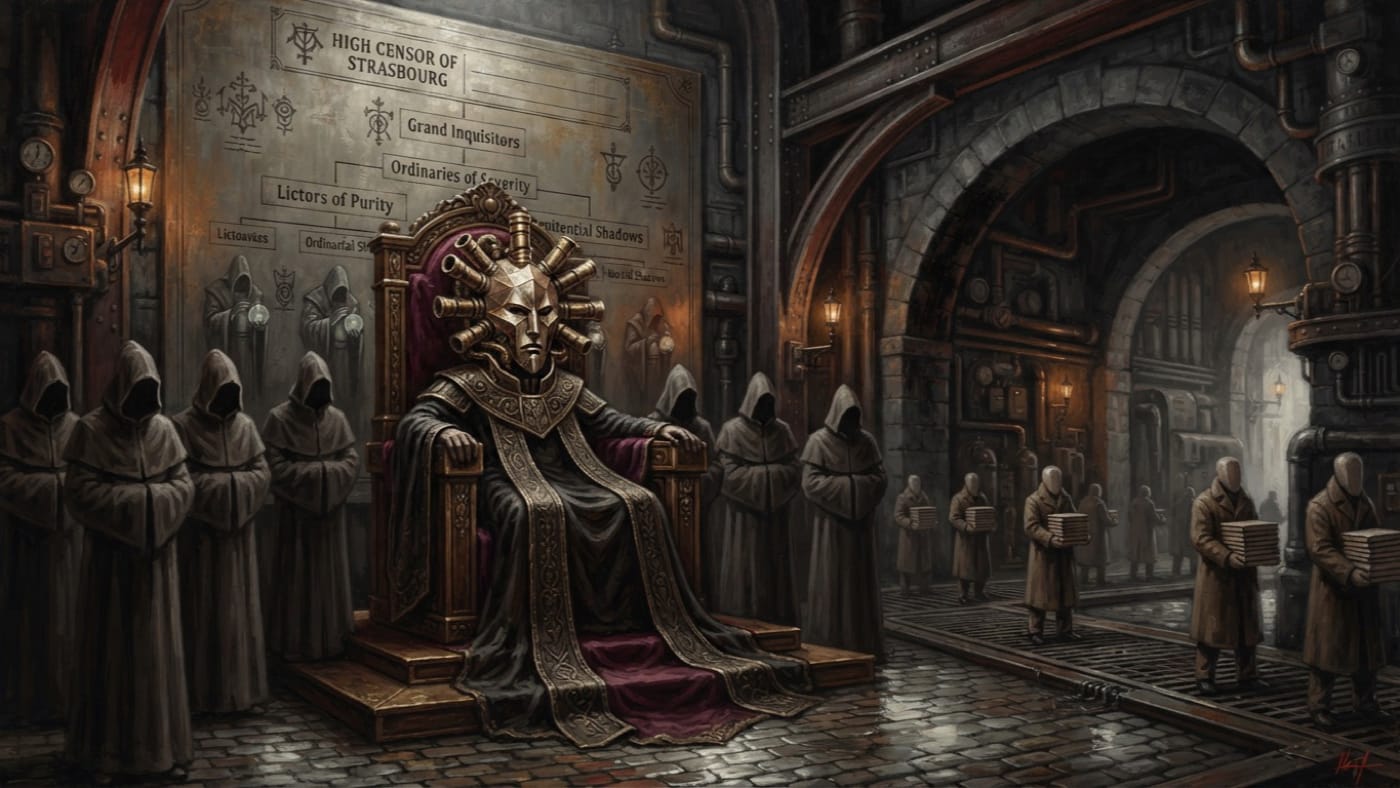
#On the Station of the High Censor
The High Censor of Strasbourg heads every printed table of the Inquisition I have ever been permitted to copy. Beneath the title come the Grand Inquisitors. Beneath them sit the Ordinaries of Severity, then the Lictors of Purity, then the Penitential Shadows. Beneath those lie the condemned. They hold no rank, but they are always listed, because a pyramid requires a floor. The precedence is fixed and the ink is good. In every edition, the column beside the topmost title, where an ordinary register enters the bearer's name, has been ruled, given its margin and left empty.
This is the supposed supreme authority of the Inquisition, and its supremacy is narrow by profession. Provincials who promote the office to one of the Seven Seals, or confuse it with the Hierarch of Purity's chair, or crown it governor of the whole Synod, have mistaken the summit of one ledger for the whole archive. The High Censor stands over one apparatus. According to Doctrine, that apparatus answers to the Censor alone.
The office is "rarely glimpsed in public." The Bureau of Doctrine chose that adverb with care. Never would invite an audit. Occasionally would invite petitions. Rarely invites only rumour, and rumour files itself.
The peasants, who have met a Lictor, could not give a tinker's damn whose name tops the column.
#On the Bearer of the Mask
Three accounts circulate, and the Church has had the wisdom to endorse none of them in writing.
The first holds that the High Censor is a single mortal who is seldom seen and secluded for reasons of security and taste. The second holds that the office is a mask passed among inquisitors in rotation, so that no wearer becomes indispensable. Some versions put that mask in the keeping of the Council of Veils. The third holds that the mask is empty and moved by Providence, and that the voice issuing from it is neither male nor female, neither young nor old.
Each account brings its own clerical consequence. If the Censor is one mortal, then there is a body, and a body implies a death and a succession. No register I have handled records the body, the death or the succession. If the mask rotates, then every order issued in the Censor's name had an author whose name was deliberately left out, and attribution becomes a question of who held the thing that quarter. If Providence moves the mask, then succession is a blasphemous question and attribution is the Creator's affair. The Bureau declines to open a file on the Creator.
What the Bureau can certify is smaller. No face has been recorded. No document admitted to my reading room gives the bearer's age, sex, mask material or distinctive vestment. Witnesses describe drapery, distance and a voice.
Drapery can be hung on a stand.
#On the Advisory and Its Records
Older Purity lore, and older lore of my own, joins the High Censor to the Council of Veils. The Council is a cloister within the cloister, said to dwell inside the Censor's mask itself, and by institutional insistence it has always had seven members. The Bureau of Records files it under conditional actuality. That is the archival equivalent of laying a place at table for a guest who may be dead. The Council's existence is unconfirmed. Its effects are paperwork.
The Council's minutes come down to us in competing traditions. One holds that they are written in ash on censers that consume the writing. Another holds that they are kept as smoke on water in the cisterns beneath the capital. A third says the decrees emerge already written in ash before anyone has asked the question. A fourth says there are no minutes at all, only blank sheets whose blankness is the record. In an earlier chapter, under my own seal, I wrote that I had seen the cistern minutes and watched them vanish when disturbed. I stand by the sentence. I also note that no clerk can reproduce it unless they were standing beside me, and no clerk was.
The Veils are said to issue Severity Indices each quarter. Purity pretends to ignore them, and the Orders do not. Whether any Index ever carried an instruction from the Censor personally, I cannot say. Nobody who could say has applied for the privilege.
Then there is the correction, which survives:
Rumours persist of the Council of Veils, a cloister-within-the-cloister, said to inhabit the High Censor's mask itself.
Replace all references to "Council of Veils" with "High Censor's Advisory." Strike mention of smoke minutes. Friction is fuel.
The instruction survives in more than one copy and in more than one bureau's hand, and the copies dispute their parentage with the dignity of rival heirs. I decline to award it to either claimant. Its effect is the same in both: the Veils are renamed after the office they are said to wear.
Advisory is a magnificent word. It suggests a committee with chairs, an agenda and a superior to advise. It proves none of these. The euphemism stays perfectly quiet on the question it was hired to bury. The Advisory may advise the Censor, command the Censor, or be the Censor wearing a plural noun.
#On the Obedience of the Shadows
By rank, the Penitential Shadows sit below the Lictors and above the condemned. They are the Bureau of Purity's faceless, voiceless watchers, stripped of their names and fitted with glass orbs said to hold martyr ash. No reader should confuse them with the Bureau of Shadows, a separate apparatus with separate keys and its own talent for declining to comment. The work divides plainly. The White-Mantled pronounce. The Lictors make guilt visible. The Shadows make the guilty absent.
In theory, the Shadows answer to the High Censor. The theory is in print. The practice is whispered: the old account says the Censor trembles before their silent emissaries. When Purity last revised the Shadows' classification, it asked that they be styled an "autonomous penitential instrumentality," and Doctrine complied. Mark the adjective. An instrument answers to a hand. An autonomous instrument has made its own arrangements about the hand.
Here the office's distance shows its use. A superior who cannot be reached cannot be petitioned, and an unpetitioned superior is never asked to restrain anybody. Under sacred exception, an inquisitor's word already overrides procurators, wardens, governors and every ordinary appeal. Set an unreachable summit above that exception, and each act travelling downward may claim the summit's authority while each complaint travelling upward searches in vain for the summit's door. Doctrine proclaims that the Inquisition answers only to the High Censor. A redacted Records ledger once replied that it answers to no one. On the cobbles of the River Quarter, the two statements produce identical widows.
#On Verdicts Beyond the Office
The Judges stand outside the Bureaus and outside the Inquisition, and every authority in Strasbourg has drafted a sentence claiming them. Doctrine once called them the Synod's unspoken tribunal, answerable to the High Censor alone. Doctrine later declared that they answer only to Heaven. Off the record, Purity allows that they obey the Censor, but only when the Censor dares to speak their language. In a redacted line, Records says they answer to no one. That makes three bureaus and four claims, with no demonstration.
The Vienna account arrives without any commission attached. Grand Inquisitor Malthus the Red ordered a Judge seized as an impostor. Within the hour, so it is told, Malthus and his retinue were found as husks, their tongues laid across the floor in a script resembling ledger entries. The Veils never spoke of him again, and within a week his name was gone from every Bureau list. A stamped erratum assigns him natural causes.
No account says the Censor sent Malthus. No account says the Censor sent the Judge. That double silence is the most exact entry in the file. The office claims to stand above both parties, yet nothing shows it moved to stop either one.
#On the Present Register
For the survey of A.S. 201, the entry stands as follows. The title is current, and the precedence is printed. The public may speak of the High Censor and of the High Censor's Advisory. It may not speak of the cistern. Records holds no appointment, no tenure, no succession and no vacancy. The Bureau of War has its own draped chair and its own unhappy year. Anyone who borrows either to date a vacancy in the Censor's mask has borrowed the wrong furniture.
Writs still descend under the Censor's authority, and inquisitors still invoke it at thresholds. Somewhere in the capital, the mask is worn, or rotated, or moved by nothing a clerk may name.