
#On the Name and the Old City
"A city designed by soldiers is a barracks. A city designed by clerks is a filing cabinet. A city designed by both is Sibiu." — Overheard in the Rathaus Quarter, attributed to everyone and no one
Hermannstadt is the name the Saxons gave their city. Sibiu is the name on the Bureau's maps. Bastion-Sibiu is the name on the Writ of Establishment, the garrison rolls, the ration tables and every requisition order issued since the Line came looking for stone. All three names belong to one place: a city on the Transylvanian plateau behind the Transylvanian Alps, a little short of forty-six degrees north, in Zone 4 at the middle of the Sagittal Line. The Bureau of Records has searched its folios for a renaming ceremony and found none. The names simply accumulated, as names do in a place that has been owned by more than one ledger.
The city is old. Its churches were walled and its granaries cut with firing slits centuries before the Sundering of A.S. 45 / 1755 CE. The archive in my keeping holds no founding charter and no first year, and I decline to invent one for the convenience of an infobox. The Saxons did not build against demons. They built against Transylvania, and on the evidence of their masonry Transylvania was a thorough teacher.
The fortress has its own dossier, longer and better armed. This entry concerns the people who were already living inside the masonry when the Line arrived, and who, to the mild embarrassment of several Bureaus, are living there still.
#On the Requisition of Stone
The Line needed a vertebra between Bastion-Przemyśl and Bastion-Irongate, across some seven hundred kilometres of ridge and snowfield with no anchor. Hermannstadt offered one already built. Its fortified churches stood behind walls three metres thick. Their granaries had firing slits. Their bell-towers had been raised for ringing and for watching, and the Saxons had never seen much difference between the two.
The designation of A.S. 66 / 1776 CE was the act of a wartime Church still assembling its offices, in the years when the Line had become defensible without yet becoming complete. Ratification followed in A.S. 72 / 1782 CE. The Concordat-mandated expansion of A.S. 92 / 1802 CE came after the formal Synod had been constituted at Strasbourg in A.S. 90. Synodal clerks look back from that later vantage and describe the whole sequence as Synodal. They are entitled to their retrospect. They are not entitled to backdate it.
The Codex entry on Bastion-Sibiu states that "the Synod arrived in A.S. 66."
The formal Synod was constituted by the Concordat of Strasbourg in A.S. 90. The A.S. 66 designation and the A.S. 72 ratification were acts of the emerging Church's wartime authority, later absorbed into Synodal record. The stone was requisitioned on schedule. The institution that requisitioned it acquired its present name twenty-four years later.
The requisition converted the town's buildings and demolished little. Granaries became ammunition stores. Churches became barracks, armouries and chapels at once, their slits widened for rifles and their naves partitioned for cots. The old Rathaus, where the town's council once sat, became the garrison command post. Over the original parish church rose a cathedral. Its formal dedication is rendered in the bastion survey in a form I decline to repeat, and the vaults of the Bureau of Tithes lie beneath it. The Bureau of Tithes describes the placement of its vaults beneath the altar as coincidental. I call it architecture.
The bastion survey records the inner rings complete by A.S. 92 and the outer works at the treeline by A.S. 110 / 1820 CE. The city did not expand to meet them. The fortifications arrived around it, ring upon ring, until a town with walls had become walls with a town in their keeping. Turnu Roșu, Bran and Predeal are separate pass approaches under sector command, well beyond the old streets. A visitor who expects to enter Hermannstadt through any of them will be disappointed and, depending on the season, shot.
#On the Parish Rolls
By A.S. 140 / 1850 CE, the bastion survey records, the original Saxon community had been compressed into three streets near the old Rathaus. The garrison grew around those streets in rings. The streets did not grow at all.
Inside them the parish rolls continue. Births, marriages and burials are entered in the dialect of the people who witness them, and baptisms are not filed in Synodal Latin. The Bureau of Records calls a register kept in the wrong language by the right people inconvenient. It has no approved word for a register that may be more complete than its own, though several were proposed in the Records refectory and none can be printed.
Saint Martin's of the High Wall, one of the converted churches, still holds services in the Saxon dialect. The survey counts fourteen Bureau of Doctrine directives requiring Synodal Latin, and the congregation has obeyed none of them. Doctrine has not enforced the directives, because the same parishioners maintain the ammunition stores of the inner churches, and the Bureau of War has let it be known that it prefers a heterodox magazine to an empty one.
The arrangement is an accommodation, and a brittle one. The three streets answer to the garrison commander, to Tithes auditors, to Purity examiners and to every curfew the Rathaus issues. Purity's examiners, who have looked, report a congregation that prays to the Creator in an older grammar and is otherwise unremarkable in its theology. Anyone hunting for a schism here will find nothing worth a pyre. The Saxons are also only part of the city. The Market Ring is crowded with sutlers, teamsters, refugees from the eastern highlands and the families of soldiers, and their baptisms go to Latin as instructed.
What the parish keeps, it keeps because the bastion needs it kept. The families who enter their children in dialect sign for powder and cartridge in whatever language the quartermaster prefers, and the quartermasters have learned not to prefer one. The arrangement predates every officer now enforcing it. Each new officer who arrives intending to correct it soon learns how long an inner magazine takes to inventory without the people who built the shelves.
#On Bread and Account
"Gold is the only siege engine that does not require assembly." — Bureau of Tithes, Internal Memorandum (Leaked, A.S. 197)
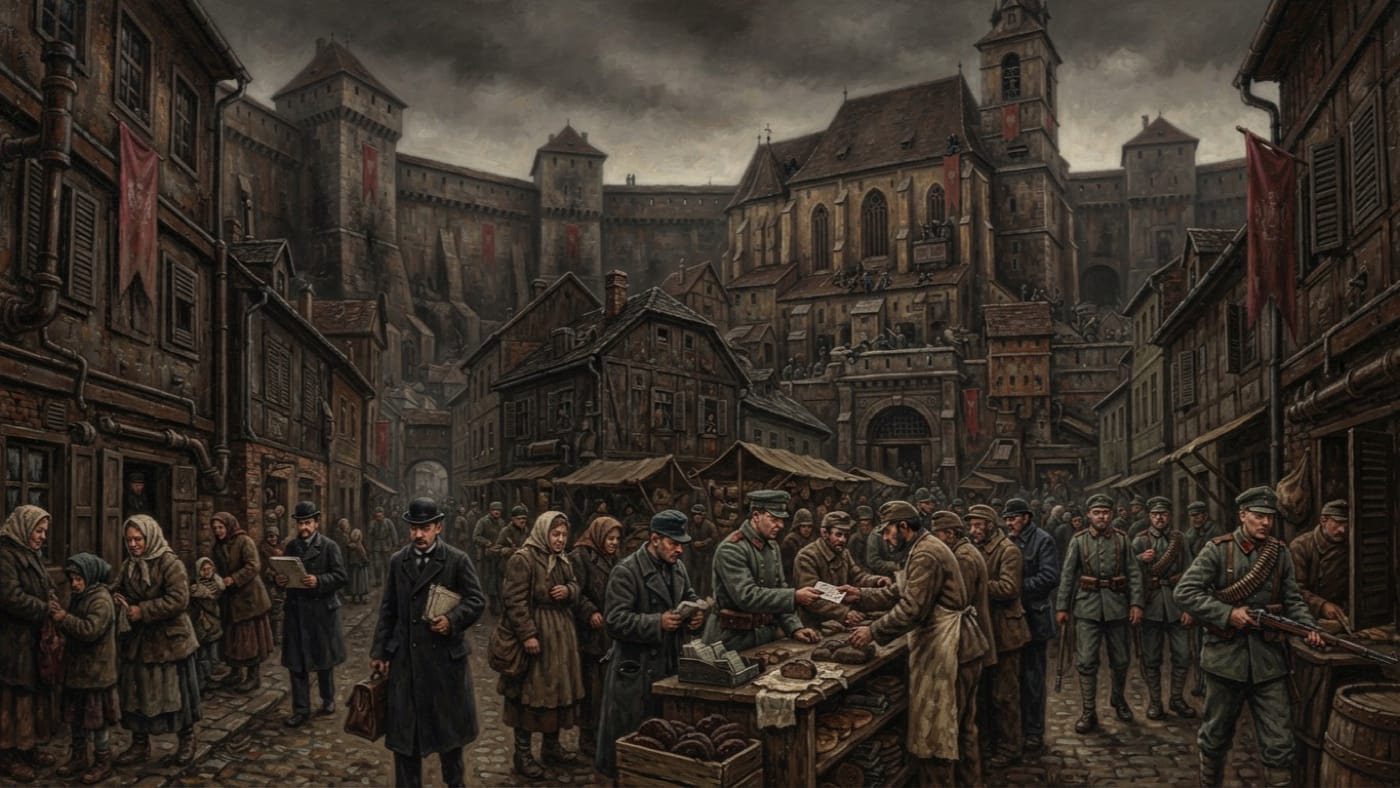
Hermannstadt trades in the Market Ring: ration distribution, boot and harness repair, canteens and sutler stalls. The Weighhouse stands among them, a long stone building that now houses the Convoy Escort Corps. Every shipment arriving on the routes from Budapest, from Przemyśl and from the Danube crossings near Irongate is logged, counted and argued over there. By the Escort Corps' own reckoning, a convoy may stand four to eleven hours under inspection. The bread waits with it.
Crown scrip was introduced in A.S. 130 / 1840 CE to keep demonic coin out of the ration economy. In A.S. 181 / 1891 CE a Tithes audit found notes in circulation whose serial numbers matched no issue in the master ledger. The paper and ink were perfect, and the serials came from nowhere. Since then every note has been suspect in principle and accepted in practice, because the verification window has a queue and the stall has bread.
Take a soldier buying a loaf. He holds a voucher. The stall-keeper holds a loaf, a price and no instrument for proving the voucher genuine. Behind the soldier stand eleven men who also want bread, and the window is two rings away. He does not carry his note to the window. Neither would I.
Hunger beyond the walls feeds the same ledger. In the highland villages, cells of the Ten Thousand Keys lend to farmers whose harvests have failed, and harvests fail readily where the Blightbearers of Kargath have carried his famine through the valleys. Velmora's lenders did not make that hunger. They arrive after it with reasonable terms, prompt funds and a brass key taken as collateral. The relief is real, and the obligations compound. Some of what is borrowed in the highlands is spent in the Market Ring, on bread, from stall-keepers who have their own debts.
The Codex will not call every lender a cultist, every prosperous trader an agent or every hungry borrower damned. Prosperity proves nothing, and poverty is no armour against the Covetous Serpent. Her people look like successful merchants because she makes successful merchants of them, and the Assay Chamber has no reagent for gratitude.
#On the Present Condition
"We are solvent, Hieromnemon. The question is: in whose currency?" — Garrison Commander's dispatch, A.S. 201
By every measure the Bureau of War uses, the fortress holds. I do not stretch that boast back across every century of Hermannstadt's life. A city this old had masters before the Church, and the archive does not list them all. The three streets remain. The registers remain in dialect. The magazines remain full, and the people who fill them remain inconvenient. The garrison relies on the parish for powder, on the market for bread, on the Weighhouse for arithmetic, and on all three for a civilian population that has not yet decided to leave.
Since A.S. 178 / 1888 CE, the year the Bureau of Engineering confirmed gold-veins beneath the foundations, the walls of the Citadel Ring have at intervals wept a thin film of gold. The Assay Chamber finds it warm and pure and detects no Velmoran taint. Doctrine has offered explanations and withdrawn them in favour of silence. The soldiers suspect a connection to Velmora's extraction beneath the range, and nobody has proved them right or wrong. In a market that already doubts its paper, gold that tests clean and is trusted less for it does the citizens' confidence no good.
The parish keeps its rolls. The garrison keeps its walls. The Tithes ledger keeps whatever it is given and asks where it came from later, when the queue is shorter.