
#On the Proposition
"The relics work on their own.": the proposition entire, as entered in the catalogue of prohibited thoughts
The Heresy of the Unnecessary Creator is the smallest of the four heresies of the Question. It is also the only one that keeps me at my desk past Compline. Its proponents grant everything the faithful have seen. They grant the glow. They grant the bell that rings with no hand upon the rope, the consecrated ground the Adversary's columns will not cross, and the reliquary that blazes. They accept every line in the Bureau of Rites' register of phenomena, and then they strike through a single column of it, the one headed Source.
As I set it down in my entry on the Creator, the heresy holds that the power was always in the bone, the bell, the consecrated stone, and that the Creator is an explanation the Church applied afterward to effects requiring no divine source.
A Rationalist denies the miracle and is refuted by any sergeant who has held a trench under a bell that rang itself. An unbeliever denies the Creator and has a furnace reserved for that purpose. The Unnecessary heretic keeps the miracle and leaves the Creator unrefuted. Such heretics ask only whether He is required. A glowing bone cannot answer that question, and a glowing bone is the only argument most of my colleagues have.
My office obliges me to catalogue what I condemn. This is a contemporary survey, compiled at Strasbourg in A.S. 201. I compile it with gloves on.
#On the Bone, the Bell, and the Stone
The phenomena are real. I insist on this point, because the heresy depends on it and so does my salary.
Relics glow. They do it under examination lamps, in trench reliquaries and in the vault beneath the Basilica, where I have watched them do it. Bells sound without ringers. Consecrated stone holds where unconsecrated stone gives way. At the Siege of Vienna the reliquary of Saint Aldebrand answered the Creator and broke a sorcerer-lord before fourteen thousand witnesses. The Bureau of War notarized the event and the ash. Clemens Stahlhand, who carried the reliquary, swore under seal that "it was not I who struck." Doctrine files that sentence as holy humility. The Unnecessary heretic files it as plain description. The same quotation marks hold both readings, and I cannot evict either one.
At the Siege of Vienna the reliquary of Saint Aldebrand answered the Creator and broke a sorcerer-lord.
Corrected. The reliquary blazed, and the sorcerer-lord was broken, before witnesses. The Bureau of Doctrine attributes the blaze to the Creator. Fourteen thousand men saw the blaze and none of them saw the attribution. The Hieromnemon regrets filing an interpretation in the column reserved for an observation, which is the precise error this entry exists to condemn.
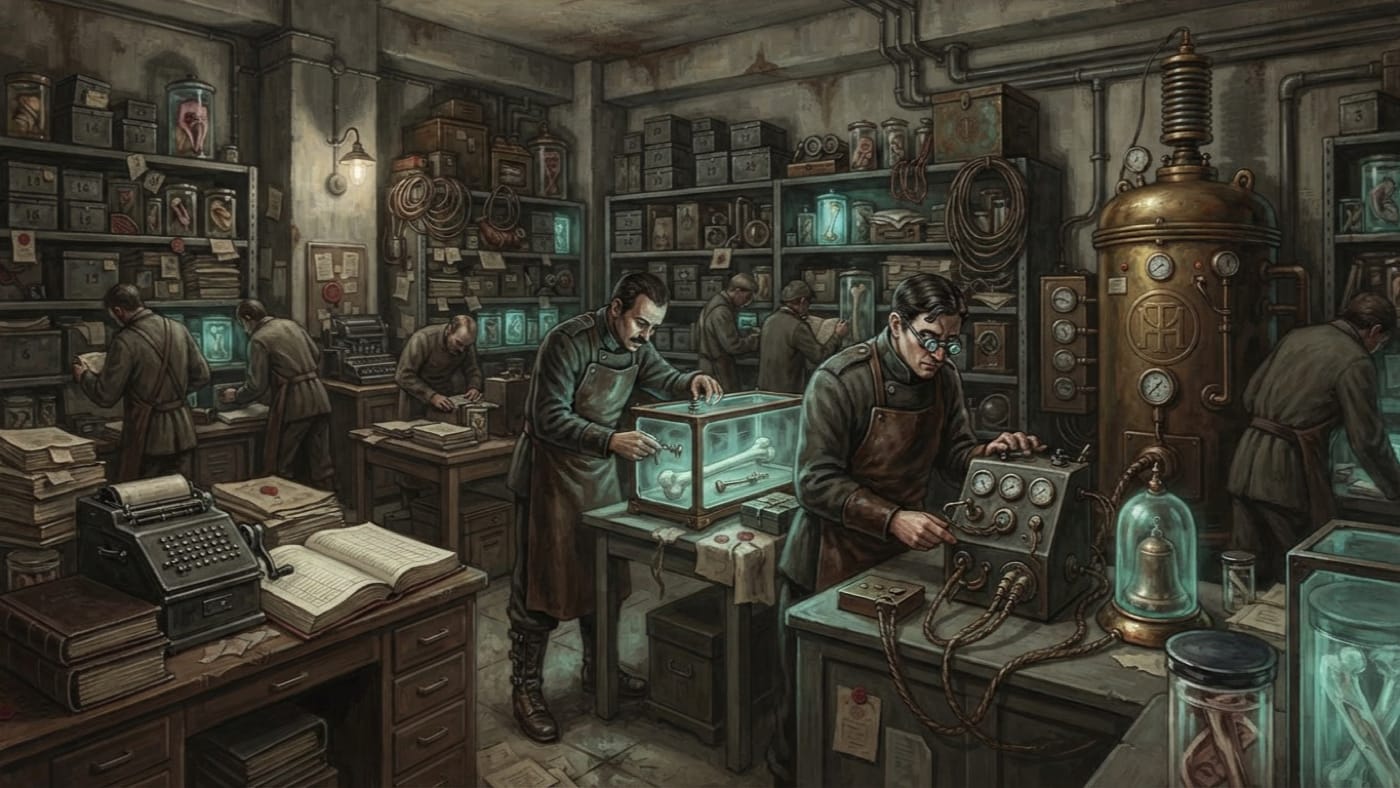
Look at how the Church actually examines a relic. A Relic Authenticator takes the object into quarantine, rebuilds its chain of custody, weighs it and measures it, and then tests whether it responds. The tests are the lamp, the tincture, exposure to bell-hum and proximity to a ward. If the bone answers, the ledger says so. The ledger does not say what answered, or through what. A Sanctity Writ is a custody document. It tells you where the bone has been and who has held it, and it says nothing about where the power comes from. The Authenticators are practical people with families on the ration lists, and they prefer to keep that silence.
The same holds on the Line. A Litany-Engineer tunes a bell to its pitch and recites the sanctioned cant over the tuning. I have never asked one which of the two does the work. The answer would be either insolent or interesting, and I can afford neither.
One fact troubles the heretic as much as it troubles anyone: whatever the bone holds, it does not give it away for free. A miracle is paid for in hunger, in lost names, in years taken off a choir's lives, and in the slow grey arrears the Bureau of Rites calls devotional debt. If the power sits in the material, it is a power that charges for its use. No proponent has demonstrated a relic working on its own terms. The archive contains no successful experiment, and I have looked for one with more diligence than a loyal man ought to admit.
#On the Necessary Distinctions
Purity's clerks lump the four heresies together, the way a hangman lumps together necks. I will separate them.
The Heresy of the Absent Creator keeps the divine source and kills it. It says the relics run on residual holiness, the twitch of a dead heart, after a death at or before the Sundering. The Heresy of the Sleeping Creator keeps the source alive and unconscious, and it fears the bells may wake Him. The Heresy of the Complicit Creator makes the Creator and the Great Deceiver one entity, or two faces of one, and I am instructed to state that I have never met it.
Each of those three is a heresy about the Creator. The Unnecessary proposition is a heresy about bone. It has no use for a corpse, a sleeper or a conspiracy. It needs no claim about where the Creator is, or what He is doing, or whether He is. A heretic of this school may kneel at Vespers with every sign of sincerity. The proposition does not forbid a Creator. It simply declines to employ Him.
The Absent heretic mourns. The Sleeping heretic whispers. The Unnecessary heretic takes inventory.
#On the Bureau's Answer
The Bureau of Doctrine has answers, and I wrote several of them.
Miracles are gifts of the Creator, given to the faithful at a cost the faithful bear. Sorcery is theft from the Great Deceiver, paid for by the world. The catechism draws the line by source, and the Lore of the Dialectic draws it by who pays the bill. I teach both, on alternate weekdays. The Creator withdrew His voice when the Rationalists smashed the means by which it reached us: this is the Doctrine of Divine Withdrawal, set down at the Second Doctrinal Congress of A.S. 72, eighteen years before there was any Synod to ratify anything. His voice continues in a register we cannot hear: the Inaudible Voice, from the Fourth Doctrinal Congress of A.S. 104. He will act fully when faith is perfect, which it will never be. Beneath all of this lies the First Catechism's foundation stone: the Creator is.
These are fine answers. I have defended them before cadets, prelates and one drunk artillery colonel. Every one of them answers the question by what right. They say who may ring the bell, who may certify the bone, and in whose name the glow is filed. The Bureau of Rites holds jurisdiction over every miraculous phenomenon under Standing Order 44-A, and jurisdiction is a magnificent thing. It settles who owns a phenomenon. It cannot settle what the phenomenon is.
The heretic asks by what means, and the catechism has nothing in that drawer. We stamp the reliquary MIRACLE, CATEGORY ONE, VERIFIED. The stamp verifies that the event happened and that the Church has claimed it. Anyone looking for the Creator's signature on the stamp will find mine.
#On What the Heresy Would Remove
This heresy threatens no bell. That is what makes it dangerous.
Under the proposition the equipment stays necessary. The Sagittal Line still needs its bells tuned, its reliquaries sealed, its ground consecrated and its choirs fasting. The garrisons need the bell to ring and have never filed a request about why it rings. An army that fights with bone would go on fighting with bone. Nobody would melt down a single carillon.
What would become disputable is the mandate. The Church claims to hold the relics on the Creator's behalf. That claim turns custody into stewardship, the tithe into an offering and obedience into a virtue. Take the Creator out of the explanation and the custody remains, held on the Church's own behalf, and custody held on one's own behalf has a vulgar name: property. Confession would become a compliance interview. The tithe would become a levy. A Hierarch would become a quartermaster with a very large hat.
The heretics believe this would end the tithe. They have never met a tax office. Strasbourg could collect arrears from a corpse and stamp the receipt. Coercion does not need a theology. It only needs a ledger and men to carry it. What the heresy threatens is subtler and worse. Consent might start to look optional, and obedience might start to look like what it costs.
Then there is the matter of my own employment. A Hieromnemon is a man paid to explain why holy things work. If they work without the explanation, the Bureau keeps the bone and has no further use for the man explaining it.
#On the Present Prohibition
The proposition's defenders protest that it says nothing about the divine nature, only about bone. The Bureau of Purity rightly rejects that defence. A claim about what the Creator is not needed for is a claim about the Creator. It falls inside 7-A with the other three. Purity keeps its own ledger of degrees and sentences, and this entry does not trespass on that ledger.
The Bureau of Doctrine fears this heresy most because no instrument it owns can reach it. Torture extracts confessions, and a confession settles nothing about bone. Theology produces answers about authority, and the heretic did not ask about authority. Doctrine's fear is my judgement, not a measurement. I have never found a reason to revise it.
I have read the proposition, recorded it and condemned it. The bone in the Basilica vault still glows at night, and nobody can say by whose leave. I have no remedy for that, and I am not paid to have one. My task is to keep the relic in its column, the Creator in His, and my seal on both.