
#On the Error of Scale
During the second hour of the Nine-Hour Rubric, three forward batteries at Bastion-Przemyśl failed to engage a Sun Spear detachment advancing inside their arcs. The guns were loaded. The crews were sober, which at Przemyśl deserves its own citation. The spotters were awake and reporting diligently. They reported the height of the Spire-Crusher, then reported it again, and kept reporting it while the detachment's range shortened, unrecorded, beneath every sentence.
The Height-Fixation Advisory exists to correct that error. A spotter who measures the enemy's tallest object has done half a duty. A spotter who measures nothing else has adopted the enemy's arithmetic, in which the only figure worth recording is the one that makes you small.
Atheron understands this better than our training schools do. His engines are built to be compared against, and the comparison does the fighting.
#On the Evidence at Przemyśl
The facts are few, and all of them were measured. In the autumn campaign of A.S. 195, which the laity count as 1905, the Spire-Crusher was first confirmed opposite Przemyśl's eastern salient on the Sagittal Line. At first sighting it stood three hundred and forty feet. When it reached the outer wire of the Wire Orchard it stood nine hundred, and it was still growing. Concentrated fire at the narrowing of its forward pier broke it after nine hours of bombardment. It folded into forty feet of rubble. The garrison went on looking at the sky for three days.
The Bureau of War still disputes earlier field reports of walking towers in the Carpathian ranges. I note those reports and decline to promote them.
The Advisory is cited by name in the countermeasures that followed the Rubric. No folio I have been permitted to read records who first issued it, which office issued it, or on what day. I have searched. I am a Hieromnemon, and searching is the only exercise I take. Like many sound regulations, the Advisory is known by its use and by the slaps that go with it.
#On the Report and the Gaze
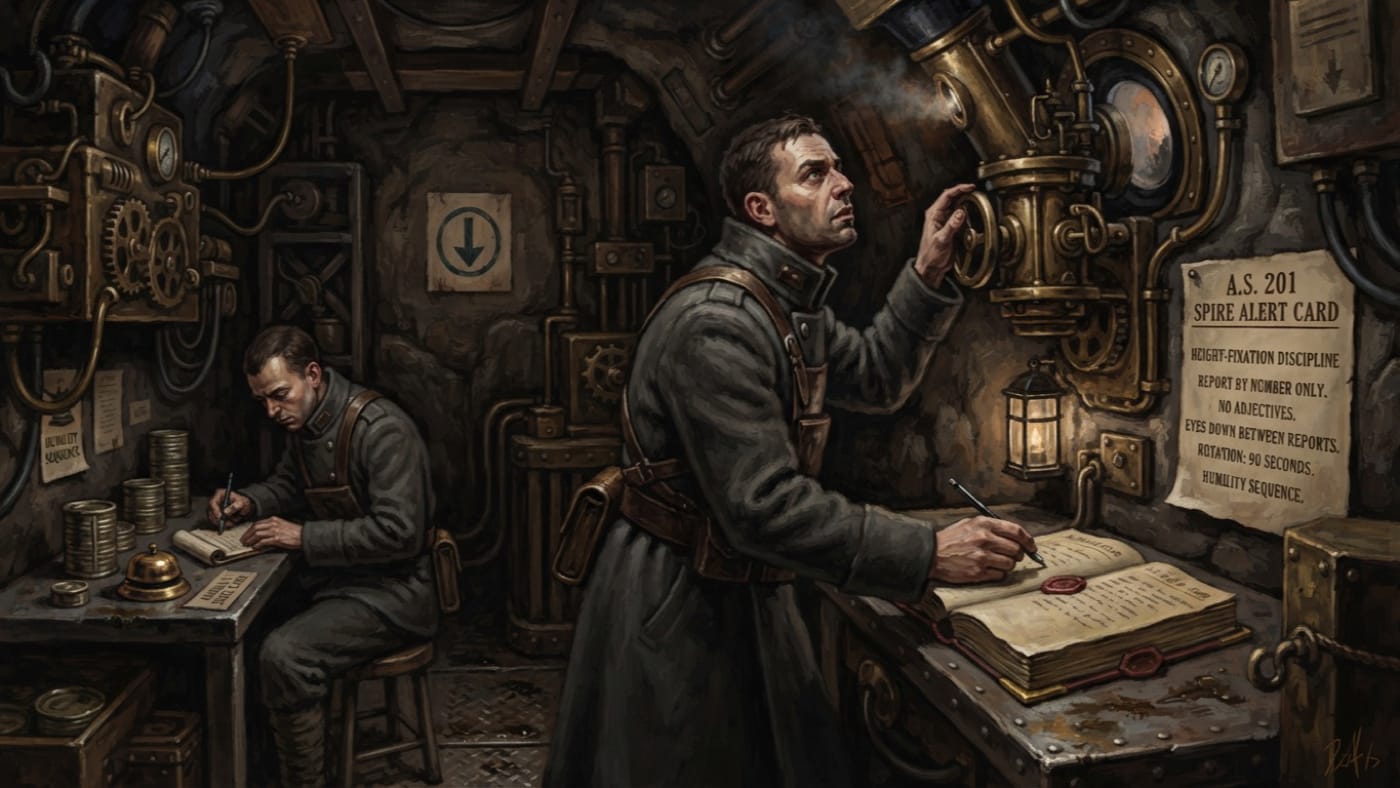
The operative rule is short enough for frightened men to obey, which is the highest compliment I can pay a regulation. Observation crews work in rotations of ninety seconds. Measurements are reported by number only. No descriptive adjective is permitted in the report.
"Five hundred feet" is a report. "Majestic" is a confession. So are "impossible," "beautiful" and "terrible." So is the especially wretched "larger than our walls," which contains no number and an entire theology of defeat.
Young officers are surprised to find terrible on the list, because they assume the Advisory exists to stop admiration. It exists to stop description. Horror is also a form of tribute. A man who calls the tower terrible is still telling you how its size makes him feel, and he is still not telling you the range of the Sun Spear file at its feet.
The height must still be measured. Engineering needs the figure, the gunners need it to lay on the narrowing, and Records needs it in triplicate. The Advisory only forbids that measurement from becoming the whole report. After the figure for the tower comes the figure for whatever is moving below it. At the Rubric that meant Crownguard at the front and Sun Spear ranks on the flanks. It also meant Mirror-Lords, at least two of them, working among the thaw pools on the eastern slope, where an upturned face is exactly what a Mirror-Lord hopes to find.
Between reports, eyes go down. The ninety-second rotation keeps any one man from living too long at the glass. I have not found the reasoning for ninety seconds written anywhere. I have found the rule obeyed, which in a fortress is better.
#On Lowering the Mind
A man forbidden to admire the tower aloud will admire it silently unless something cruder keeps him busy. The Advisory governs the report. The garrison's nerve is governed by uglier instruments, which the Bureau of Doctrine tolerates through clenched teeth.
The Humility Sequence bells are struck low and without pause. Ration inventories are recited aloud: tins, biscuit, lamp oil and the eternally disputed sugar. Men whose eyes keep drifting upward are put on mud-work details, because nobody has yet reached transcendence while digging a sump. The enemy is also compared, deliberately and unfairly, to the furniture of a poor kitchen.
At this point some clever cadet raises his hand to say that the kitchen comparison is itself a description. He is right, and he will be on mud-work by noon. The number-only rule governs what passes from the glass to the guns. What passes along the parapet from one frightened mouth to another is separate traffic, and its purpose is to make the enemy small, domestic and faintly stupid. A spotter says, "Six hundred and ten feet." His loader says it looks like a chimney. Both men are doing their duty.
One battery held through the seventh hour of the Rubric by chanting "Big chimney, bad chimney" until the final salvo. Doctrine has approved the chant for emergency use and refused it a place in the hymnal. I agree on both counts. It has no meter worth the name, and it kept the guns firing.
#On Duties Beyond the Crownline
The Advisory is one line of the Spire alert and should be kept distinct from the rest. I have heard sergeants recite the whole card as "the Advisory," which flatters the Advisory and confuses the provost. The surrounding measures share its purpose, but they are separate orders.
Dirty smoke made from ash, kitchen soot and burnt requisitions reduced Sun Spear interference at the Rubric and dulled the reflective galleries that invited men to look up. Polished brass is forbidden on exposed platforms during Spire alerts, because a gunner admiring his own gleam in front of Atheron's host has simply found a smaller tower to worship. Heroic silhouettes are forbidden for the same reason. The guns fire at the narrowing beneath the lowest gallery and keep firing. That is only possible if the men laying them are reading numbers instead of the sky.
This is where the Advisory earns its keep. A crew that reports by number can be given a mark. A crew that reports adjectives can only be given a homily, and homilies make poor ammunition.
An early public bulletin stated that the Spire-Crusher was "reduced to rubble by the unambiguous superiority of Synod artillery."
Withdrawn and corrected under the parent entry. Artillery contributed, and so did bell discipline, wire current, ash smoke, obscene song, accident, stubbornness and the enemy's own structural arrogance. A bulletin that praises its own side's superiority has only turned the glass around.
#On the Three Days After
The tower fell, and the fixation remained. For three days after the Rubric, men stared at the empty place in the sky where nine hundred feet had stood. They flinched when clouds moved. They measured parapets, dugouts and one another against a height that was no longer there, and they found everything short.
One private refused to enter a trench. Being below, he said, had become a confession. He was beaten, treated, confessed and returned to duty, in that order. I record the order because the Line records it, and because I am not certain a gentler order would have returned him faster. He was frightened. He was not a cultist. That distinction matters to the provost, who must decide which of the two he is holding by the collar. It ought to matter to the reader as well, since the reader will one day be frightened too.
Victory brought the second danger. Within a week of the Rubric, three battery captains petitioned for promotion. Two of them used phrases that were later identified in captured Pride-litanies. The third made his petition standing on the rubble and had to be dragged down. When a garrison topples one of Atheron's towers, his lesson to it is simple: you were taller. Confession after victory exists to refuse that lesson.
I note, with the candour my rank permits, that the Synod disciplines Pride through a hierarchy of ranks, stalls, stamps and raised pulpits. The captains were right that promotion exists. They were wrong about what they had done to earn it. The confessors who heard them sat higher than the penitents. Nobody has yet designed a confessional that solves this.
Ordinary confidence remains permitted. A sergeant who knows his guns are good, a gunner who happens to be tall, an officer who leads from the parapet: none of these is Atheron's work. The fault begins when a man reads his own height, or his own victory, as a verdict on who deserves to be obeyed.
#On Discipline and Present Application
The Przemyśl Spire Alert Card was revised in A.S. 201, which is 1911 by the lay reckoning. The revision compresses the Advisory's gaze discipline into the same nine lines as smoke, brass and fire, and the card is now the form in which most of the garrison meets the Advisory. The card's revision is dated. The Advisory's origin is not, and I will not invent a date to tidy the Ledger.
Enforcement is recorded with refreshing economy. Punishment begins with a slap, and under combat conditions it may stay there. I have found no sentencing table, no tribunal for adjectives and no gallows for "majestic." Anyone who claims otherwise is improving the record without a stamp.
Observers facing the Ebon Heights continue to report foundation silhouettes, which the Bureau of War classes as unconfirmed. The card stays posted. The glasses are kept clean and the brass is kept dull.
Observation crews will collect the revised card from the battery clerk before their next rotation. Bring the old card. The clerk counts them.