
#On Perfect Recognition
In the documents of the Church, Heaven is the one authority that never has to ask a man his name. The Ledgers of Self reserve absolute assurance of identity to it. They do so in a single clause at the foot of a page, in the tone a quartermaster uses for stores held at another depot. This article concerns that depot. I have not visited it. No officer of the Church has filed a survey of its grounds, and I decline to be the first.
The authority rests on the Singleton Doctrine. That doctrine holds that every human soul is unique, unrepeatable and indivisible, and that each is known perfectly to the Creator. Doctrine teaches the last clause as firmly as the first three. Perfect knowledge needs no witness and no bone-line. It needs no comparison of signatures taken in cold, in hunger and in fatigue. The Creator does not consult the sealed copy, and the catechism records no occasion on which He has asked to.
The clerk consults nothing else. He has the sealed copy, a lamp, two pens and a man before him who claims to be the man in the book. What the clerk produces is acceptance, dated to the hour and revocable at the next contradiction. Doctrine says Heaven possesses recognition. The two words share a desk in every identity office of the Church, and they are forbidden to marry.
#On the Earthly Copies
Morwen does not argue with the Singleton Doctrine. She forges its evidence. Her creatures return with the right face and the right gait. They have the cough after cold meals, the dead sister's nickname and the yellow dog behind the tannery. They recite the Creed in the correct cadence and weep at the correct name. The Ledger meant to expose them can be altered too: scraped, amended, misfiled, or corrected by a hand that has learned the clerk's hand. A man may answer every question correctly and still be the wrong man. He may also be the right man and stammer.
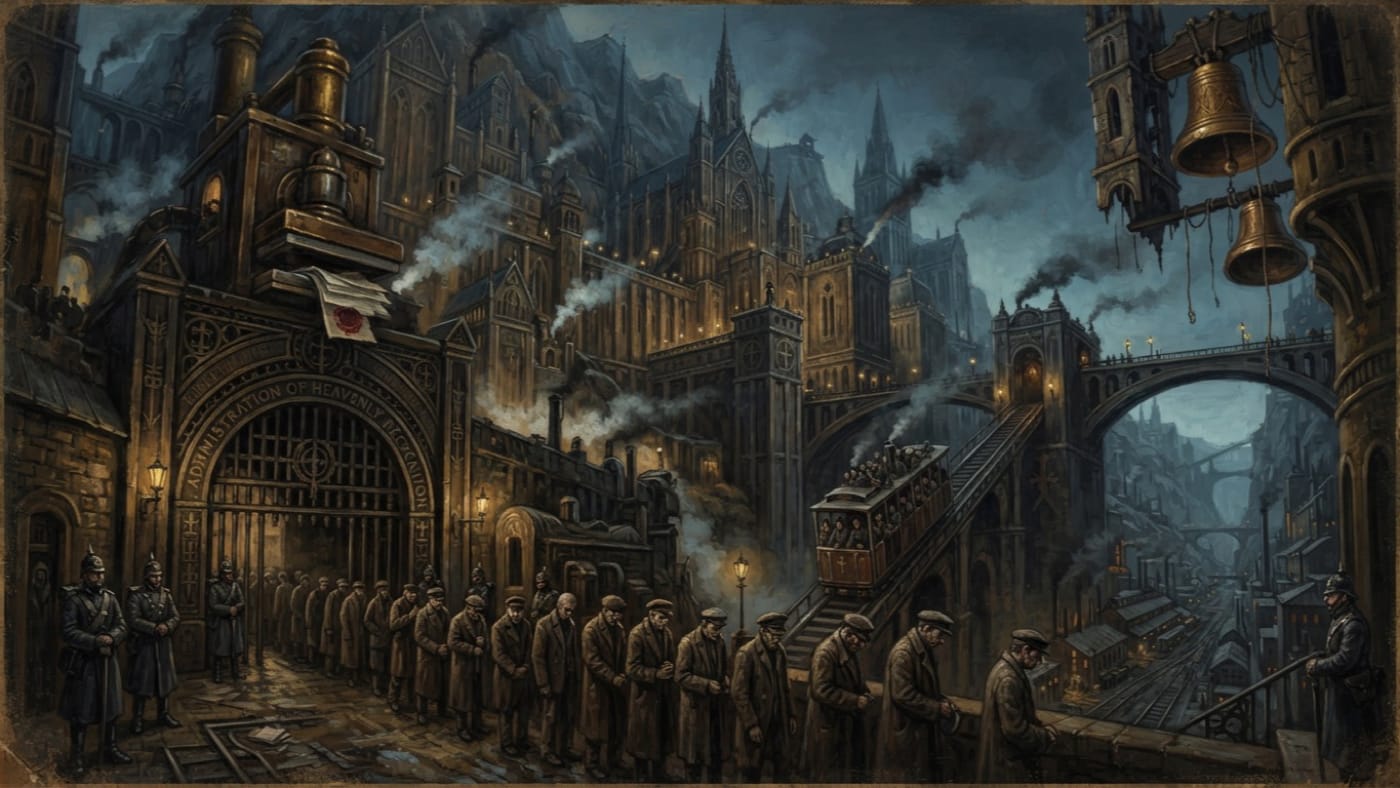
At Bastion-Irongate, above the Danube gorge, this ceased to be a seminar question long ago. When two claimants present as one person, the Hush Court beneath the Transit Spine opens the book between them. If neither can be disproved before the risk becomes intolerable, the Twinning protocol permits the execution of both. Doctrine's formula for this is that both bodies are sent to Heaven's final knowledge, and no false claimant is left inside the walls. I reproduce the formula because I am obliged to. Doctrine certifies its own phrasing. It has never certified a delivery.
Doctrine's position remains that Heaven is not confused by Morwen. Nothing filed from Irongate shows otherwise, and nothing filed there could. The watch commander's difficulty lies elsewhere. He has to issue a rifle before the third bell to one of two identical corporals, and the Creator's perfect knowledge, wherever it is held, has not yet been issued to the armoury.
A.S. 180 guidance stated that Ledger confirmation provided absolute assurance of identity.
Revised A.S. 199, after the Twinning proceedings. Ledger confirmation provides operational assurance for duty assignment, ration allocation and provisional absolution. Absolute assurance is reserved to Heaven. The Warden's remark in the Ledgers article regarding alternate Thursdays is withdrawn at the request of the Bureau of Doctrine, which claims no share of that assurance on any day of the week and lodged its request on a Thursday.
#On Eternal Service
The Church has always been surer of Heaven's welcome than of its address. Death, in the public teaching, is the closing of a long contract: the soul is reclaimed by the Creator it served. At the Rite of Passing, clerks and kin bend over the failing body and whisper the Creed into its ear until the breath stops. The body is then displayed so that the neighbours can bear witness that none departed unshriven. If the passing was proper, bells toll, incense burns and a proclamation is read aloud declaring the dead entered into eternal service.
Popular teaching keeps a darker clause beside the proclamation. It is said that a soul who dies without the Creed on its lips wanders as a hollow husk, denied the embrace of Heaven. Chaplains repeat this. Mothers repeat it more often. I record that it is taught. I hold no register of the husks.
Then comes the ledger. Every death must enter the Book of Departures, and the faithful dread omission as they dread little else. Families do not weep at the grave so much as at the clerk's desk. In the parishes, an unrecorded soul is spoken of as forgotten, uncounted in Heaven's tally. Doctrine permits the phrase and has never ruled on it. The Book is kept by Records beneath cathedral vaults. Its ink runs out, its mules kick over satchels and its clerks mishear names from better provinces. A Heaven whose census depended on that apparatus would be a Heaven at the mercy of Records, and no Congress has ever said so. The faithful say it at every bedside. The Church lets the fear stand, because it keeps the nibs sharp.
The Hospices of Departure put the teaching into practice. A Ward-Sister of Mercy warms a sealed vial between her hands, breaks the wax before witness and pours a bitter black draught into the Departure cup. The choir lowers pitch. The Records Witness watches the chest. The final designation on the intake abstract reads Freed to Heaven. The internal designation, two lines below, reads closed body, ledger pending. Both lines are in the same ink. Only the first goes out to the family.
#On the Unanswered Petition
Heaven is addressed daily. Bells summon the faithful at dawn, the Creed rises from every courtyard, and the forges keep time to litany. Heaven has not replied in any form the Church can transcribe, and the Church holds two binding explanations for its silence.
The first is the Doctrine of Divine Withdrawal, ratified by the Second Doctrinal Congress in A.S. 72. That body sat under the ecclesiastical administration that came before any formal Synod, and the Bureau inherited its ruling later. Withdrawal holds that the Creator withdrew His active presence after the Rationalists smashed the means by which His speech reached mortal ears. Those means were the shrine, the reliquary, the bell and the kneeling congregation. One chronicle puts it more plainly: Reason swore it alone would rule, and Heaven, wearied, withdrew. Return is promised on the condition of Perfect Faith. No date is attached. None has ever been attached.
The second is the Doctrine of the Inaudible Voice, ratified by the Fourth Congress in A.S. 104. It holds that the Creator still speaks, in a register beyond mortal hearing, and that the failure lies with the hearer. One ruling describes a bell whose rope was cut. The other describes a bell ringing at full voice over a deaf parish. Both are taught and both bind. No Congress has reconciled them, and I will not convene one in a footnote.
The silence has leaks. Relics still glow. Bells still sound now and then with no hand on the rope, and consecrated ground still burns the creatures of the Great Deceiver. The Bureau of Rites certifies such events as gifts of the Creator, and that certification is the Church's position. The Bureau has also admitted, in more than one hand including mine, that it has no independent means of establishing their source. A certified miracle states that something happened and which office owns the file. It does not describe where the effect came from, and it does not countersign every promise later made in its name.
Schoolchildren recite that the Synod is Heaven's quill upon earth. A quill does not know the mind of the hand holding it. The internal memoranda are more candid. A Records minute, which I have read twice to be sure, states that the Bureau believes what is needed.
#On Present Administration
As of A.S. 201, four offices administer Heaven's claims and none of them has been there. Doctrine interprets: it decides what may be said of Heaven's knowledge, its welcome and its silence, and what may not. Records keeps the particulars: the bone-lines, the death lines and the corrected margins, which Heaven by Doctrine's own teaching has no need of. Purity polices belief. It watches above all for private descriptions of Heaven's interior, its gates, its ranks and its seating, all of which it classes as unlicensed revelation. Mercy administers the dying body up to the moment the proclamation is read.
Each office stamps its papers with heavenly authority. The stamp shows that Strasbourg claims the authorisation. It does not show that Heaven keeps bureaus, honours seals, or files anything at all. I have signed enough of these papers to know the difference, and I sign them anyway, because the faithful need a signature on this side.
At Irongate, a confirmed soldier leaves the Hush Court with a chit reading IDENTITY ACCEPTED AS OF HOUR AND DATE. He folds it into his breast pocket beside his field prayer tin. On the tin's inner lid, stamped in small capitals, is the Inaudible Voice's public line: He speaks where obedience learns to hear. The chit says that the Synod accepts him until the next contradiction. The tin says that the Creator knows him and has not said so aloud. He carries both to the firestep, because he has nothing else to carry.