
#On the Hall's Place at Gate Nine
"Witnesses don't remember — witnesses invoice." — Queue Road proverb
The Gate Nine Hearing Hall is the appeals room of the Queue Road. It is the one place on that long Heartlands artery where a waiting man may argue with his wait. It stands at Gate Nine, the road's largest court and its reclassification hub. The road's own people describe the place with their usual thrift: whoever controls Gate Nine controls prosperity.
Four things share the name. The clerks confuse them whenever confusion pays, and the reader should not. Gate Nine is the gate complex, both the choke and the hub. Gate Nine Court is the tribunal clique that works there. The Hearing Hall is that tribunal's appeals venue. Gate Nine Commons is the neighbouring district of day labour and recruiting. It smells of chalk and bodies, and as a recruiting ground beside a reclassification hub it has never lacked for recruits.
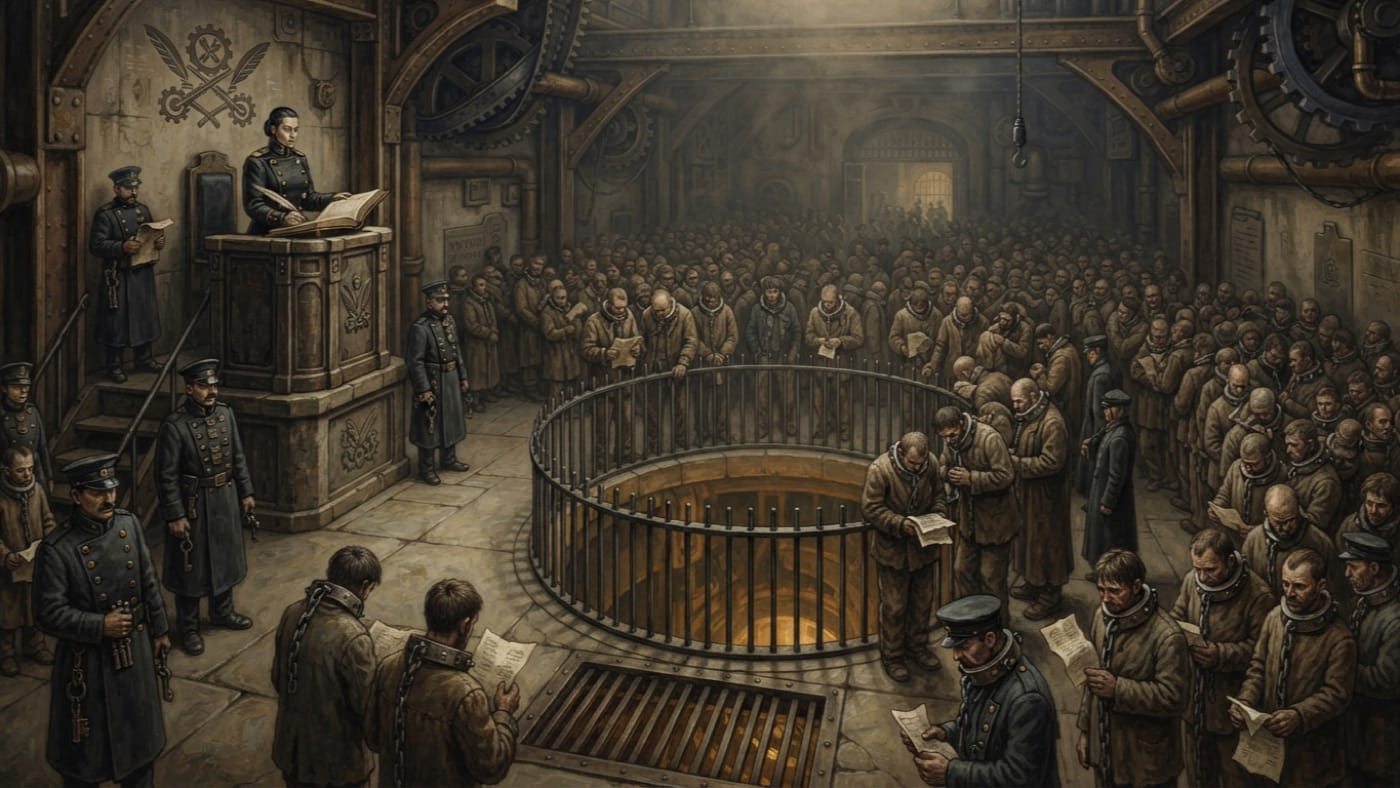
The Hall smells of hot wax and sweat, which are its incense and its offertory. Damp paper changes hands. Stamps click. The bell-mark clang carries in from the lanes, under the low murmur of people who know that laughing during an appeal hearing is taboo and find the rule unnecessary. At the centre is the witness ring. Around it, in numbers no ledger shown to me bothers to record, men and women are collared.
I cannot say who raised the Hall, or when, from anything I am permitted to cite. It was standing by A.S. 178. That is the earliest date the archive will give me, and it gives that date for another reason entirely.
#On Petitions and Minute Accounts
On the Queue Road a man's life is a minute account. Waiting earns recorded credit. The bell-mark stamps it, and the Time Clerks' Collegium enters it in ink-grey cuffs. That credit can be traded, sold upward, laundered and spent. Debt is a separate creature. It comes through penalties, fees and the clerks' talent for finding what a traveller owes, and once it comes it compounds. Unpaid minute debt becomes labour conscription at Gate Nine or erasure into the Null Verge. The first has a name: Queue Service Assignment. The second has none, and that is deliberate.
Appeals reach the Hall from that border. A man is reclassified into conscription. A lane reclass is refused. A credit is flagged stale for audit. A Throughput Assignment names the wrong man, or the right man for the wrong reason. Appeals surge at midday, and the Hall takes the surge as a font takes rain: it does not drain, it only fills. For the people of the road, a first solo appeal is a rite of passage, much like a first communion with worse catering.
The petitioner brings paper. The road deals in Minute Permits, Bell-Mark Slips, Lane Reclass Tokens, Appeal Dockets, Witness Certificates and Throughput Assignments. The Hall honours each of them exactly as far as a clerk is willing to read it. In practice, recognition is the first court of Gate Nine. A docket the clerk will not see does not exist. A bell-mark he chooses to misread was always wrong. The bench hears what the counter has agreed to pass. Petitioners keep their eyes down and their palms open, and they answer briefly, because the road teaches that every extra word is a minute someone else will bill.
Confession is the other tender. The road lists it openly among the currencies of appeal, beside minutes, coin and labour-hours. Confession booths stand beside the courts, and each admission is indexed by timestamp. What a petitioner said at the second bell can be laid beside what she said at the fifth, and the difference sold back to her.
#On the Bench, the Ring, and the Collars
Mistress-Court Sera Nox controls appeal approvals for the Gate Courts. The road knows her by perfume and iron, in that order of arrival. She fears erasure stamps, which means she understands them. Bailiff Dorn wears oath collars the way other men wear rings, and the Court's bailiffs keep the collar keys, the cells and the stamp room. Director Othmar Vell of the Permit Directorate sets the minute price bands that decide how much debt a petitioner carried through the door. Clerk-Prime Yoren's Collegium keeps the ledgers and the bell-mark machines that produced the figures in dispute.
These four offices press on the Hall from different sides. I have seen no instrument that ranks them into a chain of command, and I would distrust one that claimed to.
In public, the Court exists to give fair appeals. In practice it works through hearings, void marks and mercy rulings, and what it harvests is confessions and favours. A mercy ruling is mercy in the sense that a toll is a gift. It is granted, and then it is entered.
The witness ring is where the Hall's trade shows itself. The Witness Rental Houses of Stamp Court Row are a cartel under Mother Venn and Garrik Two-Names. They supply believable locals and coached statements, and when the occasion requires it, whole perjury rings. The courts use "witness rent" as an ordinary term. The Appeal Whisperers draft confessions that sound holy, so a petitioner can stand in the ring and admit to something cleaner than what he did, or to something he never did, in words a bench can approve without blushing. Public confession at Gate Nine is one of the road's sanctioned rituals. Few rituals are so well attended or so well rehearsed.
The road's defence doctrine runs funnel, isolate, collar, and the Hall performs the third verb in bulk. Behind the collar comes what unpaid debt buys: hauling barricades, cleaning latrines, copying ledgers until the fingers bleed. Further behind lies the Null Verge, where the erased go on breathing without a name.
Waiting purifies intent.
Withdrawn from this entry. The waiting public at Gate Nine is reliably purified of coin, credit, confession and, once the Hall is finished with them, name. No one has audited intent. The phrase stays on fence notices until someone drafts a replacement of equal brevity and smaller liability.
#On the Chamber Below
In A.S. 178 the Bureau of Engineering went looking for the source of sub-grade vibrations that were spoiling the calibration of the stamp presses. It found the Apparatus: a turning wheel in a hexagonal chamber of dressed stone, forty-two feet beneath the Hearing Hall. The published account of the Minute Drift holds that the chamber is older than the Permit Directorate and probably older than the road. I repeat that claim with its owner's name attached. It dates the chamber's discovery. It tells us nothing about the Hall except that the Hall was already there, standing on top of it.
Report Two reached the archive in A.S. 194, six days before the Bureau of Rites classified the Drift as a Category Two Localized Temporal-Scribal Disturbance. The Bureau of the Hourglass prefers Class II-Extractive, sub-designation Alpha. Report Three, in A.S. 199, recorded an eleven-percent rise in throughput after a spring rate adjustment and recommended continued non-disclosure pending completion of Phase Nine. Its fourth sentence is withheld.
REPORT THREE — A.S. 199 — SENTENCE FOUR ████████████████████████████████████████████ ████████████████████████ Status: withheld. No text recovered.
I do not know what Phase Nine is. I do not know what the wheel produces, who tends it, or where its product goes. The Codex will not dress my ignorance up as revelation.
The Hourglass offers the least foolish account available: the Apparatus grinds waiting. A road built never to clear yields spare hours, and those hours are taken from the people standing in it. The Hourglass draws a careful line between this and Syrion. Syrion slows time; the Apparatus extracts it. Nothing in the record places Syrion's stillness inside the Hall, and I will not import it for atmosphere.
The record's silences matter as well. It does not say that Nox knows what lies under her bench, or that Dorn, Vell or the Collegium knows. It does not say that any of them commands the wheel. It does not say that any particular docket heard upstairs feeds the wheel downstairs. Petitioners stand in wax heat and sweat for hours, forty-two feet above a mechanism the Hourglass says eats hours. I state the distance. I do not state the arithmetic.
#On the Closure
In the spring of A.S. 200, minute pricing doubled without a public decree. This is a different event from the A.S. 199 adjustment that Report Three measured; the road is prone to springs. After the doubling, the Drift widened at Gate Two Bridge Pinch, the Bell-Mark Gantry and the Shed Wards. That autumn Gate Nine closed for sanitation, and bodies piled up in the Barricade Maze faster than the Null Verge carts could take them away.
The Hall depends on the gate as a pulpit depends on its nave. A shut gate cannot reclassify. A hub that cannot reclassify leaves the conscript, the debtor and the holder of stale credit standing where they are. The road has a proverb for it: "When Gate Nine yawns, the road starves." The road's siege doctrine says the same thing more bluntly. A siege here does not need an army. A shut gate is enough.
The record I hold notes the closure. It does not say who ordered it, how long it lasted, or how many of the dead in the Maze had business pending in the Hall. I will not hand the order to Mistress-Court Nox for the pleasure of having a villain, and I will not count the Hall's share of the dead to give a paragraph a number. The bodies were in the Maze, and that is where the record left them.
#On the Unsettled Account
In A.S. 201 the Drift is still widening along the road, and revenue continues uninterrupted. The Rites classification stands. The status is Amber. The Gate Nine inquiry is pending. The published account of the Drift records that three subpoenaed clerks vanished between summons and hearing. It does not say which hall would have heard them, and I will not say it on the account's behalf.
I can cite no inspection of the Hearing Hall. I certify its floor neither sound nor unsound. Petitioners still stand in the witness ring, the wax is still hot, and the Commons waits next door with its chalk. Forty-two feet down, on the word of Engineering and the Hourglass, the wheel turns. The Bureau of Doctrine has asked for a closing sentence. It will get a stamp.