
#On the Origin of the Book
"The ship is in the book. The bread is in the ship. Do not ask the book for bread." — Hieromnemon Valerius Drax, marginal instruction to a port-court training copy
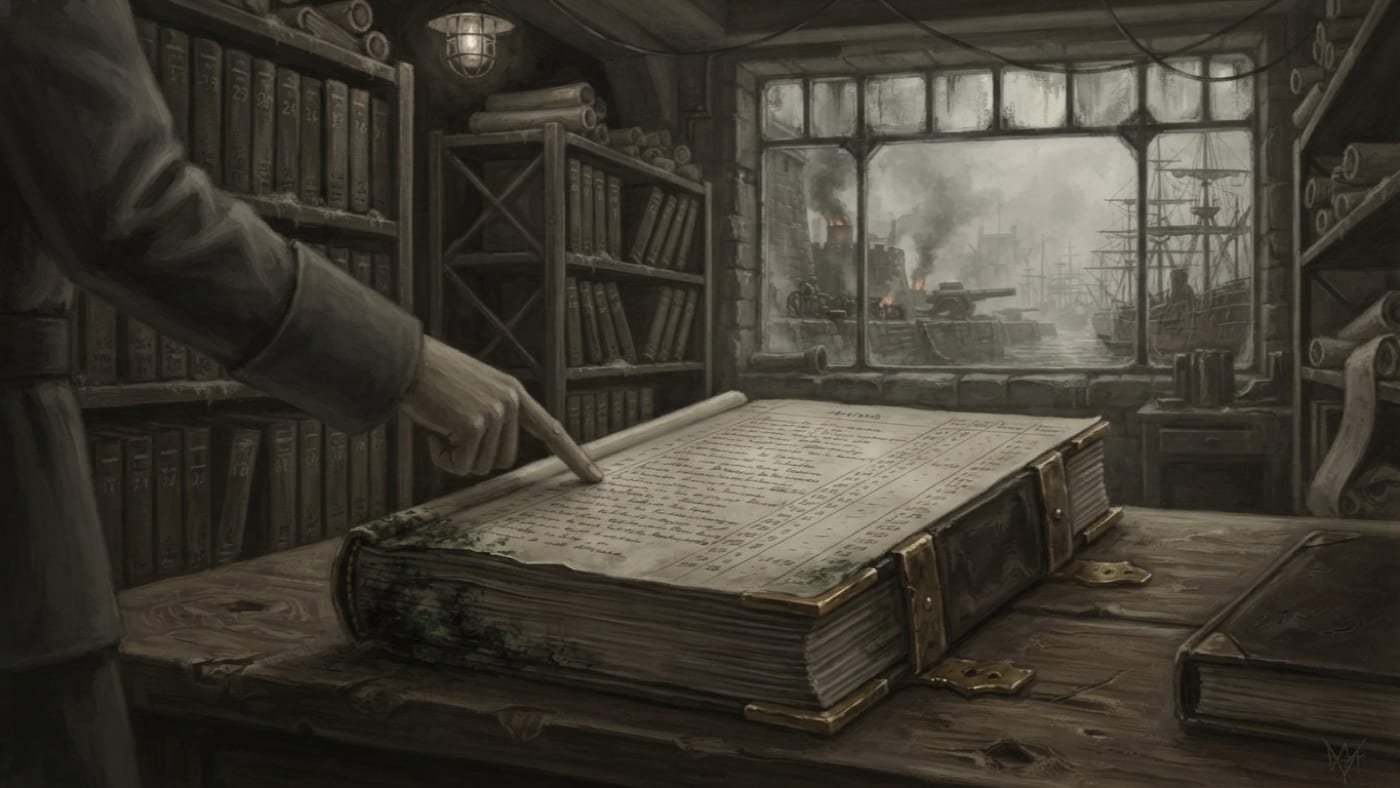
Of the three books that make up the Ledgers of Varna, the Harbour Ledger is the plainest, and it is the one I would steal first. It was kept in A.S. 129 at the Ashen Redoubt of Varna. The Redoubt is a cliff fortress on the western Black Sea coast, where bone-kilns smoke above a tariff harbour and the coastal guns watch water the Synod has never trusted.
Varna is a forward coastal installation and not one of the seven principal bastions. The Sagittal Line runs north to south behind it and ends at Bastion-Constantinople. The sea forms the eastern flank, and nobody has ever garrisoned it quite enough. Grain that reaches Varna has usually come a long way to be argued over.
The lower corner of the book is stained with mould. Every student who handles a training copy mentions the stain first, as though it were an entry. Of all the marks on those pages, it is the only one nobody ordered.
The book's function is narrow. It lists arrivals, berth assignments, inspection times and the first count of ships. Rates, exemptions, claims and the dead were entered elsewhere, by offices with cleaner hands or better locks. The Codex holds no record of who wrote in the Harbour Ledger, how many leaves it runs to, what its boards are made of, or which office keeps the original today. I have asked. My request was entered, timed and acknowledged, which is more than the wheat received.
#On What an Arrival Proves
A ship entered in the Harbour Ledger has arrived. That is all the entry accomplishes, and in a port court it is worth a great deal.
Every later act depends on that first line. At the tariff-chapel, the Commerce Clerk begins with identity and manifest. Next come witnessed reliquary calibration, then weighing, gross and then net. After that the Clerk computes the tariff, applies the purity mark or the condemnation, issues seal and ticket, and reconciles the ledger for the auditors. There are seven steps, each one sacramental, and none can begin until the harbour has written down that there is something to weigh. The altar stands on this page.
The entry authorises nothing. Release belonged to the port court and clearance to the chapel. A sack could stand entered as present in Varna for nineteen days and be exactly as far from a child's mouth as it had been at sea.
The book establishes presence and time. Presence tells the court that the cargo fell within its jurisdiction. Time tells the court how long the cargo lay there, under whose seal, and while whose motion was pending.
Both sides at Varna drew on those hours. The Clerk used them to show diligence: the inspection had been performed, the hour entered and the scales checked. The Manifest Litigant used the same hours to show that the cargo had stayed under lawful hold for the whole interval. In other words, nobody had touched it improperly while it rotted properly.
#On the Nineteen Days as the Book Kept Them
The fleet came out of the Anatolian and Aegean supply circuit carrying rations meant for three zones. The holds were dry, the sacks sound and the scales calibrated. The Harbour Ledger took the ships in and gave them berths, as it would have given berths to any fleet.
The manifests were less obliging. The colonel named in the transport orders appeared in three spellings. A coastal parish carried a Greek ending in one packet and a Latin one in the next. The grain itself changed category depending on which page one read.
The Bureau of Tithes claimed the cargo as taxable strategic grain. The Bureau of Pilgrimage claimed it as route-sustaining ration, and the Bureau of Settlement claimed emergency civic custody. The Bureau of Commerce claimed procedure. Procedure was the room in which the other three sat, so it could not lose. Two Litigant houses filed Sanctity Stay Orders, and the port court barred release until the manifests were harmonised.
From that hour the Harbour Ledger had nothing new to say about the ships, and it went on saying it. The berths did not change, and the inspection times accumulated. The first days went to copying, countersigning and attestation, the ordinary devotions of delay. By the fourth day, heat had entered the lower holds. On the sixth, dockhands reported a sweet smell. Later arguments used the spoilage as grounds to reclassify the cargo, so the rot became a new question of law in place of an answer to the old one. On the fifteenth day the Bureau of Purity arrived.
The harbour book records none of the smell. Smell was never a harbour category.
#On the Companion Ledgers and the Count
The case requires all three books. The Tariff Ledger is the cleaner one, with columns for rate, exemption, Bureau claim and adverse condition. In it the grain was worth something, and its ruin was entered as a condition of that worth.
The Riot Ledger is locked under Purity custody. Its pagination disagrees with its index. Its casualty count rises or falls depending on whether one includes the bodies recovered from the harbour after sunset. Those faults belong to the Riot Ledger alone. The Harbour Ledger shares none of them and would thank you not to lend it any.
If the questions are divided, each book answers its own with perfect competence. Was the cargo here? Yes: berthed, inspected and timed. What was it worth, and to whom? See the columns. Who died near it? Apply to Purity. No book records a decision to let the grain lie. That decision was spread across so many desks that nobody ever had to write it down in one place.
The Harbour Ledger also keeps the first count of ships, and on this point the case quarrels with itself.
This office's earlier lecture notes reconciled the Varna fleet counts by blaming the difference on an error in the Harbour Ledger.
Withdrawn. The instructional version of the case gives sixty-three vessels, and the correction gives sixty-one. The Codex enters no reconciliation of the two figures. It identifies no vessel, berth or officer responsible for the difference. Both counts stand, each with its qualification. Students who supply an explanation will be commended for initiative and failed for it.
#On the Present Application
Port-court training annexes keep Varna copies, and the Harbour Ledger is the first book opened. Commerce teaches the case as a velocity failure. Every record was correct and every calculation was correct, but all of it was finished too slowly to save food that anyone could eat. The Harbour Ledger supplies the measure of that slowness. Lay its inspection times beside the reported heat in the lower holds and the lesson needs no lecturer. A Clerk trained on Varna learns that clarity must reach the hatch before the heat does.
The Litigant studies the same pages and grows richer from them. Condemnation closed the cases. The houses that filed the stays received partial payment, because a condemned cargo is a concluded matter and concluded matters pay. Tithes kept its calculations correct. A procedure that ends lawfully keeps its fees and its classifications, whatever became of the wheat. Beneath all of it, the arrival entry remains true.
The case lent professional weight to Saint Vellum of the Narrow Line. His cult already had a following among manifest men before Varna, and afterward it gained a favourite example. The seal-autopsy rights won in the Seal-Forgers' Winter belong to A.S. 145, sixteen years later. Nobody at Varna in 129 held them, and the Harbour Ledger records an older, blunter kind of litigation. The demon glass that later gave Varna its louder reputation had nothing to do with the grain. The grain needed no demon.
The Bureau of Records closed the matter by entering the deprivation as a voluntary holy fast: "Civic abstention from compromised grain, undertaken beneath corrective authority." The Harbour Ledger has no column for that phrase.
In the first draft of this article, the citizens of Varna starved within sight of the berths the Harbour Ledger assigned.
Corrected to approved instructional language. The citizens of Varna undertook civic abstention from compromised grain beneath corrective authority. The berths remain as entered.