
#On the Watch Record
"Forty-seven ships. The Bureau of Records counted them twice, because the Bureau of Records does not trust its own arithmetic, and because the second count was worse than the first." — Drax, annotation to the Harbor Patrol Log, A.S. 201
The Harbor Patrol keeps a log because it keeps nothing else. It holds no warrant and issues no order. Its boats go out through the water-gates beneath the Harbor of Chains and its sailors look at the Bosphorus. They write down what they see by bell-time and hand it up to men with seals. The log is the whole of the Patrol's property. Everything after the ink belongs to another office.
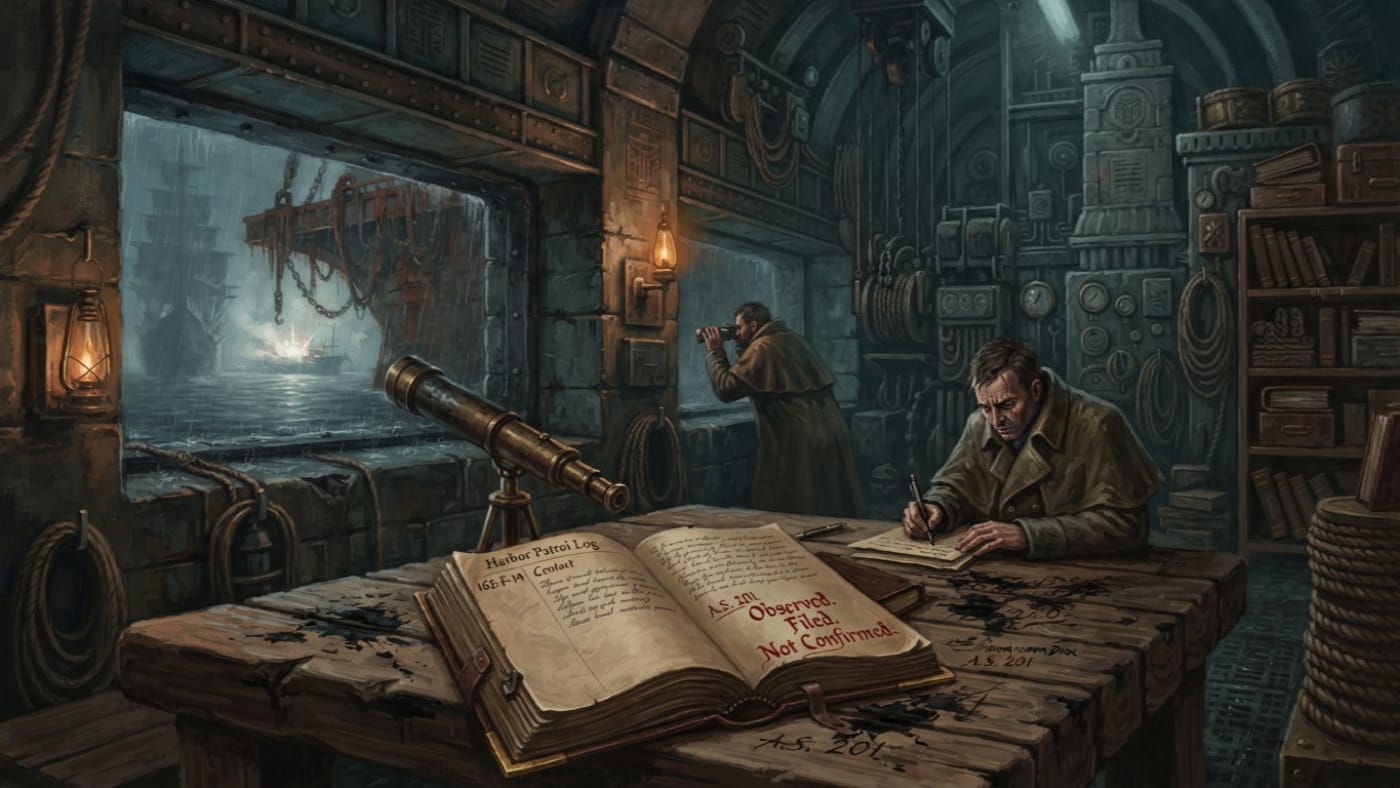
Most of what fills it is dull: lanterns, hulls riding low, fog thickening against the wind. One evening is anything but dull. The entry for the 14th of Ferrum, A.S. 162, filed under the reference 162-F-14, records the approach of the Black Sea Armada upon Bastion-Constantinople. More Bureaus have read it since than any sailor's handwriting has a right to expect.
Three dates attach to it, and they must be kept apart the way a sacristan keeps the oils apart. The entry was written in A.S. 162. In A.S. 165 the Bureau of Records ratified it, retrospectively, as a contact report. I annotated it in A.S. 201, thirty-nine years after the ink dried. The sailor wrote what he saw, Records decided what it was, and I decided what Records had missed. Only the first of us was looking at the water.
#On the Fourteenth of Ferrum
The entry begins, as such entries do, with weather. The water was calm under a half-moon. Fishermen in the outer approaches came in reporting a smell of hot iron on the air. These are men whose trade obliges them to know the sea's temper before it shows it. The Patrol entered the smell as "atmospheric residue, thermal origin," which is how a sailor spells fear when the column has no heading for it. The fishermen went home. The Patrol stayed, since its only home lay under the harbor.
At the seventh bell of evening watch, the observation tower on the Anatolian shore reported sails. The report reached Praefect-Naval Cassius Tern eleven minutes later, which is a long time for sails and a short time for paper. The tower's count, as it has come down to us, was "Number: all of them." I have seen this phrase cited as evidence of panic. I cite it as evidence of accuracy. The tower had no figure to give, but its eyes were working.
Tern ordered the chain raised and the ravelins manned. He sent runners to the Belfry of the Hinge, to the Reliquary Flotilla and to the Cathedral of the Perpetual Registry. None of this was the Patrol's doing, and the Patrol gets no credit for any of it. A sailor who writes "sails" has commanded nothing. He has only made sure that nobody can claim afterward that the sails came unannounced.
The entry ends with one word: "Contact."
The Bureau of Records' graphological division attributes the evening entry of 162-F-14 to three separate hands, the letterforms deteriorating toward the final word.
The division's finding remains in the division's file, and no office has withdrawn it. My own reading, entered in A.S. 201, gives the page to one man whose hand began shaking somewhere between the weather and the word. Records counts authors by the shape of the letters. I count them by the sense of the lines, which run from calm water to Contact without a seam. The recorder's name is not on the page. Neither Records nor I have supplied it, and I will thank the reader not to try.
#On What Was Seen
The Patrol's most quoted observation from that night is a separate page, and it belongs to a telescope.
During the engagement, with the chain burning white across the strait, the forty-third hostile vessel hung against the links. A Patrol telescope operator, with brass to his eye and the glare in it, recorded that one of the crew aboard appeared to be writing.
The page survives. In red ink it carries the standard marginal hand of the Bureau of Doctrine: "Observed. Filed. Not Confirmed." The operator was reassigned to a ground posting the following week.
Each of those is a separate fact, and every reader, clerical or lay, is tempted to stitch them into one sentence. I decline the needle. The operator observed and the Patrol filed. Doctrine declined to confirm, which is an act of classification and says nothing about whether the observation was true. The reassignment happened. No reason is given on the page, in the margin or in any posting order I have been allowed to read. A week is long enough for a man to develop bad lungs, a debt, a quarrel with his bosun or a reputation. I record the sequence. I record no motive, because none was recorded to me.
The entry does not say what the creature was writing. The telescope was a good one, but the distance was too great. In taverns I have heard it supposed that the creature wrote a tally, a hymn, a name, or a list of the men on the quay. I have heard the same taverns suppose that the chain is lit by bottled saints. Taverns may suppose what they like. The Codex may not.
The telescope page must not be confused with 162-F-14. They are distinct observations made at distinct hours. I have not established that they were ever bound in one volume or kept on one shelf. Archivists who find two pages in the same box tend to believe they found them in the same book. Boxes are generous that way.
#On Ratification and Other Ledgers
A watch log records in the present tense. A Bureau ratifies in the past tense, at leisure, with better lamps. In A.S. 165 the Bureau of Records classified 162-F-14 as a Harbor Patrol contact report and ratified it after the fact. That was three years after the contact, by men who already knew how the night had ended.
That knowledge separates the two documents. The sailor at the log-table could not know that the engagement would run seven hours and fourteen minutes, or that the Belfry would ring for the whole of it. He could not know that the chain would burn white for some seven hours and then go cold. Still less could he know the final account: forty-seven hostile vessels, forty-three destroyed, three retreated, one unaccounted. Nor could he know that a later reconciliation would sort the fleet into five types like specimens in a herbarium. The page at the seventh bell knows sails. The reconciliation knows totals. Records' great talent is to make the totals look as though they had been inside the sails all along.
The Patrol's present log is ruled under four headings: time by bell; vessel, bearing and lights; observation; and disposition, reserved for others. I give them to show what a Patrol entry is for. I do not claim that the page of 162-F-14 was ruled this way. The fourth column is the one worth studying. The Patrol rules a column for authority and leaves it empty on purpose.
Beside the Patrol's log sits the ledger of Harbormaster Joram Clee, appointed in A.S. 162. His morning inspections record the chain's condition, temperature and luminosity, in triplicate, countersigned by the harbor watch. The Patrol logs what passes the chain, and Clee logs the chain. When the two agree, Records files them together and calls it corroboration. When they disagree, Records calls it a discrepancy. A countersignature makes the two ledgers neighbours, not one book. It certainly does not make Clee the author of Contact.
The unaccounted vessel lives in the gap between these records. The engagement logs place it present at the second hour and absent by the fifth. The watch entry cannot speak to it, having been written before the vessel became a problem. Clee's inspection at dawn on the 15th concerns iron, not hulls. When a hull is missing from a ledger, that proves only that the line is missing. It proves no sinking, flight or concealment, and nothing stranger either. Stranger things have been proposed, mostly by people with sea-water in their boots.
#On the Retained Entry
My annotation of A.S. 201 adds no evidence. I say so plainly because I am rarely plain and the occasion deserves it. I read the page. I counted the ships alongside Records and found its arithmetic as nervous as Records itself. I disputed the graphologists and wrote my disagreement in the margin, where disagreements are kept so they cannot escape into the body of the text.
The Church has a settled method for evidence it cannot resolve. It does not burn such evidence, because burning is an admission. It retains it. The Contact page stays in its box and the red ink stays on the telescope page. The Bureau's classification of the missing hull, "Resolved — evidence submerged," stays in its index. The fishermen of Phaleron Bay go on saying what they say about the sea-floor. I note what they say as testimony and do not adopt it as a finding. Everything is kept and nothing is concluded. The archive calls this custody.
I confess to a vanity here, being entitled to several. I believe I have read 162-F-14 better than anyone who has handled it since A.S. 165, and I believe the hand was one man's. What I fear in the Patrol's archive is a single word. A frightened sailor wrote it correctly, in the right column, at the right bell. Every office since has ratified, classified, annotated and filed it, and none of them can say what came through the strait that night and left by no recorded route.
The sailor wrote Contact. Everything since has been disposition.