
#On the Grey Ledger
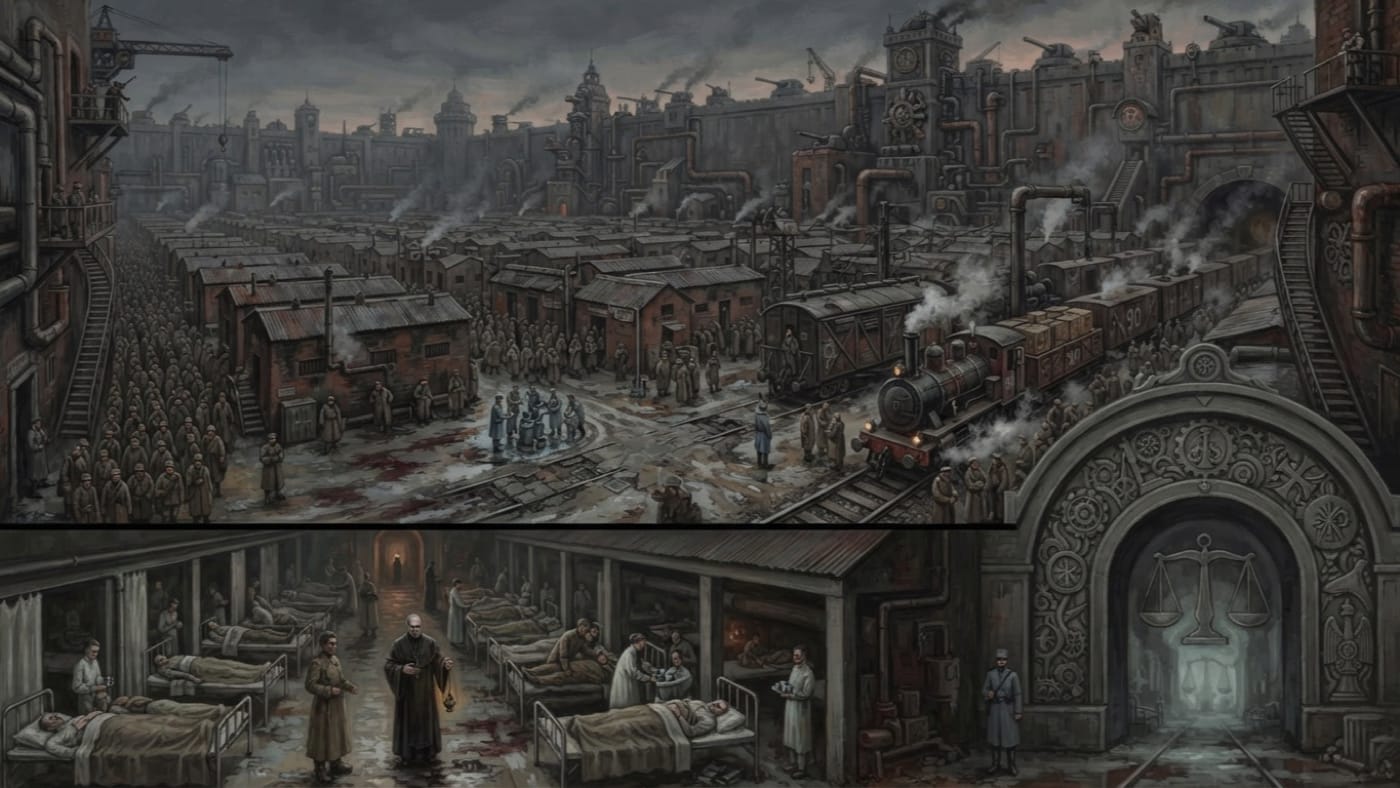
The Hammers is where Bastion-Constantinople keeps its borrowed men. It is a district of mass barracks, ranged in rows for the rotating contingents of the Continental Levy. Twelve thousand men live there at any given time. Each arrives on a ninety-day deployment and each departs, in principle, on the ninetieth day. The southern anchor of the Sagittal Line needs bodies in quantity, and the Hammers is the shelf where that quantity is stored between uses.
The Bureau of Settlement files the district under Grey, one of the seven ledger-colours that sort Constantinople into White, Crimson, Black, Grey, Blue, Ochre and Green. Every citizen carries a permit dyed the colour of their ledger, and crossing into another colour requires a transit stamp. Settlement draws the lines. The Bureau of War fills the beds and keeps the rotation schedule. The two Bureaus share the district the way two creditors share a debtor: each is certain of its claim, and neither is fond of the other's paperwork.
Grey is also a sentence. A Crimson permit-holder found in the White zone without a stamp may be detained. If the sub-Archon is having a poor morning, that person may be reassigned to the Grey barracks as a "volunteer auxiliary." The classification does not require consent. Settlement records consent as a preference. I have read the filing. The ink is very steady.
I have found no filing that explains the name. No smith built these barracks, and no hammer hangs over any gate. Soldiers will tell you the name describes what the district does to them. Soldiers will tell you a great many things for the price of tobacco.
Settlement once proposed a use for the Grey barracks beyond the levy. Between A.S. 180 and A.S. 200 it filed twelve proposals to regularize the sub-civil population of the Warrens. The second of them called for forced relocation into the Grey barracks. All twelve went to committee. The committee meets every two years, on a date that moves. The barracks remain full of levymen. The Warrens remain irregular.
#On Ninety Days
Ninety days is the figure printed on the deployment order. It is a figure of devotional character, true in Strasbourg and aspirational on the Bosphorus. War's scheduling office has never managed to make relief rotations arrive with the trains that must carry them. A company whose departure has been stamped still cannot leave on a stamp. It needs a carriage, and the carriage is generally carrying shells.
So the companies stay. The order is extended, and then extended again. The men learn the barrack bells as other men learn a catechism, because in Constantinople the bell is law: miss the noonday peal and the kitchens lock. A levy boy from some valley parish, who has never in his life eaten on a schedule, learns within a week to sing for bread. He sleeps in a range of two hundred cots. He drills in a yard paved for twice his company. He watches for the train with his company's number chalked on its side, and he watches it leave full of brass.
#On the Relief Spur, A.S. 177
The Hammers is a reservoir, and a reservoir is opened when the city burns. During the Three-Night Bombard of A.S. 177, the agents of Velmora turned the supply chain of the Foundry Quarter into a fuse. These were Greed's people, and procurement was their trade. The Quarter burned from within. Maldrake needed no invitation from his rival. He saw the glow from the Thracian Plain and opened his forward batteries before midnight.
Relief crews from the Hammers went by rail spur toward the Ravelin of Fortitude and the fires beyond it. The shells found the spur. In the same hours they struck Fortitude's outer face and its cistern buttresses. The comfort sheets afterward recorded, with pride, that the wall did not breach. Men of the Grey ledger died crossing toward fires they had not set, under guns aimed by a Sin-General who had not lit them either. Hell, like the Synod, runs on borrowed initiative.
#On the Lower Barracks, A.S. 182
Five years later the Hammers stopped being a reservoir and became a target.
The Bombardment of Bastion-Constantinople opened before second bell on the fourth day of Ashwane, during Maldrake's Wrath-tide offensive. The first official report moved the opening to third bell, so that the garrison's late counterfire would appear punctual. Thirty-seven shells struck the outer Thracian works in the first hour. Two passed over the walls and detonated in the Hammers, among sleeping levy companies whose rotations had already been extended twice. Their relief had been scheduled, but it had not arrived. The shells were more reliable.
No casualty figure for the Hammers survives that I would sign. The general figure, according to the later review, is "lower than arithmetic."
The shells then did a second, slower thing. They broke three conduits at Junction D-17 that fed the Hammers and the western infirmary galleries. One carried clean cistern water, one carried grey wash, and one carried drainage. The three met. By the second night the lower barracks were fouled. By the third, the fever benches were full. By the fourth, men of the Grey ledger were collapsing in the firing lines while War went on requiring posture of them.
Bureau of War summaries describe the sickness in the lower barracks and galleries as "camp flux aggravated by stress."
Corrected. The cause was shell damage to the conduits at Junction D-17, made worse by delayed repair access, confusion over ration water, and command reluctance to admit that the fortress's own drains had changed sides. Stress did not put grey wash in the cistern line. A shell did.
Medicine was slow. The passage assigned to medical carts had been reassigned to shell movement, and priority is a word War pronounces very cleanly. The first thing to reach the lower galleries was Tribune-Chaplain Seraphinus, the field chaplain and no relation to the Legate of Lyon, with his fourteen stanzas on the providential emptying of the body. The homily reached Strasbourg before several casualty packets. Medical stores reached the Hammers over thirteen days, in lots.
Material repairs were finished within eighteen months. The A.S. 184 review closed the packet. Junction D-17 was rebuilt with three separate conduits, and the lower-gallery drainage was sealed apart. The medical-delay inquiry was closed for insufficient surviving paperwork. The Hammers received new barrack slabs, new drainage gradients, and a memorial tablet for "those emptied in service." I admire the phrase. I would prefer not to.
#On the Infirmaries
The Bureau of Purity's annual review acknowledges active cells of the Velvet Choir in the infirmaries of the Hammers district. It names no member, no officer and no ward. It reports that the Choir recruits through seduction and blackmail and binds its people through escalating compromise. Purity sweeps every quarter and finds nothing every quarter. The review concedes that the Choir is very good at this.
Consider what a Hammers infirmary offers to Velkara's people. The men there are far from their parishes, on orders that do not end when promised. They are in pain, and since A.S. 182 they have known exactly how a fouled conduit humbles rank. They are grateful to whoever brings water in the night: an extra blanket, a letter carried home outside the censor's bag, a dose that dulls the bell. Gratitude becomes a debt. A debt becomes a favour asked, and the favour becomes a secret held over the next request. The Choir has no use for a broken man. It wants him tired, lonely and owing, and the Bureau of War delivers all three on a ninety-day schedule.
Doctrine is exact here, and so shall I be. No demon possesses a soldier of the Hammers, and no pact binds him. The Great Deceiver's servants may tempt, flatter, supply, threaten and wait. The man still chooses, every time and under every pressure. That is the dignity of his condition and the horror of it. A compromised orderly is a man who said yes and then said yes again. That he was frightened is his defence. It is not his absolution.
#On the Men Who Leave
Eventually they do leave. A relief train arrives with the right chalk on its side, the Grey permits are surrendered, and the companies go home to the parishes that sent them. Those who study returned levymen note that they sleep very lightly for several years afterward and flinch at sudden quiet. In the Hammers, quiet means that a gun has stopped, or a conduit has, or a train is not coming. A man learns which silence to fear, and he never stops listening for it.
In A.S. 199 a petition reached my desk, folded into a powder requisition and smelling of candle soot. Someone had thrown it toward Chamber 7 from the Ravelin of Sorrow, and a soldier with a hooked pole had retrieved it from the ditch. It asked the wall to remember a brother who had forgotten his own name after three months in the Hammers. I do not know what the brother suffered. The petitioner was no physician, and the wall is no clerk. I know only that three months is ninety days, and ninety days is the figure printed on the order.
I returned the petition to the fire. I did not correct the grammar.
As of A.S. 201 the Hammers remains in service: twelve thousand on the rolls, ninety days on the orders, Grey on the permits and new slabs underfoot. Men going down to the lower barracks touch the D-17 marker on the way. The trains still carry shells first.