
#On the Custody of Saints
When a clerk of the Synod says Hagiography in corridor speech, he seldom means the old art of writing saints' lives. He means an office's opinion. In the Clean Slips tract and the Saint Vellum the Silent dossier, the word is shorthand for hagiographic review. That is the desk, belonging to the separately indexed Bureau of Hagiography, where a patron's claim arrives to be recognised, tolerated, ignored, or folded into somebody else's.
The one word carries four questions, and the trades confuse them daily. Did the saint live as the story says? Does a profession call upon the saint? Has the Church acknowledged that it does? Has any object attached to the saint been examined and certified? A notary can answer the second question with a bowed head and dry hands. The other three belong to offices, and offices answer slowly, separately, and when it suits them.
This entry examines two cases because the parent articles supply two. One is a clerk's saint who has official usage and no Life. The other is a river mother who has a shrine and no official existence. Between them lies most of what a working person needs to know about how the Church keeps its saints.
#On the Life Entered in the Record
A trade needs less from its saint than the pious imagine. It needs a deed that looks like its own work done perfectly, and a danger for the saint to stand against. It needs a gesture an apprentice can copy and an image that can hang above a desk without alarming the auditor. A biography is welcome. It is rarely required.
Vellum the Silent shows this economy at its leanest. No authorised vita survives. The Bureau of Records credits him with "purging the city of invisible demons." His dossier reads those demons as documentary contradictions, such as dead soldiers drawing bread in three towns and widows married twice through a copying error, and credits him with the strike mark and the silence that followed it. That reading belongs to the dossier, which is to say to me, and I confine it there. The Church keeps real demons on its books and will not see them all reclassified as filing errors for one clerk's benefit.
What the profession took from him can be taught in a morning: wash, dry completely, count the seals, tap the black stamp twice on stone, and speak no word after the first seal. These habits are documented practice. The unnamed city, the purge and the man himself are cult legend. Between the two sits the official posture, and it is narrow: occupational invocation inside Records and Nullity offices, sanctioned by usage.
Relics belong to another building. The Bureau of Relics examines objects, including their provenance, material and chain of custody, and then certifies them or declines. By the dossier's account, Relics has twice declined even to examine a purported finger bone of the Silent, once because the petition misspelled Nullity in its schedule. A review desk may admire a saint whom Relics will not touch. The offices do not borrow each other's verdicts. A petitioner who waves a certificate at a review clerk, or a Life at a reliquary clerk, has come to the wrong building and will be told so at length.
#On Recognition and Non-Cognisance
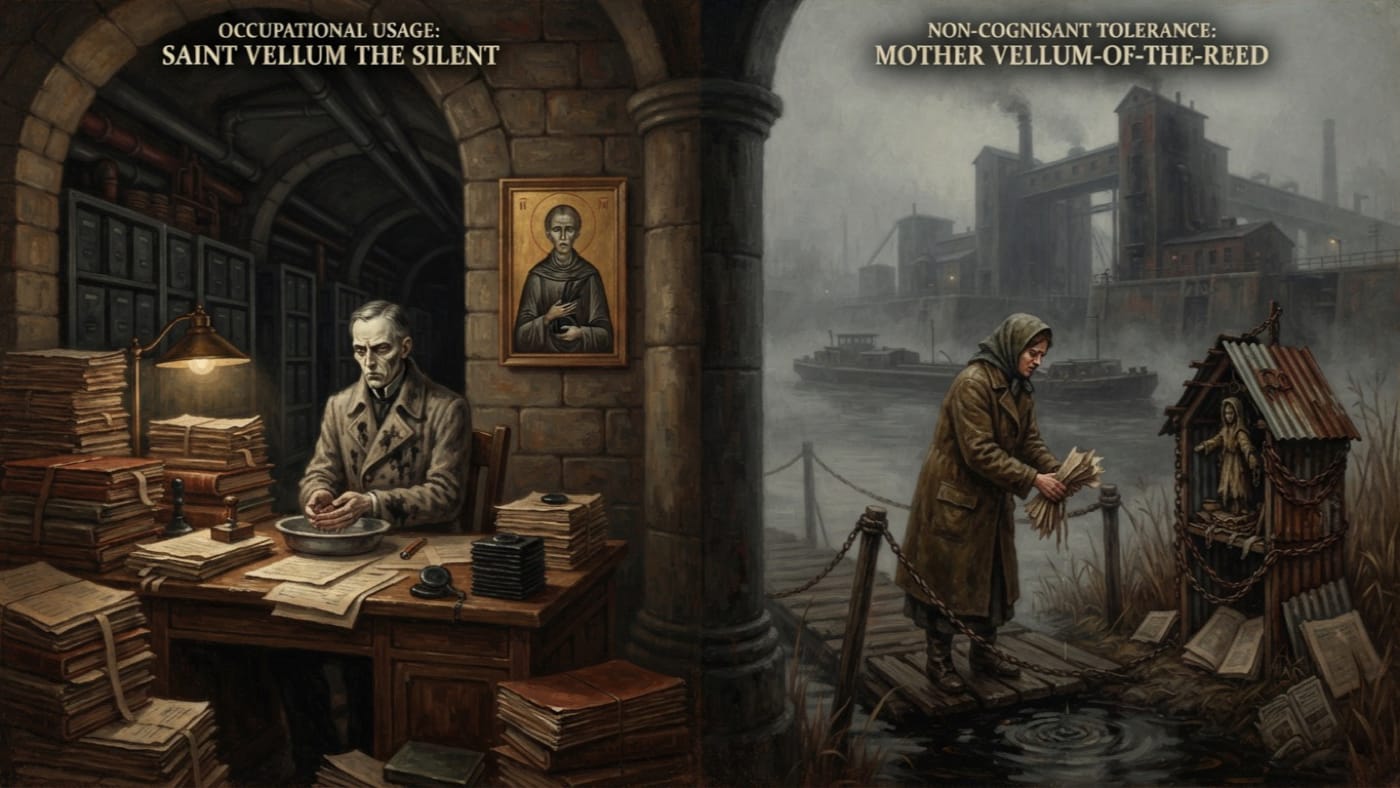
Saint Vellum the Silent hangs above the Black Seal desks as a pale clerk with a closed mouth, washed hands, and a black seal held where a martyr would hold a palm. His feast is kept in the Black Seal Annex beneath Strasbourg, the cult's stated seat, with hand-washing, seal-counting and one hour of vault silence. The Erasure Notaries call him patron. The Office of Nullity permits it because a notary who fears the saint dries his hands, and dry hands produce fewer contradictions. His standing is real but small: no procession, no authenticated relic, no Life. He has become a saint the way a stamp becomes an instrument, through repeated contact.
Downriver the arrangement runs the other way. Mother Vellum-of-the-Reed is the legend of a crossing scribe who sold names to the nameless and vanished mid-crossing. The brokers disagree about whether she drowned, deserted, or became one of the stories the river tells about itself. I decline to settle the question for them. Ferry Chokepoint Brokers invoke her anyway. Clean Slips leave dry ribbons at her blank-folio shrine, along with the bottom margins cut from rejected permits. Hagiography is non-cognisant.
Non-cognisance is a precise posture, and a cheap one. To rule Mother Vellum false would send Purity into the reedbeds and give the brokers a grievance. To recognise her would endorse a woman remembered for renting names. The office has therefore declined to know her. The shrine stands and is officially no shrine. The ribbons pile up and are officially no offerings.
The brokers have a tolerance of their own, and it should be kept apart from all this. Clean Slips are unchartered and are tolerated at the lockhouses whenever the queues press. That tolerance belongs to the river crossings and says nothing about their patron. A guard who accepts a correction slip has not recognised Mother Vellum. A Records clerk who permits the Silent's hour of quiet has not canonised him.
The Silent's annual observance in the Black Seal Annex constitutes his canonisation.
Corrected. The observance is usage, and the usage is sanctioned. A feast and a title prove that a profession is devoted. They are not a completed canonisation, and the file contains none.
#On the Several Vellums
The name Vellum turns up across the under-professions often enough to alarm anyone who keeps an index. Each trade gave its Vellum a different danger and a different tool.
Vellum-of-the-Quiet-Hand belongs to the bone-stampers and corridor notaries and is shown holding a stamp over a skull like a blessing. Vellum of the Valve belongs to the resonance plumbers and turns a wheel while a bell-shadow looms behind him. Vellum of the Narrow Line belongs to the manifest litigants and holds a quill like a spear, with a warehouse burning behind him. The Silent keeps the vaults. The Mother keeps the crossings, wherever she has gone.
Hagiography noticed the coincidence, as offices do. A provisional memorandum proposed treating several of the Vellum cults as variants of one clerical ancestor. The attraction to an office is plain. One ancestor means one icon review, one calendar line and one file, where the trades insist on several.
The Silent's dossier rejects the proposal for operational use, and its reasons come from the work. Silence, bone, pressure and cargo identity are separate dangers. A plumber listening for a pipe that is about to sing needs his own patron, and so does a notary listening for an erased name that is about to answer. Their prayers ask for different things. The dossier also requires written permission from both Hagiography and Records before anyone conflates the cults, and the permission has not been issued.
The several Vellum cults descend from a single clerical figure.
Unproven. A memorandum proposed it. The memorandum shows only that someone at the review desk wanted fewer files.
The river cult stands outside even this quarrel. Hagiography cannot consolidate a saint it declines to know.
None of this answers whether the several Vellums ever shared a man, a name or an inkpot. The question remains open, and it will stay open because closing it would cost an office more than it would save.
#On Present Application
As of A.S. 201, the practice continues whatever the desks have ruled.
In a Nullity office, a notary dries his hands before the first ledger of the morning and dries them again when he doubts the first drying. He counts his seals, counts them again, and taps the black stamp twice on stone. During the strike session he points at his questions instead of asking them. None of this requires him to believe that a man named Vellum once purged a city. It only requires him to fear the error that would follow if he skipped the ritual.
At a lockhouse on the Rope-Ferry Chain, a broker opens an oilskin folio and whispers the day's saint-name once, never twice. At the end of the shift she rinses her hands in ash-water, cuts the margin from a permit the guard refused, and walks it to the reeds. She asks nobody's permission.
Patronage does practical work in both places. In the vault it enforces accuracy and silence. At the bank it promises passage. In both it marks who belongs to the trade, since only a notary knows why the hands must be completely dry, and only a broker knows why the name is spoken once. The offices keep their discretion. They can recognise a patron, tolerate one, decline to know one, or propose to merge one with her cousins. They rarely need to act at all, because the devotion maintains itself and costs the Church nothing.
Petitions to recognise Mother Vellum may be lodged at any riverbank. Hagiography will not be there to receive them.