
#On the Guns in the Chalk
"Shutter on one, traverse on two, powder on three, and the Creator on whatever beat is left." — casemate saying, Calais
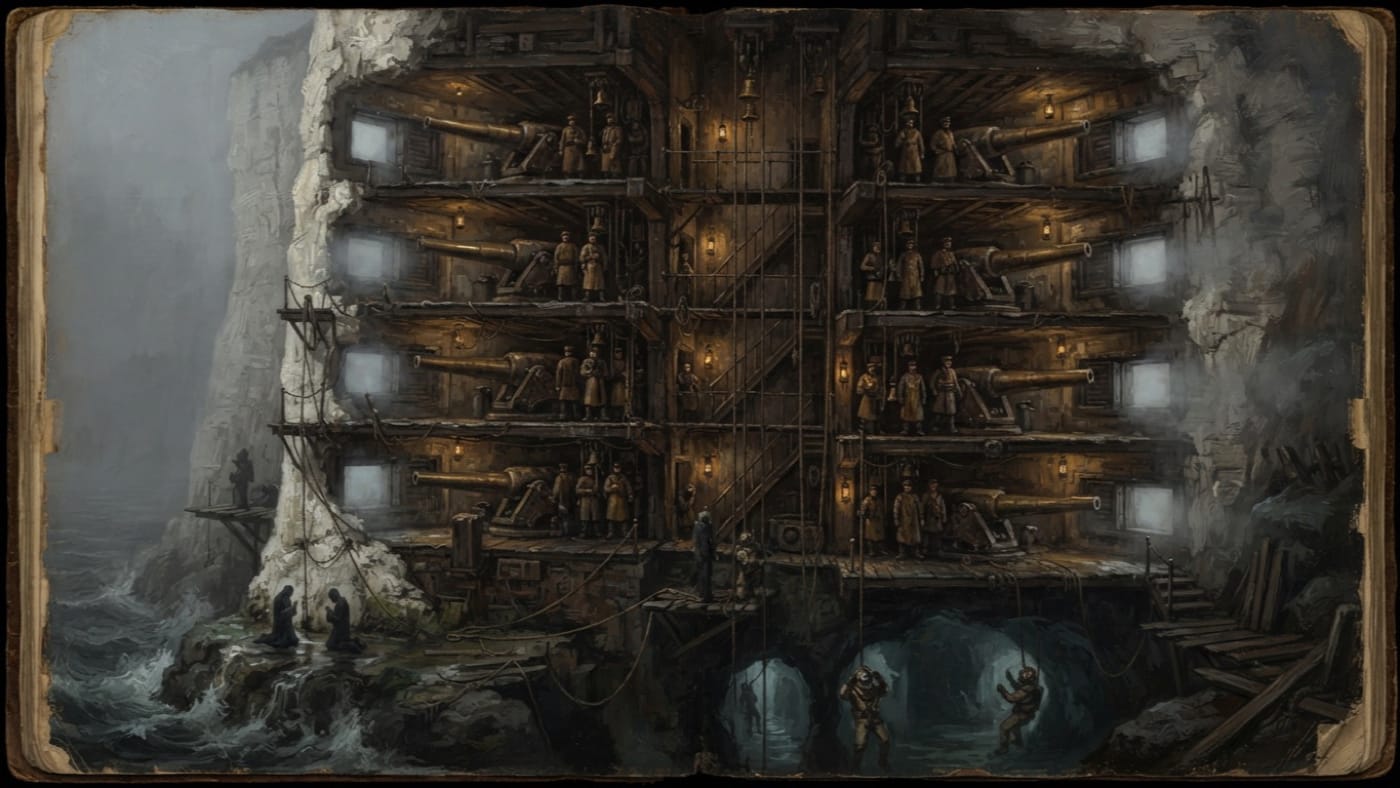
A gunner in the Gun Galleries of Calais spends most of his service with his hand away from the lanyard. The shutter is closed. Fog leans on the embrasure from outside, and the brass sweats as though it has been accused of something. The relay rope hangs from its cage along the casemate ceiling, wet through, with a small bell at its end. He does not watch the sea, because at Calais the sea is seldom visible to anyone entitled to shoot at it. He listens.
The galleries are casemates cut into the white cliff of the Chalk Redoubt of Calais. The present establishment holds nine positions, and each houses a consecrated cannon worked by the Gunline Choir. They cover the harbour approaches and the coastal lanes against fog-masked raids and against the Undertide, which does its raiding from below. Calais is a Zone 1 coastal installation and lies outside the Sagittal Line. The eastern front measures its war in trench-yards. Here an independent British Crown sits a day's sail away, the water is a mixed jurisdiction, and the enemy comes in under weather and under keels.
The district sits in the middle of the cliff's stack. Above it is the Crownline, where command lives in dry rooms. Every competent register places the Script Wall between the galleries and the Crownline: seventy feet of exposed chalk that writes names in fog. Below are the tunnels and sea caves where the Undertide Divers go down on rope. Out at the harbour mouth stand the Teeth. No measured section of this arrangement has reached me, and I will not draw one to flatter a reader's sense of order.
Crews reach the guns by cliff stairs, hoist cages and rope lifts, then by catwalks inside the casemates. The building materials are chalk-lime, iron, brass fittings, tallow sealant and salvaged ship timber, and none of them improves with salt. The galleries smell of cordite, brine, brass polish, wet rope and chalk dust. The dust gets into the powder, the lungs and the hymnals, more or less in that order of official concern.
#On the Cliff Before the Choir
In A.S. 69 the war administration that later registers file as the Bureau of War requisitioned the chalk headland, and engineers from Strasbourg cut the first galleries into it. The surviving record gives the year the cutting began. It does not say how many casemates were opened that season, when the ninth position was finished, or whether the present line was finished all at once. I have read men who claim to know. None of them produced a ledger. The coastal Chapterhouse followed in A.S. 70, under a Synodal name that the Synod would not formally possess until A.S. 90. The Church has always enjoyed backdating its own christenings.
The engineers expected raiders and wreckers, and perhaps a demon courteous enough to arrive above the waterline. In A.S. 71 the Great Breach came through the sea caves beneath their new embrasures and drowned hundreds. The guns proved nearly useless in wet corridors. The repulsion came from an improvised clatter of signal bells, powder ladles, a chapel handbell and the rims of cracked cannon, which is to say the galleries' first effective contribution to the defence of Calais was their scrap. The Wall wrote for the first time in the aftermath of that night, and the Divers began as men sent down to bring out the bodies.
Emergency bell practice was regularised in A.S. 72, and the Teeth went up in A.S. 74. The Choir, with its rank tables, tone plates and certified authority over the guns, dates only from A.S. 92. For twenty years the galleries were served by men who had learned bell discipline the way survivors learn anything, by remembering who died.
An earlier Redoubt survey states that the Script Wall first wrote in A.S. 83, "fourteen years after the Redoubt's founding."
Corrected. The Wall first wrote after the Great Breach of A.S. 71. A.S. 83 is the year of the first standardised reading register. The gallery crews stood beside that chalk through twelve years of names before any clerk produced a book fit to hold them.
#On Bell Permission
No gun in the galleries fires on sight unless the fog has granted a sight-window, and the fog charges dearly for one. Orders come down from the Fog Bell Tower and pass through relay cages along the casemates. The tower bell called Pell's Quarter announces readiness. After that every physical act needs its own bell. One grants the shutter, two grants traverse and three grants powder. A long low toll holds fire. A split high peal cancels range and orders the repulsion tone. A gunner who moves early has committed a liturgical offence with a ballistic result.
The permissions are divided among several offices. Commander-Prior Sabelle Morn and the Coastal Chapterhouse hold the writs and the gun keys. Cantor-Major Pell administers the intervals and keeps the fire-chart, a scored brass plate of approved sequences, cancellations and emergency deviations. One copy rests with the Bureau of Bells and one with Pell, close enough to his cot to be reached before his boots. Captain Lute Auvray holds the reading rosters, and through them the low-hand sign. When a name appears below the surf-line, that sign tells Pell to hold the guns and let the reader wade.
The public abstract lists seven repulsion sequences by purpose. The first presses fog downward. The second clears the Teeth. The third opens a sight-window. The fourth covers readers kneeling at the lowest names. The fifth denies the sea caves during west-hush. The sixth has been altered since A.S. 198, and the seventh is held under restricted authority. Their scores belong to the chart, and the chart does not belong to the reader of this Codex.
What the abstract leaves out is who stands underneath. On bad nights readers kneel in surf to pronounce the last letters of a name. Divers hang below the galleries on rope bells, with throat plates hooked to lines that riggers swear they can read through stone. A beat struck late gives the water time to take a reader's ankles. A gun fired early can kill a Diver, who feels it first in the teeth. A missed cancellation leaves a cave route open. Pell's discipline is the discipline of a man who knows exactly who is beneath his guns.
#On the Lower Gallery
In A.S. 198 the third fire-chart vanished from a sealed wall box in the lower gallery. The box remained locked and the wax remained whole. The inventory slip still carried Pell's countersignature and the salt print of the inspecting warden's thumb. In place of the brass lay a damp flake of chalk. When warmed, it raised in white grain the first four beats of the sixth sequence.
Pell closed the gallery. He re-scored the two remaining charts by hand, altered three intervals and moved two cues into hand-sign custody, where no bell can be overheard. Then he stood everyone who had handled the lower inventory, riggers, gunners, readers and Chalk Scribes alike, in a circle and counted them through the dusk sequence backward. Two fainted. One woman vomited seawater, although she had not been near the harbour that day. Pell asked for seven fog nights to prove the new cues. Morn gave him five. The fifth held.
LOWER GUN GALLERY — INCIDENT FILE, A.S. 198 Object missing: third fire-chart, brass, scored, Seal Amber. Replacement object: chalk flake, damp, responsive to heat. Pell's notation: "If the water has learned authorisation, alter the grammar." Witness disposition: two transferred; one retained; one █████████████.
The record names no thief and describes no method. The Grey Keel Syndicate wants the chart, as it wants every chart, and has denied interest in its usual dialect. The Unread allege things about sound and the sea that the Bureau has condemned. Neither the wants of smugglers nor the allegations of heretics amount to a finding. The register I hold also says nothing on whether the lower gallery has since reopened. The question stays open.
The lower gallery had its good night before its bad one. In A.S. 188, when every lamp on Salt Tribunal Row burned blue and the harbour recited names in a child's voice, published accounts have Pell sounding the seventh sequence from that gallery with three guns unloaded and two bells muffled in wet linen. The water fell silent after the fifth measure.
#On the Present Amber Watch
The A.S. 201 survey finds the galleries in service under Amber seal. The missing chart is still missing. The crews are tired in the way artillerymen get tired when they are made to listen more than they shoot. Salt is getting into the brass faster than the riggers can polish it out. Rope swells and has to be re-spliced by men whose fingers have split along old cuts. The chalk dust in the casemates gets swept, settles and gets swept again, and the powder clerks recite their cancellations before breakfast.
The pressure comes from all sides. Since A.S. 199 chalkscript has appeared inland in the Chalk Warrens, and the Wall writes more often. Each new reading night means another night of fourth-sequence cover. Lantern oil is short, and short oil lengthens a reading, which keeps the guns manned longer. The Undertide now presses the Teeth even in clear weather. The Salt Tribunal wants the Choir's compliance certificates issued faster and more cheaply, because a ship held for bell discipline is a fee unpaid. Morn has asked for more oil, more readers, more bell-riggers and permission to seal the boat tunnels the Grey Keel uses. Every one of those requests is still a request. The Bureau of War sent a circular commending vigilance.
At dusk the tower gives three short, one long and three short. Riggers test the relay ropes, readers file onto the chalk below the rim, and somewhere beneath them a Diver's bell tests clear. In nine casemates nine shutters stay closed while nine gunners wait on a brass plate's grammar.