
#On the Charter
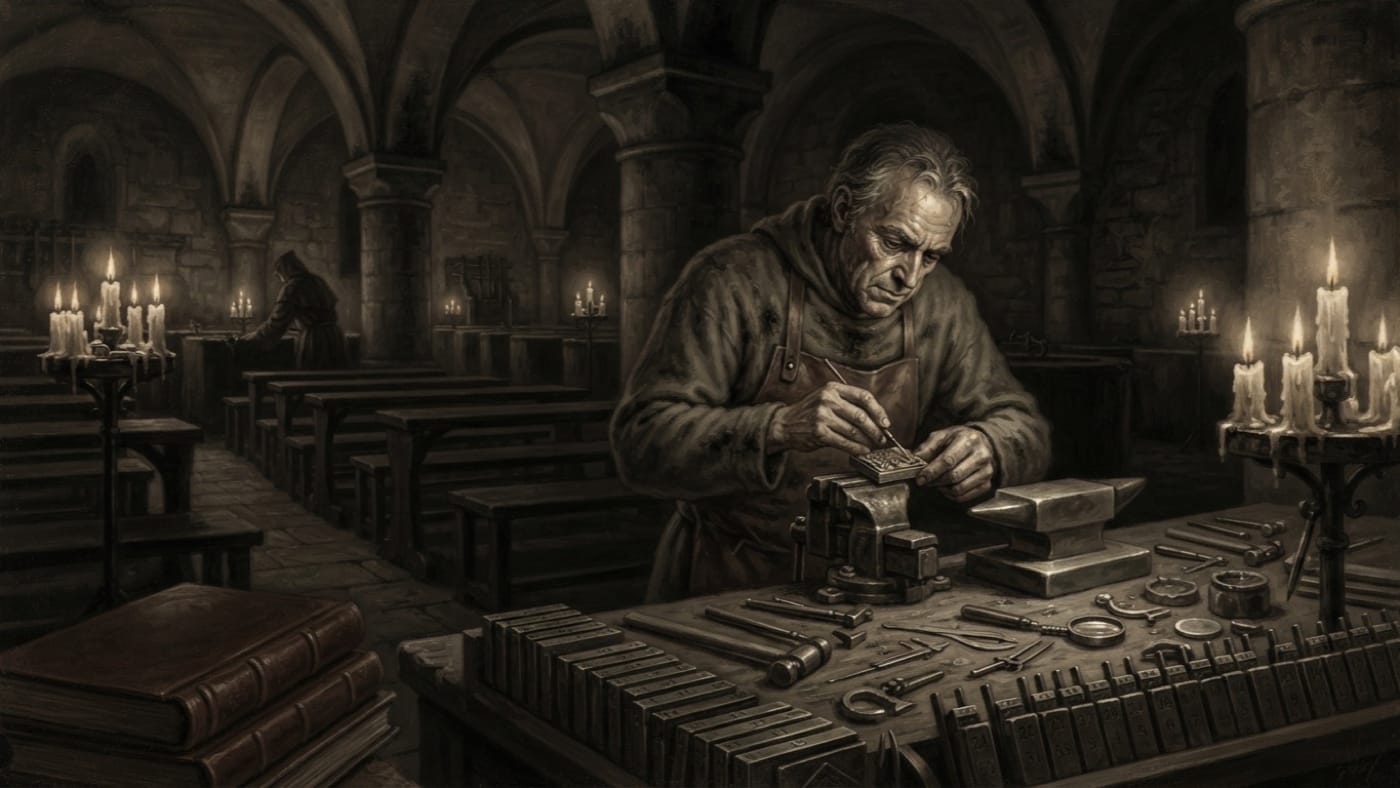
Every impression the Synod honours has three makers. The issuing office supplies the words. The Bureau of Masks and Seals supplies the counter-seal, and with it the difference between a decree proposed and a decree enacted. Below both, a cutter bent over a bench in tallow light supplies the shape of the metal that meets the wax. Of the three, the cutter is the only one never named on the document.
That cutter belongs to the Guild of the Anvil and Stylet.
The Bureau received its Founding Instruments in A.S. 92 (1802 CE), two years after the Concordat of Strasbourg gave the Synod its formal constitution. The guild came thirteen years later. Its charter was issued under the Bureau's authority in A.S. 105 (1815 CE). The full text has never crossed my desk, but its effects have. By that charter the die-cutters were removed from the jurisdiction of the Bureau of Oaths and from the ordinary structures that govern every chandler, cooper and tanner in the Synod's territories. In short, the guild answers to no authority in the Synod save the Bureau that chartered it.
The record does not say who sat at the benches between A.S. 92 and A.S. 105, under what oath or for what wage. I decline to supply it.
The craft is older than the charter. Sigmund of Aachen, the Bureau's first Archon, had cut dies for the Rhineland coinage before the Sundering. He brought two things into the Bureau: the counter-seal system itself, which the Bureau credits to him, and the rule that every die be tested against the thumb of the hand that cut it. He died in A.S. 107, two years after the charter. The archive does not say whether he drafted it, signed it or merely lived to see it, and neither will I.
#On the Work Beneath the Cloister
The guild works in the Sigillary, the sealed warren cut into the eastern cloister of Strasbourg Cathedral and running three levels below the flagstones. The Bureau of Engineering classifies those levels as "the old foundations." The cutters call them the Sweat. Both names are accurate. Only one appears on the requisition forms.
The light is tallow. Oil lamps are forbidden near the wax stores, and in the Sigillary everything is near the wax stores. The cutters share their stairs and their stink with the engravers, the wax-masters and the seal-testers, and a visitor who mistakes one trade for another will be corrected with a look. Shared air confers no shared oath.
What the cutter makes is a copy. Every lawful die reproduces a registered master impression, and the Bureau measures fidelity in a unit of its own devising: one-sixteenth of a hair's breadth. A die deformed past that figure is retired. In service, each die is weighed every quarter and set against its master once a year. The callipers that do the measuring are made by Engineering to specifications that Masks and Seals supplied. The instruments that judge the instruments are therefore themselves instruments under the Bureau's warrant. The chain has no last link, by design.
Before any of this, the die meets flesh. Sigmund's test survives: the new die is pressed into the ball of its maker's thumb and the mark is read. The Bureau keeps Sigmund's own print on file and has authenticated it with a perfectly straight face.
The cutter never sees the documents. A ration chit, a marriage, a death warrant: each becomes real only when the wax takes the counter-seal, and the counter-seal is only as true as its metal. A tremor at a bench in Strasbourg travels, by courier and impression, to every gatehouse on the Rhine.
#On the Oath to the Die
Every functionary of the Synod swears to the Synod. The die-cutters swear past it.
"I serve the impression," the oath opens. "The impression serves the Synod. I do not serve the Synod directly, for intermediaries are the Bureau's theology."
That is the whole of the published portion, and it suffices. The cutter's loyalty runs to the die, the die's to the wax, and the wax, once counter-sealed, belongs to the Synod. Each link answers only to the next. The Bureau's existence rests on the doctrine that no office may authenticate itself. It has sworn its craftsmen to the same principle and put one more link between the hand and the throne.
The Bureau of Doctrine has challenged this position three times. Each challenge reached the Bureau of Masks and Seals the way every Synodal document does, as paper that needed a counter-seal to become binding. Each time, the Bureau of Masks and Seals applied the counter-seal and filed the challenge. The record shows no ruling afterwards. Each challenge was made real and then made a file.
Separately, the Bureau of Oaths has complained twice that the cutters' vows overlap its jurisdiction. These complaints are not to be confused with Doctrine's. Doctrine objects to the theology of the oath. Oaths objects to the oath existing outside Oaths. Theology can be argued. Jurisdiction can only be filed.
#On the Defective Impression
Precision is a pious word until it fails.
In A.S. 176 (1886 CE), seventeen counter-seal instruments went out to offices in the Rhine corridor. They had been taken from a master die with a casting defect: a bubble in the alloy, invisible to the eye, which all seventeen faithfully reproduced. The copies were perfect. The original was wrong.
For two years, every document those instruments counter-sealed was unsigned under the Bureau's strict reading. Grain requisitions. Tithe assessments. Marriages. Three death warrants, all three carried out before anyone noticed. A clerk of the Bureau of Tithes finally noticed in the autumn of A.S. 178, comparing a requisition against the master on file under magnification.
The Bureau answered with Retroactive Authentication Order 178-A. It declared the affected documents provisionally authenticated, pending counter-stamping after the fact. Teams of officers re-stamped two years of paper along the corridor, and the work took fourteen months. The three condemned were past consulting.
The record names no responsible cutter, and I name none.
The reform went straight to the bench. Every master die is now tested by three cutters working independently, and each files a separate impression. A fourth officer compares the three and is forbidden to communicate with any of them. A guild sworn to serve the impression now proves its service in triplicate before a judge it may not address. Outside the Sigillary, the crisis produced the Annual Die Audit and its travelling Seal-Walkers, who carry callipers into every office in the Synod and are loved accordingly.
#On the Present Service
In A.S. 201 the guild cuts for Archon Casselius of Mainz, who holds the Bureau of Masks and Seals and the Bureau of Heraldry in personal union. The two charters remain separate. The Bureau of Records keeps their filing numbers apart with the devotion of a sacristan guarding two keys to one reliquary. Heraldry decides what an emblem may mean. Masks and Seals cuts the metal that proves it was lawfully issued. The cutter works on the seam between design and material and is paid to add nothing. Sigmund's successor as Archon, his former apprentice, is remembered for being dismissed after trying to add a decorative flourish to the Triune Knot. The stated grounds were "artistic ambition." The guild has studied the precedent.
The most delicate dies in the Sigillary belong to the Reliquary Sigillators, nine die-cutters whose tools are consecrated by the Bureau of Rites and whose work is inspected by the Bureau of Relics. The Bureau calls them a specialist sub-guild. The published record does not say whose rolls they stand on, and I will not draw an organizational chart from one sentence.
A lawful die's service ends where its tolerance ends. A revoked die goes to the Retirement Furnace. It is melted before three Bureau officers, recorded in triplicate and stored as a numbered ingot. The metal is kept long after its meaning is spent. Custody outlives use.
ERRATUM — On the Charter, paragraph three
The statement that the guild "answers to no authority in the Synod save the Bureau that chartered it" is withdrawn. The A.S. 105 charter exempts the Guild of the Anvil and Stylet from the jurisdiction of the Bureau of Oaths and from the ordinary craft-guild structures. It grants no further exemption. The guild remains subject to every other authority of the Holy Synod. The Warden regrets the flourish and notes that the Bureau has dismissed men for less.