
#On the City That Burned
"Wax keeps its fire in the cellar and its pride on the roof." — Lantern Mile saying, attributed to no one willing to sign it.
The Great Fire of Candlewick occurred circa A.S. 98, some six years after the Bureau of Records planted its annex in the canal town and began teaching chandlers that their trade had become a branch of theology. The archive does not give the day or the month. Clerks who later copied the event into House chronicles supplied both, with the confidence of men who would never be asked to prove either, and I decline to inherit their stationery.
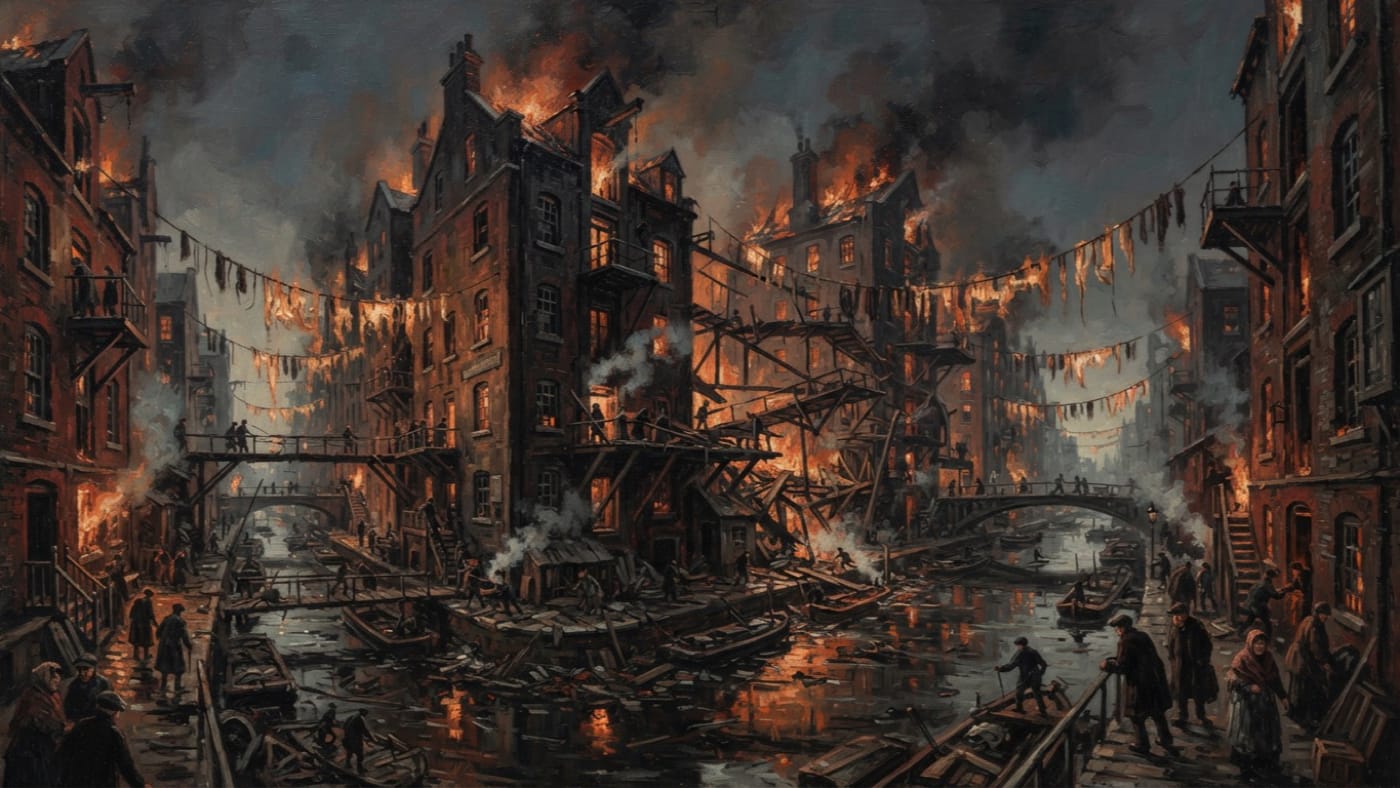
What burned is better recorded than when it burned. Candlewick in those years was a warehouse of combustibles arranged as a town. It kept tallow in the rendering sheds and beeswax in crates. It kept paper in bales and quires, lacquered wood in every counting-house door, and drying cloth and treated cord strung between the towers. It also kept spirits, some for the solvents and some for the men who handled the solvents. The town manufactured the materials by which the Synod made a document true: wax, ink, seal and watermarked sheet. It stored them in the most flammable arrangement a guild economy could devise on a marsh.
A fire in an ordinary city destroys houses. A fire in Candlewick destroyed the stock of authority, and once that stock ran short it had to be counted. Everything that followed came from the counting.
#On the Lower Mile and the Surviving Glass
The fire began in a wick hall. It began in a spirit store. It began in a lamp chapel. All three accounts survive in the published record of House Wickwarden, each has its sponsors, and the sponsors chose their origin the way one chooses a pew, by the company one wishes to be seen with. A wick hall implicates the chandlers' own negligence. A spirit store implicates the dyers and solvent-merchants. A lamp chapel implicates the clergy, which is why that version is told quietly and repeated often. No surviving document I trust names the first building or the first hand, or says whether the hand was careless, paid or innocent. Those who would like to find the Great Deceiver at the bottom of it may petition Doctrine. I have found the explanation unnecessary. Tallow requires no assistance.
The fire's path is better attested than its origin. It moved through the lower Lantern Mile with indecent speed, ran along the roof-walks where wick and cord hung drying, took the drying lines one after another, and entered two stamp rooms. The stamp rooms matter. Seal wax burns with appetite, and a room of finished impressions awaiting dispatch holds authority already promised to someone. Those promises were not kept.
Downstream, the main glass rows of Bottle Quay escaped because the canal wind turned. That is the whole of the established fact, and it is a narrow one. The record says only that the principal glass was spared. It does not say the Quay came through unscorched. Wickwarden at once read the turning wind as candle merit, a reward from the Creator for the proper keeping of devotional flame. House Vatmarsh read it as chemical luck. Both Houses claimed the wind. The wind had consulted neither.
#On Water, Firebreaks, and the First Quotas
The engineers drew one lesson from the fire. The House drew another.
Candlewick already had water arranged against fire. The dikes, service mouths and overflow cuts of the charter years were in place, and beneath them ran older culverts from the free dyers' market. The fire proved them insufficient. Afterward the city committed itself in earnest to firebreaks, canal cordons around the districts, bucket law, and dike-water rights, under which the water near a burning ward belongs to the fire before it belongs to the man who paid for the sluice. The Palatinate's lasting architectural creed dates from here: a city built of wax will burn periodically, and the survivors will be those who drew their lines in advance.
The stock losses taught the second lesson. Enough wax had burned to make the first strict quotas necessary, and the Bureau of Records required what quotas always require: measured wax stores, inspected wick allotments, lantern licensing and distribution schedules. Before the fire a chandler sold flame on the strength of his craft and his reputation. After it, flame was issued. Someone had to hold the stores, and someone had to decide which ward would be lit after sunset that winter and which would sit in the cold with its papers unread.
House Wickwarden decided. The greatest of the chandlery Houses took control of candle distribution in the winter after the fire, and it has kept that control into the present year. It did not invent itself in A.S. 98. It already had towers, halls, credit and the habit of command. The fire handed it a ledger, and a ledger once handed over is a ledger kept.
House memorial plates record the consolidation of A.S. 98 as an emergency charity, undertaken to shield Candlewick's poor from unsafe flame.
Corrected. The emergency was real. The poor were shielded from unsafe flame chiefly by receiving less of it. The distribution regime has outlived the emergency by more than a century, and a charity that bills in perpetuity has changed its classification.
Whether the House profited from a fire it also kindled, I cannot certify. The speed of its benevolence invites the question, and the record does not answer it. I have no wish to forge an answer when the Black Canal already sells them at reasonable rates.
#On Papers Lost and Water Used
The fire consumed more than wax. It consumed the papers of burned guild households: memberships, apprentice indentures, ration entitlements, all the small sealed proofs by which a family in Candlewick showed that it existed. A widow who could prove her husband's guild standing kept her bench. A widow whose proof had gone up the roof-walks with the drying wick became, in administrative terms, a stranger standing in the ashes of someone else's house.
The lawful channels offered queues. The lower channels offered speed.
Beneath the cordoned canals, in the culverts and service mouths that the Black Canal would later make infamous, trade found its way through the months after the fire. Contraband wax passed under the cordons while the quota ledgers were still being ruled. Unregistered pigment that had survived in wet cellars was sold up to workshops that could not wait for their allotment. Burned families bought fresh signatures from men who had never seen their faces and never would. The ink was cheap and the likeness approximate. It was enough to keep a bench.
Romantic historians, a breed few in Candlewick but loud, like to place the founding of the Black Canal Syndicate in the ashes of A.S. 98. There was no Syndicate then. There was a habit: a boat at night, a lantern behind blue glass, a provost studying his boots. The cartel, its name packages and its personalities belong to later generations, and I will not seat them at a fire they did not attend. The fire's contribution was humbler and has lasted longer. It made the lower water useful, and nobody has managed to make it useless since.
#On the Settlement That Outlived the Flame
The emergency regime became the constitution of the candle. By A.S. 104, Wickwarden ration seals governed household candles, chapel tapers, workshop lamps, inspection lanterns, mourning flames, and the red sticks burned before sealed contracts. By A.S. 110, mobilisation pressure across the continent had made Candlewick's supply a matter for armies. The quota born in a burning Lantern Mile now regulated the wax on writs carried to the Line. The Seal Locks counted the barrels out, and the Houses counted the profit in.
When the Fading Winter began in A.S. 199 and the Chromatic Registry tightened its grip, House Wickwarden met the crisis with the instruments it had won in the fire's aftermath: stores, schedules, and the right to say which ward waits. Its three accidental shortages of recent memory are A.S. 98 performed in miniature, without the inconvenience of smoke.
The firebreaks remain as well. Candlewick still burns, Bottle Quay still has furnace ruptures, and the Palatinate still lists its fire risk as permanent. Old workers on the Mile say the Great Fire climbs the towers on fog nights, testing each room for unfinished work. The Bureau does not record ghosts, which spares it the cost of paying them.