
#On the Pause
A Gratitude Alcove is where a procession is allowed to stop being a procession. The drums soften. The float halts beneath a banner or a painted saint. A cider barrel is tapped, a confetti basket is upended, and a crowd that has walked for an hour finds that it may stand still and be thanked. The Bureau of Festivals calls this a gratitude pause. It is also a count.
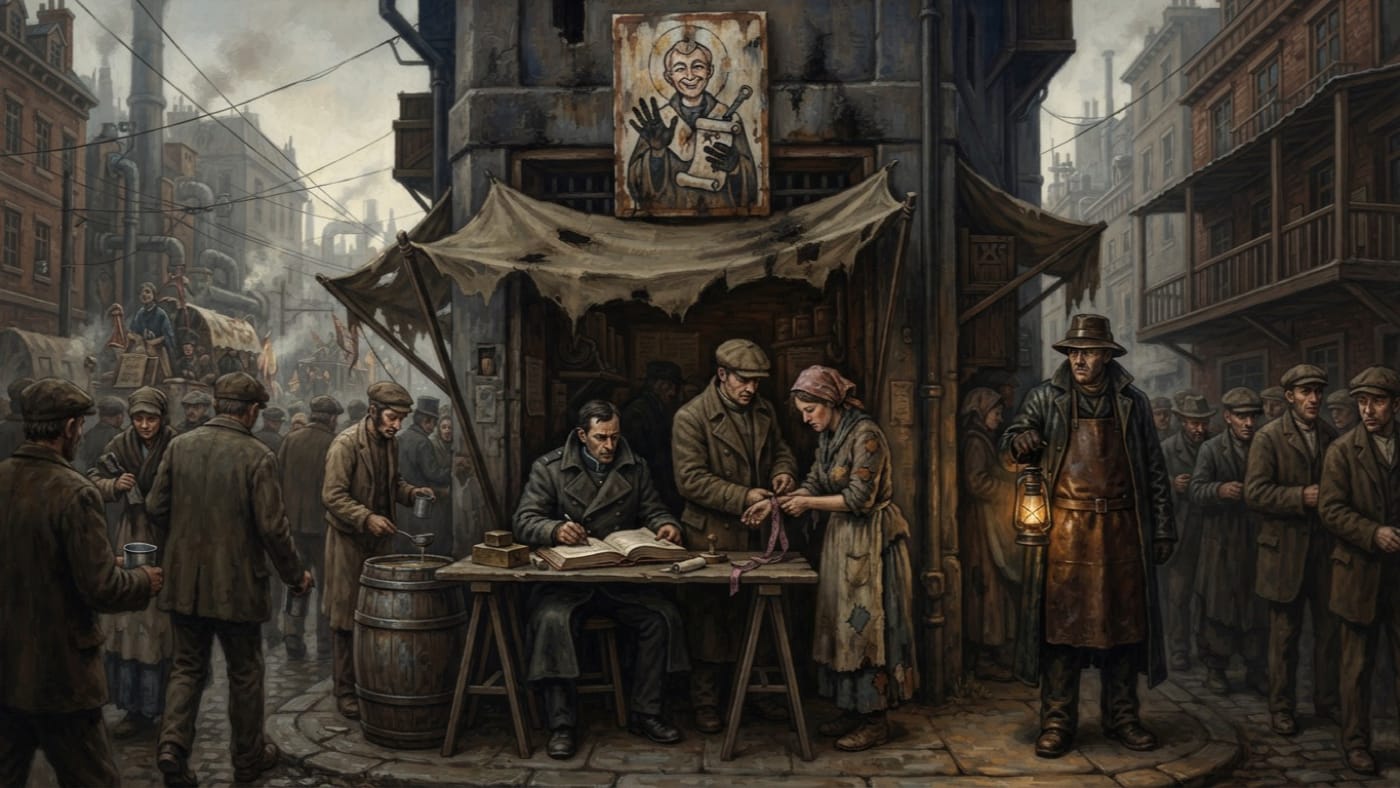
The Codex can find no standard plan. Some alcoves are recessed chapel-fronts on a boulevard. Some are a canopy and two trestles lashed to a market arcade. Some are a wide doorway chalked on the morning of the feast and forgotten by evening. They form one class because of the work done inside them while the citizen believes she is resting.
The pause and the alcove are related, but they are different things. The pause is a timed procedure that a Captain may call anywhere a crowd will tolerate standing. The alcove is a named station on the route, with an image above it, a table under it and a man with a lantern at its narrow end. Every alcove hosts a pause. Many pauses never see an alcove.
#On Its Precedents
The open audits of Gray Week failed in the plainest way available to government. The auditors came to the doors, and the doors answered with stove hooks. Offices still dispute Gray Week's year, and this survey declines to referee.
What followed was a clerk's idea. In his first memorandum, Caldrin of Essen proposed the Ribbon Runner, the receipt-scroll and the gratitude pause. The pause slowed a procession beneath banners, saints or free cider long enough to count wrists. The Receipt Reform of A.S. 138 made the wrist-ribbon mandatory at sanctioned celebrations. The Lantern Accord of A.S. 139 then gave recognised Lantern escorts movement rights before, during and after processions. Those rights ran through restricted staging lanes and through Gratitude Alcoves, which the Accord names.
That clause is the earliest firm attestation this Codex holds. It proves that alcoves stood on the Accord's routes by 139. It proves nothing about who built the first one, or where, or in which season. The Bureau keeps a pleasing silence on the point, and so shall I, though my silence is better documented.
Gratitude Alcoves were raised under Saint Caldrin's own direction as the natural seats of his pause.
Corrected: Caldrin's memorandum supplied the pause. The alcoves belong to the later expansions sealed with his name and image. No record seen by this Codex places his hand on a single installation.
#On the Count
Follow one citizen through. Call her a laundress from the river wards, since the alcove has no interest in her name until it has checked it.
She arrives with the crowd and slows as the drum drops to the gratitude beat. Above the alcove hangs Caldrin in paper, with his smile, black hands, punch and scroll. Below him a Receipt-Chanter leads a verse about provision. Somebody hands her a cup. The cider is thin and warm. She drinks it because it is cider and the day is long.
While she drinks, a Ribbon Runner takes her wrist with the courtesy of a dancing master. He reads the ribbon for colour, punch pattern, station mark and tearing. If it was issued at the head of the route, he adds the alcove's punch beside the first. The click is small and wet, and the drum swallows it. Behind him at the trestle sits the clerk with ledger board, stamp block and the parish roll for her ward. He gives her face one look, the roll one look and the ribbon's district mark one look, then makes a single stroke.
If the three agree, she is released toward the next float, punched twice, counted once and thanked. If they disagree, the clerk raises two fingers and the matter passes to the edge. The trouble may be a torn ribbon, a punch from the wrong district, or a face answering to a dead woman's entry.
The official output is an attendance tally and a ribbon-integrity figure, and any auditor may read both. The clerk keeps a second column without a heading. In it he notes the household behind the laundress: which children walked with her, which husband did not, which lodger appeared on no roll at all. Records draws on that column. Ration offices and labour conscription boards draw on Records. The laundress goes home with a sore wrist and a pleasant memory of cider, and she is right about both.
#On the Lantern at the Edge
Every alcove narrows somewhere, and the Lantern escort stands there. The Accord gave him three rights. He may enter the alcove. He may inspect wrists. He may hold an anomaly until someone decides what to do with it, whether a Pageant Captain, a Runner, a Warden clerk or a judge's agent. It gave him no commission. His authority lasts as long as the drums and the Bureau's patience, and he can estimate both to the quarter-hour.
He walks the anomaly aside so the line keeps moving. If a lost-child tent stands near the route, the walk may end there, though the tent's uses deserve their own entry. If there is no tent, the anomaly waits beside the lantern in the oil-smell and the hiss of the wick. The procession files past and pretends not to see that one of its guests has stopped being a guest.
The escort's discretion is the softest part of the machine and the most profitable. He may report a torn ribbon. He may also press it flat, examine it at length and judge it sound once a coin has gone into his glove. The Accord's discipline annex forbids independent passage fees within active procession lanes. An alcove is very nearly a lane.
#On Miscounts and Reconciliation
The alcove's chief enemy is its own success. A pleasing pause holds the crowd. A crowd held too long backs into the street behind it, and that street cannot see the cider. It only feels the bodies ahead pressing back. Captains call the remedy "keeping the route breathing." They curse the failure in Caldrin's name. A backed-up alcove forces the choice the profession hates most. The Captain can cut the pause short and lose the count. Or he can hold it and risk a surge that tramples citizens, overturns trestles and scatters the ledger into the gutter in front of witnesses. Safe movement and the quota want opposite things from the same ten minutes.
Lesser faults are routine. Blank ribbons turn up on wrists that never passed the issuing table. Counterfeit punches copy the alcove mark well enough to fool a Runner at dusk. A family of five becomes seven by the next station because two cousins shared one sleeve. Someone at the back of the press starts an unsanctioned refrain, half hymn and half complaint, and the drummer must bury it under tempo before it reaches the trestle.
All of it is settled on reconciliation night. Each alcove's tally is set against issuance, against the parish rolls and against the other alcoves on the route. Duplicates are struck out. Discrepancies are written in quiet ink, which fades by morning, until the totals tell a story the Captain can sign. The anomaly list is sealed in red wax.
The terror of the trade is the auditor or judge's agent who arrives before the wax. He demands the raw ledger and finds the second column still wet.
#On the Present Use
As of A.S. 201, Gratitude Alcoves stand along sanctioned routes in Strasbourg and in the cities that copy Strasbourg's processions. Above them Caldrin smiles in paper, tin and cheap fresco. Mothers lift children to touch the icon as they pass. Grain porters who would spit at a census clerk in their own doorway wait patiently in front of the same clerk at an alcove. The cider is there, and the bench, and the shade, and ten minutes in which nobody shoves.
The Codex records that the shade has real merit. Alcoves break a crowd into portions that can breathe. They give a fainting grandmother somewhere to sit and a lost child somewhere to be found. A route without them crushes more of its own people.
A route with them counts everyone it does not crush.