
#On the Glass Rain
In A.S. 194, which is 1904 CE, a garrison in the Wire Orchard of Bastion-Przemyśl lost track of who outranked whom for forty minutes. Every soldier in Przemyśl lives by a list of where each person stands. The paper itself was never lost. It hung where it always hangs, on the wire, damp and correct. What the garrison lost was the ability to believe it.
The Ledger calls the episode the Glass Rain over Orchard Ring. The surviving account is short. It is one paragraph in the case history of the Mirror-Lords, plus a report by the Archivist-Prelate of the bastion that is known mostly for what it leaves out. The year is fixed. The month, the day and the hour of the first strike are not recorded, and neither is the number of dead. I have supplied none of them. An archivist who invents a casualty figure has simply taken up forgery with better penmanship.
#On the Orchard's Instruments
Bastion-Przemyśl holds the western Carpathian sector of the Sagittal Line. Facing it across the eastern highlands is Atheron, Sin-General of Pride. Its outer works are the Wire Orchard, a forward denial grid of barbed, electrified, signal and tag wire, crossed by controlled lanes and watched from towers. Orchard Ring is the district of wire groves and gallows posts. Ration tags, travel chits and confession receipts hang from the barbs like dead leaves that nobody is allowed to rake up. The district smells of rust and wet rope, of lamp oil after dark, and of ozone wherever the current runs.
Above the groves stands Tower Nine, which the garrison calls the Orchard Eye. It is an overwatch post of cold wind, oil lamps and observation glass.
The Ring runs on authenticated identity. Bread goes to whoever holds the tag. Lanes open to the correct chit. Orders come down through ranks the roll confirms. In a district where the wire kills anyone who walks the wrong lane, a disputed order is a quick way to die.
Glass is everywhere in this arrangement, and nobody notices it. The Orchard Eye watches through lenses. Clerks read tags through spectacles. Lamps burn inside glass chimneys, and the chimneys crack. Ration tins come back from the line polished by idle thumbs. None of this is ornament. These are the plain instruments of a counted life, lying wherever a soldier's eye might drop while he waits to be told what to do.
#On the Forty Minutes
The incident began with a Sun-Spear burst against the Orchard Eye. The Sun-Spear Legion is Atheron's ranged arm, phalanxes that hurl spears of searing light and blind whole battalions. The record says the strike came first and the distortion followed. It does not say how the one produced the other.
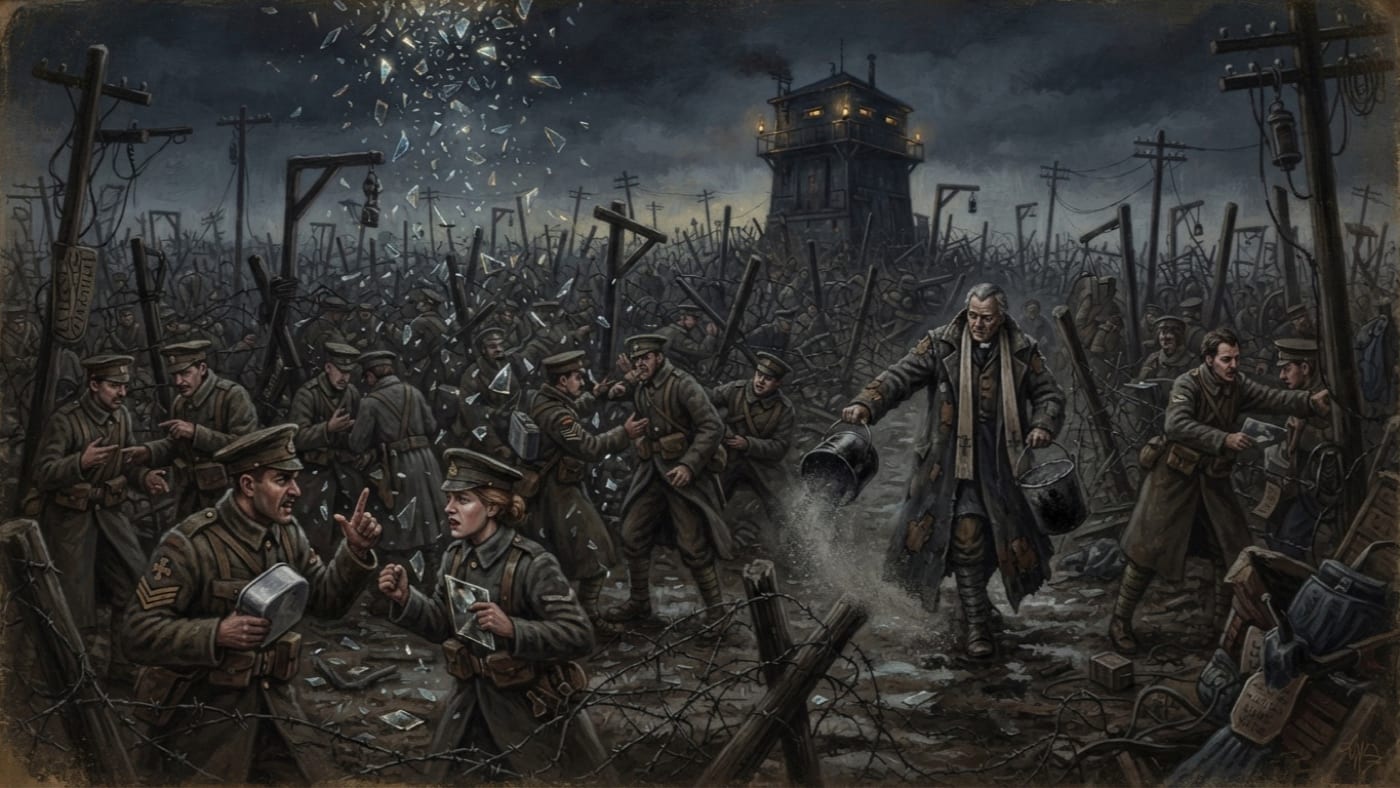
Then the glass began to work. Within a reported quarter-mile, shards of observation glass, spectacle lenses, cracked lamp chimneys and polished ration tins showed each soldier who looked down a rank. The ranks were all different. The name "Glass Rain" suggests a downpour. The record more modestly lists what happened to be lying about to be looked into, and does not say where any of it came from.
For forty minutes the garrison fought what the account calls a battle of promotions.
Corporal Jarek Muth declared himself Marshal of the Outer Wire and ordered a retreat. Nothing heavier than a piece of glass ever authenticated the appointment. No seal of Przemyśl confers it, and no tag on the wire records it.
Private Elya Sorn then declared Muth spiritually enlisted under her authority and ordered him to shut up.
That is the whole of the recorded exchange. The rest of this section is my own assessment, not recovered testimony.
The bestiary calls the condition rank fever. A soldier in its grip cannot see a peer. Everyone near him becomes superior or inferior, a judge or a defendant. Every command in a garrison depends on a quiet agreement between the person giving an order and the person taking it. Both must accept the same account of who stands above whom. Within that quarter-mile there were as many accounts as there were tins. A runner holding a message could not tell whose signature counted. A sergeant facing a private could not be sure the private was a private. Every claim to command produced a counterclaim, and the counterclaim had glass behind it too.
Nothing in the record says that anyone was possessed. Demons cannot take the will. They can only offer, flatter and deceive. Muth's mouth was his own when it ordered the retreat, and the lens only told him he was entitled to do so. This is worse for Muth and better for the Church. A deceived man can still be held to account.
The joke in all this belongs to Atheron, and I resent it. No bastion on the Line is more thoroughly graded than Przemyśl. Its tags measure the living in days, and its vaults rank the dead by what they confessed. The enemy did not abolish this hierarchy. He flooded it with forgeries, a hundred commissions where there should have been one roll. A bureaucracy that had defended its rankings against every thief and smuggler found itself defending them against a supply of more rankings.
No Mirror-Lord sighting is recorded at Orchard Ring. The Mirror-Lord doctrine describes injuries much like these, and anyone who has read it will see the resemblance. A resemblance is not an attribution. The account names a strike, a distortion and two claimants. It names no demon.
A.S. 186 recognition cards instructed personnel to identify Mirror-Lords by "reflective cranial surfaces and silver ceremonial robes."
The cards were withdrawn long before the Glass Rain. This is earlier recognition doctrine and not a finding from the Glass Rain. It is set down here because a sentry who still trusted the card would have spent the forty minutes watching for silver robes while a ration tin made him a colonel.
#On Ash and Authority
Archivist-Prelate Odran Kelle of the Chapel of Counting arrived carrying a bucket of ash and dumped it over both Muth and Sorn.
Kelle keeps the confession vaults of Przemyśl. His office knows where every soul in the bastion stands, what it has admitted and which shelf it is filed on. When a counterfeit hierarchy broke out in Orchard Ring, the keeper of the real one answered it with the nearest dirty bucket. I have heard that called crude. I would call it institutional loyalty in its purest form.
Ash dulls whatever it lands on. A lens coated in grey grit, or a cheek, or a tin, gives a reflection nothing to hold. Kelle may have thought about the theology of the moment or he may not have. He plainly understood the material side of it, and several Bureaus with larger budgets have yet to manage that.
The record goes no further, and neither will I. The bucket and the end of the forty minutes appear in the same account. The account does not say that the ash cured either claimant. It does not say what became of anyone else who had looked down, or whether one bucket was enough for a quarter-mile. I leave those questions open.
Kelle's report on the incident is said to contain no adjectives. I have not seen the full text. Nobody who mentions the report fails to mention the missing adjectives, from which I gather they were missed.
#On the Subsequent Instructions
These dates should be kept apart. The Bureaus prefer to remember them as one act of foresight.
Circular 192-M came out of the Switchbox Nine outbreak in A.S. 192, two years before the Glass Rain. It required the dulling of nonessential reflective surfaces in forward command, chapel, medical and signal positions. It also required that essential surfaces be logged, blessed and watched by two witnesses who mildly disliked each other. When the Sun-Spear struck the Orchard Eye, precautions against reflective surfaces therefore already existed at Przemyśl on paper.
What the circular says is a matter of record. Whether it reached an open wire grove, a corporal's spectacles or a private's ration tin is not. No surviving record shows how far Orchard Ring complied, and I will not invent compliance any more than I would invent dead.
The field doctrine now taught against the Mirror-Lords is five years younger than the glass. It dates from A.S. 199, when Sergeant-Matron Olya Krev's engagement at the eastern salient pulled the earlier practice into one order. That doctrine combines dulled surfaces with supervision of the surfaces that cannot be dulled. It requires paired witnessing, so that no soldier's own eyes have the last word on his station. It requires inventory speech, in which a soldier names his boot, his mud, his cartridge and the person to his left instead of the title he suspects he deserves. Where reflective terrain has been confirmed, it adds ash dispersal.
Some of these practices existed in A.S. 194 and some did not. The full doctrine did not. Anyone who applies the rules of 199 to the Ring of 194 is flattering the garrison and the Bureaus alike, and flattery is the one service the Church should not be performing in this particular article.
Kelle's bucket comes before the ash clause by five years. I do not claim that it wrote the clause. I only note that the Chapel has never tried very hard to deny it.
The next year Przemyśl faced a separate assault. The Spire-Crusher campaign of A.S. 195 belongs to its own entry.
#The Ratification
The Ledger holds a Sun-Spear strike against Przemyśl's Orchard Eye in A.S. 194. It holds a reflective distortion of rank across a reported quarter-mile, and forty minutes of competing commands. It holds a corporal who made himself a marshal, a private who enlisted him back, and an Archivist-Prelate with a bucket.
It does not hold the agent that carried the effect from the strike to the glass, the mechanism by which it worked, the dead, or the rest of Kelle's sentences. The Pride-Host has not been asked to supply them. The Wire Orchard went on hanging its tags.