
#On the Recovery of Property
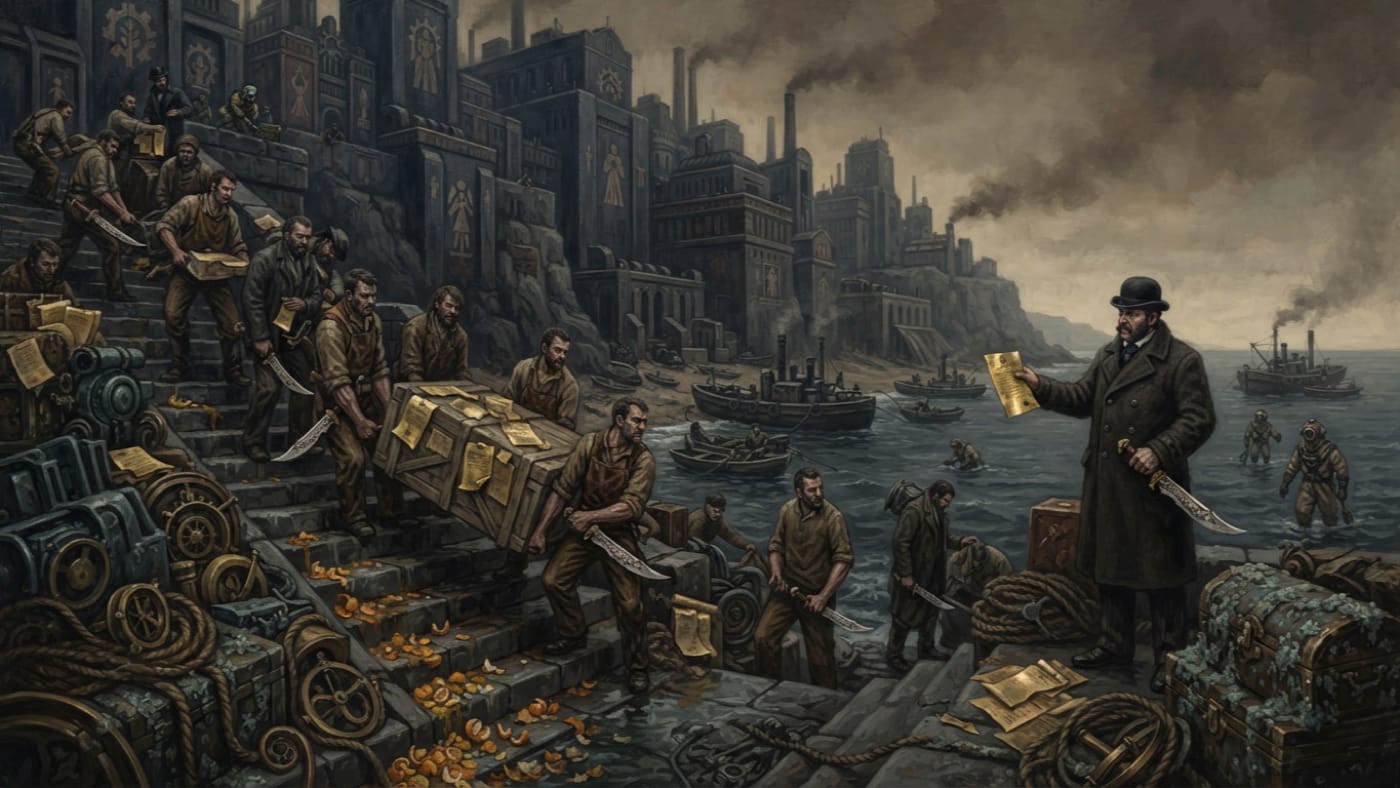
The Wreckmarket Salvagers, called the Gilt-Knives by everyone who has bid against them, recover property from the sea at Saffron Bastion. That is their public face, and it is accurate. Cargo goes into the Adriatic. Divers bring it up, boats carry it to the wreck beaches, and the stepped stone platforms of the Wreckmarket sell it to whoever holds the right paper and has the patience to wait for the right morning. Owners recover a fraction of their losses. The Coastal Registry records the recovery. Salvage dues reach the Bureau of War on the appointed day and in the appointed amount, which is more than can be said for most of the Church.
Beneath the wet crates, what the Gilt-Knives actually sell is exclusivity. A wreck is worth money. A wreck that only one party may touch is worth a great deal more, and the cartel's real trade lies in arranging that the richest hulls on the coast belong to nobody else. Their territory is the Wreckmarket and the wreck beaches below it. Their instruments are divers, boats and fences, meaning the patient receivers who take a bale of questionable silk and return it to commerce under a respectable manifest. Their legitimacy is a thin membrane stretched over a knife, and it has held for as long as anyone in the port can remember.
#On the Wreckmarket
The Wreckmarket climbs the shore in stepped stone platforms above the wreck beaches, so that a buyer may watch his merchandise being dragged out of the surf before he bids on it. The air smells of rust and cheap rum, and of citrus peel, which is strewn across the lower steps to mask what the sea has done to anything organic in the cargo. The peel fails. Nobody expects otherwise. Its office is ceremonial, like incense at a funeral where the deceased has waited too long in the sun.
The cartel controls the auction schedules. In a port where a fortnight's delay turns grain to compost and a lien to a forfeiture, whoever decides which lot is called on which morning decides who gets paid. A rival salvager who raises good cargo may find his lot called after the buyers have emptied their purses, after the quarantine clerks have arrived to inspect it, or never. A Gilt-Knife lot is called while the buyers are fresh.
Forged claims settle what scheduling cannot. Ownership at Saffron rests entirely on paper: registry, manifest, salvage notice, lien, indemnity. Each document can be drafted, and each can be drafted again in a steadier hand under an earlier date. The fences move the goods outward through the port while the claim papers move ownership inward toward the steps, and the two movements rarely need to meet.
Violence settles what paper cannot. On Wreck-Tithe Day, when the season's disputed claims come to the auction steps together, the knives come out. I can cite no approved calendar that fixes the day, and the salvagers need none, since every man on the beach knows when it falls. The lower platforms are scrubbed afterward with the same brine that rots the cargo. The Bureau of War does not intervene, because the Gilt-Knives pay their dues on time.
#On Sainted Wrecks
At Saffron, a "sainted" wreck is a hull the cartel has closed to everyone else. The word has no connection to canonization. The Bureau of Rites has opened no file on any of them, and the Bureau of Doctrine would be appalled to read the form if it had. It is a commercial designation spoken in a pious accent. A competitor is told that a sainted wreck is holy, or cursed, or claimed, or under quarantine, whichever frightens him most. A diver who ignores the designation meets the cartel's divers underwater, where disputes are brief and witnesses are few.
The term does its best work at the Sainted Wreckfield, two to three hours by skiff from the harbor, where the hulls are the cartel's most valuable holding and the one it understands least. The Gilt-Knives control access and sell the recoveries through the Wreckmarket. What comes up is reported to include sealed cargo from ships that never appeared on any register, relics attributed to saints who were never canonized, and bells that sound beneath the water in patterns matching no approved sequence. A wreck that "rang bells underwater" was reported in A.S. 199. The Bureau of Bells dispatched an auditor to the matter. The auditor has not returned, and the Bureau has filed nothing further for public reading.
The Wreckfield brings the usual friction of a haunted asset: claim wars, quarantine holds, cult pilgrims, and crews who row out in the morning and come back short. The undertow takes some of them and missing time takes others. Divers come up insisting that they were under for a minute while the boatman, holding the rope, counted a quarter of an hour. The Brine Choir gathers at sainted wreck sites as it gathers beneath the piers, for its own reasons, and the cartel has never been known to ask what they are.
The cartel owns the access to the Wreckfield and can explain none of what it brings up. Provenance is the one thing the Wreckmarket cannot forge, so it does not try. It sells the object and leaves the authentication to the buyer.
#On Disasters Entered in Advance
The dedicated survey of the port lists staged wrecks among the cartel's methods, beside forged claims and ordinary violence. It locates the schedules for those wrecks in a plain place: coded into the bid sheets of the Wreckmarket Auction Steps. The paper on which the cartel records what it intends to buy also records, to a reader who holds the key, what it intends the sea to sell. I have seen no such sheet decoded, and I will not invent its contents. That the code exists is set down in the survey, and that is sufficient to explain the cartel's prosperity.
A staged wreck is valuable at Saffron because of the Insurance Courts. Their writs turn a catastrophe into a financial instrument. Storm-damage assessments fix liability, and salvage-loss indemnities pay owners at rates the Courts set. Storm exceptions suspend civil law for the duration of a declared emergency and allow property to be redistributed by writ. A hull that goes down under such a writ produces an indemnity for its owner, a lien for its creditor and a salvage claim for whoever reaches it first. Writ-Lector Odrin Vale smiles when storms hit, and the port's concealed purge economy counts the salvage cartel among the parties who smile with him. No compact between the Courts and the Gilt-Knives has been produced. Their interests have never needed one, since a court that profits from disaster and a cartel that profits from salvage can each act on its own and still be paid by the same wreck.
The underworld calls Saffron the place where storms are authored. The port's most famous truth, and the one nobody believes, is that some wrecks are summoned by light. The Lanternline Chandlers' Lodge holds the oil and the approved patterns. No source I am permitted to cite divides the labor between the chandler who sets a lamp and the salvager who owns the shoal it shines on. I note only that both men are paid in the morning.
Coastal Registry entries described the Insurance Courts' storm exceptions as "a measured and proportionate response to maritime emergency."
Withdrawn, A.S. 200, Bureau of Doctrine Coastal Registry, following the discovery of pre-signed exception writs dated three to nine days before the storms they referenced. The revised characterization is "administratively irregular." No corresponding revision has been issued for the salvage claims entered under those exceptions.
#On What the Water Returns
The Demon-Lures of Saffron are two things under one name. In dockside speech the term means the waterline entities that call names from beneath the pier boards. Under Harbor Marshal Command it means the licensed apparatus of light, salt, false number, tone and gun that draws those entities into a kill-lane. The Gilt-Knives command neither. They come afterward. When a lureline has been run and the tide turns, the cartel salvages what washes onto the wreck beaches, and some of it, by the account entered in the Demon-Lures register, did not enter the water from any registered vessel.
The cartel prices these objects as it prices Wreckfield goods, by rarity and by the buyer's appetite. Nobody on the steps inquires where the sea obtained them, which is the Wreckmarket's oldest courtesy.
The work kills people in ordinary ways too. A salvage diver in Saffron loses teeth to cold and pressure, his lungs to brine-fever, and on a bad night his name to the water under the piers. Divers keep to registry numbers after chain-drop like every other pier hand. Some of them hold, with dockside conviction, that a man tells the truth only underwater, where nobody above can hear it.
Some distinctions bear on the claims. The Gilt-Knives do not set the lantern patterns, which belong to the Lanternline. They hold no liturgy, and whatever the Brine Choir sings at the wreck sites is not sung for them. The Ropehand Compact of Low Nets is a separate union with its own knots, its own skiffs and its own grievances. The two organizations share the same water and the same quarantine drafts, and they are not one body. When a ropehand works a salvage boat he is hired labor, and the claim belongs to whoever holds the paper.
#On the Present Claims
In A.S. 201 the Gilt-Knives keep the auction schedules, the sainted wrecks, the beaches and the boats that reach the Wreckfield. Their dues are current and their lots sell. The Bureau of Bells still awaits an auditor's report that has not arrived.
Canon-Inquisitor Silex Marrow is expected in Saffron with authority to audit the Insurance Courts' pre-signed exceptions and the Lanternline pattern books. The cartel appears in neither instrument. Both instruments, however, record dates, and a man who compares a dated exception with a dated pattern may begin to wonder what was scheduled for the same morning on the auction steps. The survey records that a rival finding proof of staged disasters is the one thing that would break the cartel's composure. An Inquisitor is a rival of a sort the Wreckmarket has never had to bid against.
Until he arrives the lots will be called in their order, and on Wreck-Tithe Day the knives will come out as they always have.