
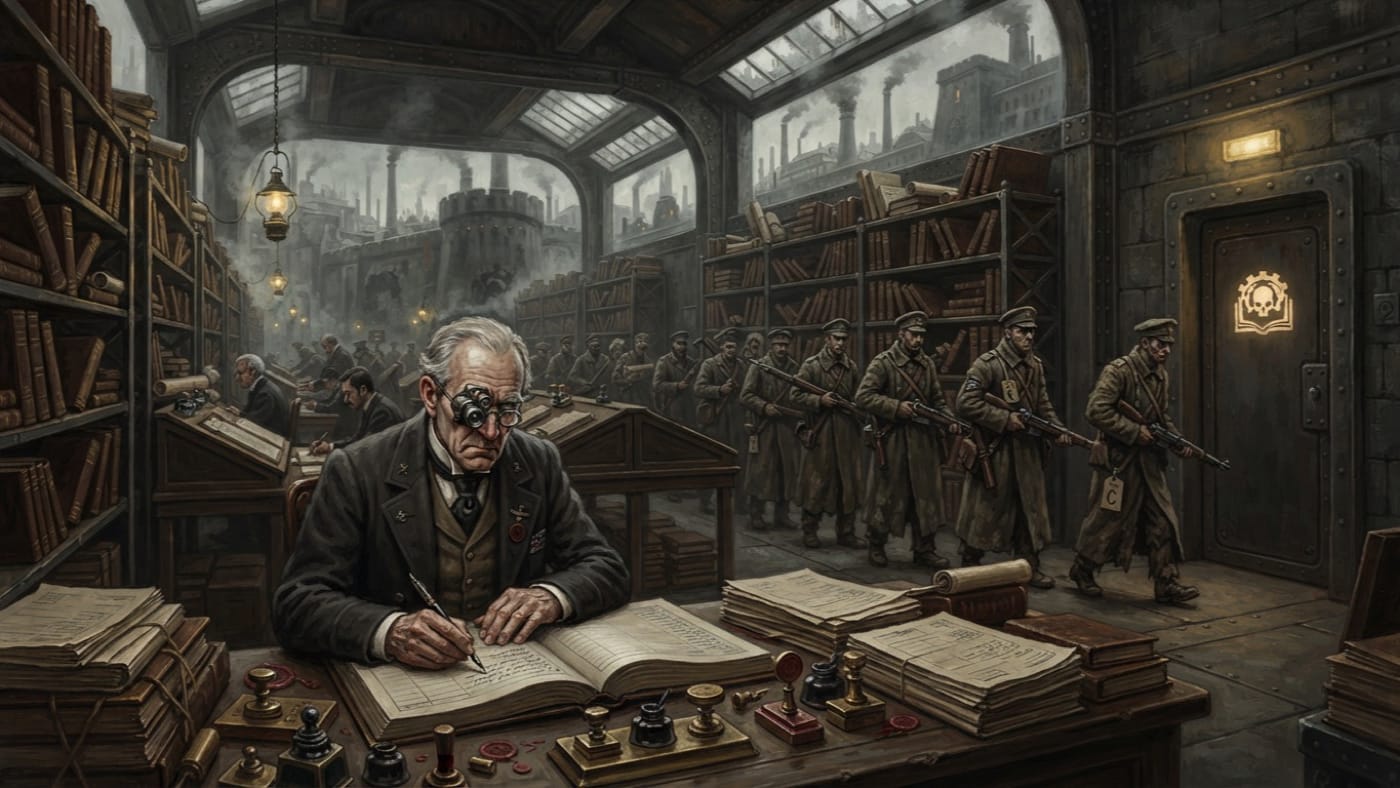
#On the Vacant Entry
A ghost slot is a line on a convoy roster that holds no one. It is ruled and numbered in sequence with its neighbours, then left blank. Later the blank receives a name, and the person who bears that name is moved. The occasion may be a day or a week away. It arrives with coin, or tears, or a bailiff's quiet cough.
That is the whole device. Every senior Ossuary-Draft Handler knows it, in the way every confessor knows the clink of a purse beyond the screen. The profession turns condemned bodies into transport capacity for reliquaries, ossuary crates, bell-caskets and warded bone loads bound for the front. Its paperwork runs in a chain: condemnation writ, draft roster, chain manifest, route permission, escort signature, completion certificate, loss report. Each document vouches for the one before it. A ghost slot is a link forged early enough that the later links vouch for it in good faith.
The word ghost belongs to the accountants. At night the cold ledger annex holds junior clerks and rats. The ghost is the vacancy, and afterwards the disappearance. The person stays real throughout. That is the inconvenient part.
#On the Recorded Loss
The variant that concerns this office was documented at Bastion-Przemyśl, in the Ossuary Convoy Office of Registrar Aldous Krenk. There the blank line, once filled, gains three things: a name, a Grade C notation, and the mark expired in transit. The person who owns that name leaves custody on foot through a waystation door. The roster records a death on the road. The road records nothing. Roads are illiterate.
The writ exists. The roster carries the name. Each later signature vouches for the page as it stood when it reached the signer. At reconciliation the loss report closes the line, and the completion certificate agrees with the loss. Nearly every hand that touches the file touches it honestly. The exception holds the pen at both ends.
The flaw sits in plain ink, waiting for the auditors of the Synod, if anyone ever lets them read it.
Grade C means unfit for march. A Grade C does not walk east. In the profession's catechism such a prisoner is delayed. In practice they stay in depot custody, or are sold into labour nobody names, or enter permanent quarantine, or go into a wall. A Grade C who expired in transit therefore died on a march they were classified as unable to join. The record has someone too weak to travel dying of travel.
I have been asked whether some lawful exception reconciles the two. None is on file. A confessor-booth clerk would call the contradiction a sin and a Handler would call it a seam. I call it a falsified record whose falsehood shows to anyone who reads two columns in one sitting. So few do. The ink holds because nobody reads across.
#On Those Who Leave
The device does not say who walks through the waystation door. A roster line has no opinion about the person who fills it.
It can lift an innocent out of a draft they should never have entered, such as a debtor misfiled among deserters or a pamphlet-owner caught in a Purity sweep that wanted numbers more than heretics. It can sell an escape to a family with enough salt and fuel chits. It can deliver a body to a gang or smuggler who wants condemned labour without the inconvenience of a sentence attached. That means another custody, uglier and unsupervised. It can simply sell the body. In every case the paper shows the same blank, the same Grade C and the same expired mark. The ink cannot tell rescue from sale. I doubt the waystation can either.
Where rescue occurs, it is thin. The one who leaves holds no pardon, no restored name, no citizenship, and no papers that survive a Gatewarden-Notary's second glance. They are officially dead. In the Wire Orchard, where a person without identity papers cannot buy bread, ride a cart or pass a counter, the officially dead live on whatever patron finds them useful. No charitable society waits beyond the threshold. Somebody waits there, and the file does not say who.
Clerks confuse the neighbouring devices, and auditors profit from the confusion. A mercy downgrade falsely marks a condemned person unfit so they stay behind, usually for payment. Nobody leaves and nobody dies on paper. Key drift records a shackle-key number wrongly so that an escape resembles a clerical slip. A discretionary upgrade sends a weak prisoner onto the march when the numbers allow it. The four share actors, bribes and cold rooms. They are separate sins and are filed separately.
Older handling manuals described the discretionary upgrade as "a mercy classification available at the Registrar's pastoral judgment."
Corrected. The discretionary upgrade is a throughput tool, used when convoy numbers, cargo weight and route hazard permit a weak body to be spent on the march. It puts a prisoner onto the road. The ghost slot puts a name onto the road and takes a person off it. Pastoral judgment has no part in either.
#On Krenk's Order
Krenk did not invent the ghost slot. The device is older than the forty-one years of service he had completed when I visited his hall in A.S. 197. It is probably older than anyone who would admit to remembering its first use. What he brought to it was order.
Under his administration the blank lines at Przemyśl acquired route logic, so a vacancy sat on a convoy whose road could plausibly kill. They acquired cross-linked dockets, so the name, once entered, answered to a writ that answered to a court. They acquired sickness stories, prepared before the person to be saved or sold had reached the intake counter. The profession's rule says to keep a sickness story ready for missing bodies. Most Handlers keep one crumpled in a drawer. Krenk kept his tailored, pressed and hanging like vestments in a sacristy.
His order could not choose its own season. A vacancy is cheap to hide in a convoy that bleeds men to fever and frost every week. In a convoy that arrives whole it stands out. Whatever mercy Krenk dispensed depended on the Bureau of War's appetite, on relic tonnage, and on escorts calm enough to sign without counting twice. When the front demanded backs, the march itself filled the blanks. When it demanded fewer, the blanks were free for other uses.
I do not claim to know every use he made of them. The attribution of the pattern to him rests on my reading of his ledgers in A.S. 197. There is no signed confession, and no authorization either.
#On Continued Observation
In A.S. 196 a memorandum of the Convoy Audit Office listed five headings for a transit loss: death in march, escape, medical withdrawal, doctrinal removal, and administrative correction. Its extract for Przemyśl ran thus:
The Audit Office wrote that carefully, and it should be read the same way. The extract names neither a practice nor a practitioner. Administrative correction is a broad heading. It covers a miscopied docket, a double-counted chain, or a name struck because it never belonged on the page. Krenk's ghost slots, as I read them, close as deaths in transit. The extract does not say how those deaths sit against Category Five in the office's own tallies. I will not invent a coding rule to make the story neater than Krenk made his ledgers.
What the memorandum establishes is narrow. The auditors looked at Przemyśl, found a pattern too clean to be accident, and chose to look again later. It fixes no date when Category Five began to swell. It fixes none for the ghost slot either. It also does not say that every administrative correction hides a living body.
The audit ritual is well known. Auditors check seals first, then headcounts, then keys. They set rosters against court dockets, sniff the wax for tallow, and question escorts about unscheduled stops. A ghost slot passes seals and keys without strain. It is exposed at the docket and at the stop, and a waystation door is an unscheduled stop with hinges. The auditors chose not to press on that door in A.S. 196, and they chose with delivery in mind. Innocence never entered the memorandum. The front was supplied, and in the field the front's satisfaction is the only absolution the Ledger grants.
The penalty for systematic roster fraud is erasure. It remains on the books. Like all our penalties, it waits for the moment when the fraud becomes less useful than the example.
#On the Remaining Entry
At the end of reconciliation the ghost slot is a closed line: a name, a grade, a mark. The column arrived one short, as the page had foreseen. The escort is paid and the reliquaries are delivered. In the annex the wax drips are scraped into the ash bowl and the bitter tea is drunk.
Beyond the waystation, a person with no lawful existence is breathing. They may be in a cellar, a work gang, a brothel or a family's loft. They may be in a grave dug by whoever bought them. The ledger is the only document that records them as dead. It is also the only place where the matter is settled.