
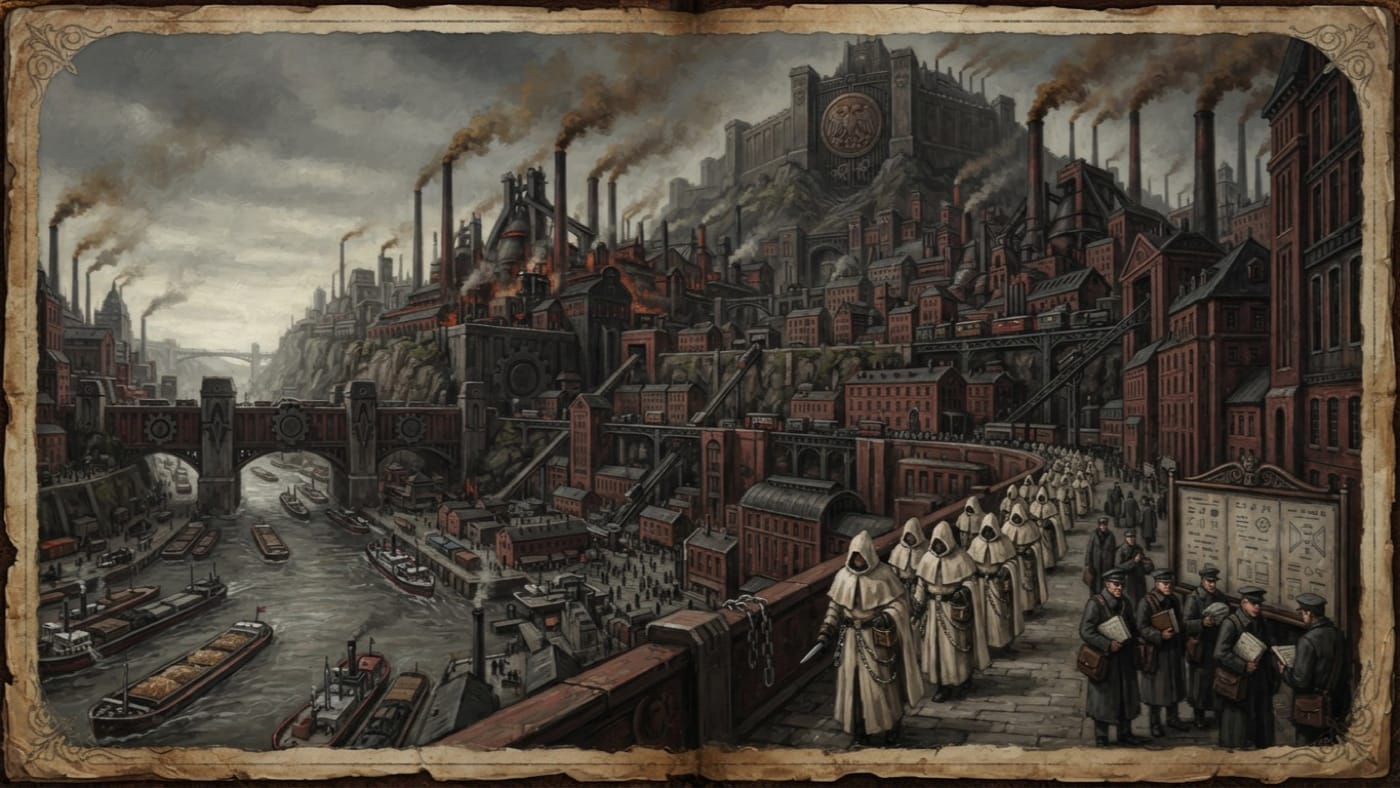
#On the Region and Its Seal
Germania is a procuratorial region. Its sins, harvests, furnaces and spelling errors answer, through several intermediate desks, to a Procurator appointed by the Concordat Hall of Strasbourg. The Procurator holds law and doctrine in one hand, and the seal is said to weigh as much as the Synod's own. I have never seen that claim tested. I do not intend to be the clerk who tests it.
The region lies in Zone 2 of the central heartlands, west of the Sagittal Line (Unregistered) and well beyond the trenches that run from Königsberg south to Constantinople. Germania hears the war chiefly as rail traffic, procurement orders and the occasional returned coffin with its paperwork in order. Its cities fear the inspector at the counter more than the Great Deceiver at the gate. The inspector is reliably closer.
Below the Procurator, the ordinary furniture of Synodal government fills every room. There are resident Governors and Vicars, city archons and wardens. There are also the Bureaus, and each of them is certain its writ arrived first. A Germanian merchant may live a whole life safe from demons and still die in a jurisdictional dispute.
#On the Earlier Authorities
The name belongs to the Synod's administrative vocabulary, beside Francia, Iberia and the Alpine Marches. It should be kept distinct from the older German states, whose princes, free cities and quarrels it eventually absorbed. Those states had borders. Germania has a filing system.
The change from one to the other took most of a century. The Rationalists governed these river towns through councils and charters, and the Treaty of Regensburg formalised their Republic in A.S. 30. Beneath them the Church kept its own registers in hiding, and it was patient. After the Sundering (Unregistered) of 1 November A.S. 45 it came into public life unevenly, town by town. Some places welcomed it. Others simply did not oppose it. A provisional council governed from about A.S. 50. The Common Allegiance of A.S. 55 and the Black Decrees of A.S. 58 extended the new authority through accessions, subscriptions and the persuasive presence of armed men. Records was transformed in A.S. 78. Purity and its Index took their familiar shape around A.S. 80. The formal Synod arrived only with the Concordat of Strasbourg in A.S. 90.
So Germania has no birthday. It has layers of stamps, laid down one on another. Kanzleiburg, formerly Berlin, received its present name in A.S. 95 when the Prussian state was absorbed. The Bureau of War has not once regretted the change.
#On Rivers, Furnaces and Supply
The Rhineland is the region's oldest artery and also its most heavily taxed. Barges carry grain, salt, wax, fuel and paper down a river that once moved them for the price of a rope. The Rhine Corridor now turns every cargo into schedules, seals and tolls. Mainz keeps its bridges, its tolls and its pilgrims, and all three are counted at the crossing. Cologne keeps its archive-banks, where vault finance and confession share a ledger and sometimes a clerk.
Rheinscarp shows the method at its most vertical. Nine terraced Steps climb a cliff above the river, and each Step is both a district and a tollhouse. Barges bring grain and ash into the Sump Docks, and the ration mills grind both into flour and receipts. To pass from one Step to the next, a citizen presents coin, verse and stamp. If the citizen gets the verse wrong, the clerk records them as absent. Only confession can amend that condition. The local motto is NO STEP UNSTAMPED, and the local proverb is "Never argue spelling at a gate." Both are sound civic advice.
Essen-of-Hymnsteel makes the war's throats. Bell-cannon throats, hymn-drive housings and reliquary fasteners leave its foundries under the joint government of three Bureaus: Engines & Furnaces, Records, and Orison & Song. Calibration choirs sing during the pour. Doctrine holds that the right stanza steadies the metal, and the casualty ledgers record what follows the wrong one. In Essen, silence is licensed property. Singers pay a voice tithe, and stokers are half-deaf by thirty and thanked in sermons. Essen's laws belong to Essen. I would not wish them exported, chiefly because Essen would invoice the recipients.
To the north, Hamburg takes in the North Sea's cargo and passes it on to Kanzleiburg, the rail junction that serves as the northern theatre's administrative brain. To the south, Munich holds the Bureau of War's largest warehouses and the last comfortable beds before the forward zones. Between them, Germania manufactures what the Line consumes: steel, flour, rails, clerks, and sons.
#On the Corrected District
Fire alone cannot govern a region that runs on presses, markets, schools and counting houses. Fire closes shops, and closed shops pay no tithe. A print-house burned for heresy on Monday leaves the Bureau of Tithes short on Tuesday, and by winter three illegal copyists will be working in its place. Germania learned this arithmetic early and has relearned it often.
The Bureau of Doctrine decides which words are permitted and publishes them in the Index Claritatis. The Bureau of Purity enforces that decision, and the Index Damnatus lists what must go. Purity's White-Mantled Inquisitors are known in every Germanian market by their equipment: the mantle, the glass chain, the amendment strips, the censor knife and the evidence box. Where a district still functions, the Pragmatist current among them prefers correction to cleansing.
Every printer between the Rhine and the Elbe knows the procedure. The examiner enters and displays the offending plate. A replacement plate or term is supplied. The bad run is pulped under witness, at the printer's expense. Schoolmasters receive corrected copybooks. Shopkeepers receive amended signs. Parish clerks receive hymnals revised by a syllable. Throughout, the warrant stays folded in the examiner's satchel, unused and available, and everyone in the room can read it perfectly well. Quarterly Language Conformity Assessments then measure whether the new word has taken.
One Pragmatist district produced the highest Claritas uptake in Germania. The internal Purity record that reports this does not trouble the casual reader with the district's name, and I shall not either. The distinction was cited to defeat a lecture that lumped the Pragmatists in with the Shadow Crew, which tells you where Purity keeps its compliments. The score is the assessors' business. The result is visible in any district of that kind. The signs are current and the hymnals match. Children use the licensed term without prompting, and adults have stopped noticing that anything was taken.
#On Rival Claims to Order
The Purists dislike Germania's quiet. They see printers still alive and call it tolerated infection. A district that corrects itself, they argue, has only learned to hide its plates more neatly. Purists are sent where language has become a banner, a song or a riot. The commercial towns of the Rhine receive them less often than they would like, and they write long reports about it.
The Shadow Crew likes Germania's quiet very much. Where compliance is measured in ledgers, exemptions can be sold and seizures can be mislaid. A printer can even be spared for payment rather than for obedience. Chainmasters have regarded an unchipped chain with suspicion ever since the Glasschain Reform taught them to. A clean chain may mean a district that polished itself, or an officer paid to look elsewhere. Records keeps both possibilities in the same file.
Each Bureau wants obedience it can count, and each counts something different. Tithes wants the shop open. Records wants the receipt. War wants the rail spur running. Doctrine wants the word. Germania gives each of them something, and each suspects the others got more.
Regional gazetteer, Cologne entry: archive-banks; vault finance hub; Council of Cologne, A.S. 70.
Corrected. The first Council of Cologne sat for nine days in September A.S. 27. The later Council and Edict of Cologne belong to A.S. 100. This office recognises no council of A.S. 70. The gazetteer clerk responsible has been recognised instead.
#On the Present Condition
As of A.S. 201, Germania is productive, literate, taxable and closely read. Its rivers carry grain under seal, and its furnaces sing on schedule. Its schools teach the current word, and its shop signs display it. The White Mantle passes through its markets carrying an amendment strip far more often than a torch, and the citizens have learned to give thanks for the courtesy.
Over all of it hangs a Procurator's seal, appointed from Strasbourg and answerable to Strasbourg. It is pressed into wax so often that no one in Germania remembers when the wax was optional.