
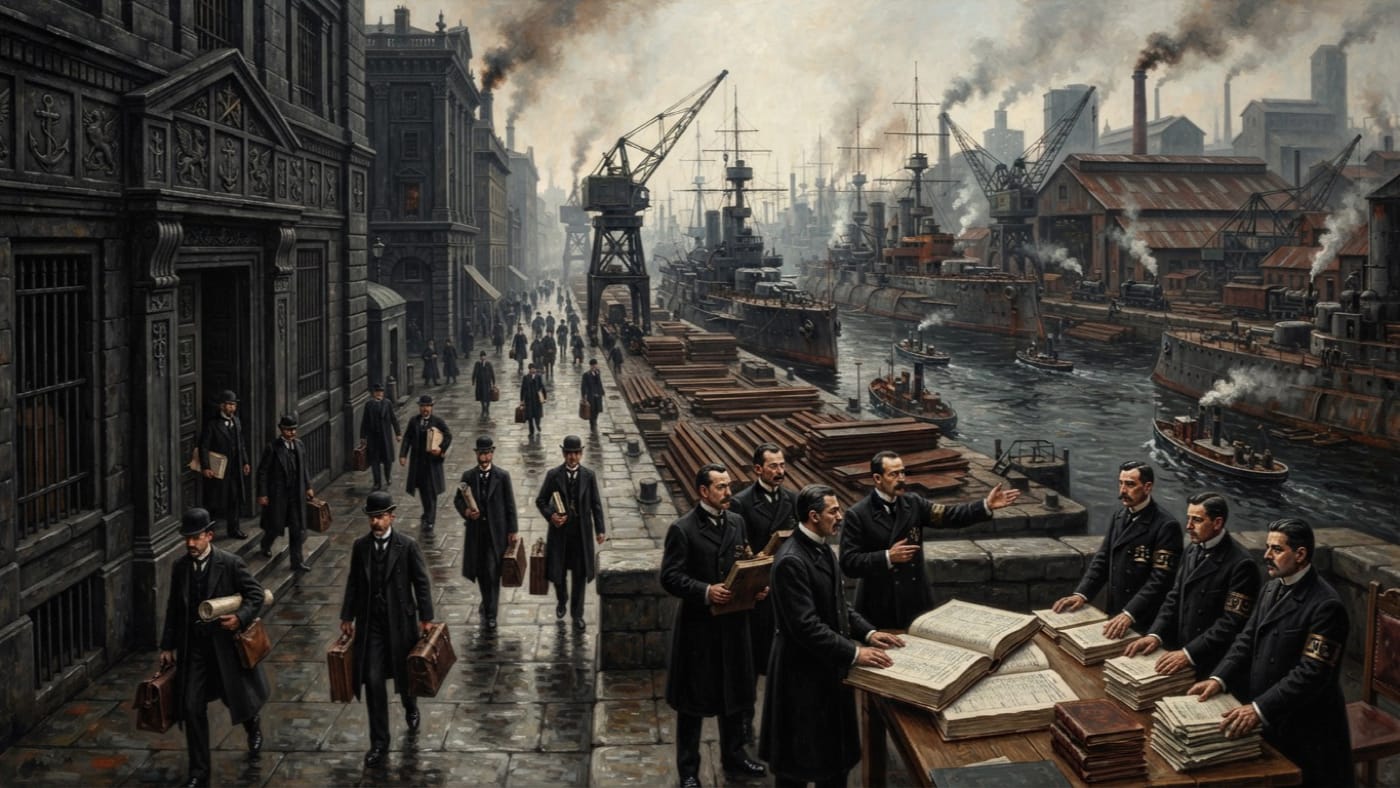
#On the Houses and the Quay
The Genoese banking houses own no fleet, cast no guns and rivet no hulls. They keep ledgers. Behind carved doors on the Bankers' Quay of Genoa, men and women in black coats write the entries that decide whether a hull leaves drydock this week or next season, whether a convoy sails insured or sails on prayer alone, and whether a grain shipment bound for Bastion-Constantinople gets its escort or waits at anchor while somebody reconsiders the paper. The shipyards build the vessels. The Bureau of War commissions them. The houses decide, with great courtesy, when either party may begin.
There is no single Genoese bank. There are several houses. They compete with one another, they are bound together by contracts more often than by marriages, and they share chiefly the conviction that a signature is a holy thing, provided it is someone else's. No charter makes them one corporation, and no council speaks for all of them. Strasbourg has sometimes wished for such a council, on the theory that one throat is easier to hold than several. Genoa has declined to grow one.
#On Service under the Settlement
Genoa submitted to Synodal administration after the Concordat of Strasbourg formally established the Synod in A.S. 90 (1800 CE). The city's compliance has always been called grudging. On the Quay that word means fully performed and separately billed. The houses read the settlement the way they read any instrument: for its enforceable clauses, its remedies, and the courts where a remedy may be pursued. They found the law of Strasbourg severe and exhaustive, and above all written down. A banker can live under almost any master who writes things down.
The commercial opening came later. In A.S. 123 (1833 CE) the Harmonized Routes Edict gave Marseille the pilgrim fleet and gave the Bureau of Pilgrimage its southern monopoly. That left the warships, the repair berths and the paper underneath them to be settled somewhere else. The Edict founded no Genoese house and named no Genoese contractor. It drew a line around the pilgrims. Genoa looked over everything on the other side of that line and began issuing terms.
#On the Instruments of Maritime Credit
The houses lend against things that float, things that sink and things not yet built. They use five instruments, and each one answers a different fear.
The convoy bond raises money against the passage of a whole convoy, so that escorts, stores and wages can be paid before any ship has earned anything by arriving. The hull mortgage binds a vessel to its debt. A ship may fly the Bureau's banner and carry the Bureau's guns and still belong, in the only sense that matters at foreclosure, to a ledger on the Quay. The war-risk note covers what ordinary underwriting will not touch: cargo sailing into waters where the enemy is no longer a figure of speech. Salvage claims settle who owns what the sea gives back and who pays to raise what it keeps. The fifth instrument is the emergency patriotic loan, issued under duress and repaid under protest. It is the only form of finance in the Church in which both parties feel robbed and both are correct.
The Genoese arsenal abstract of A.S. 200 (1910 CE) sets out the arrangement plainly. The Bureau of War's Mediterranean Naval Office is the counterparty. The Ligurian houses stand as credit guarantors, and their names are held under commercial seal. The contracts they guarantee cover convoy escorts, patrol cutters, hull repair, naval artillery housings and emergency drydock priority. The houses do none of this work. No banker has caulked a seam or seated a gun. They guarantee that the men who do will be paid, and that guarantee is why the men turn up.
When credit is extended, a damaged hull goes into drydock ahead of its turn because someone has paid for its emergency priority. The yard-master orders timber against the bond. The convoy clears with its war-risk cover stamped, and its captains will obey orders that might drown them because their widows will hold enforceable paper. When credit is withheld, nothing explodes. Repairs wait. Cover lapses. Escort rosters thin. A shipment for the east sits in the roads while its escort waits for a signature, and every day of waiting becomes an entry somewhere, a cost to be argued over later by better-dressed men.
#On the Suspension of Credit
Maritime summaries once ranked Genoa below Marseille, as the lesser port of the southern coast. That ranking did not survive the houses' suspension of three convoy-credit instruments for forty-six hours.
The public record of the suspension is narrow. It gives no year and names no house. It also omits the value, the ships, the convoys affected and the terms on which the paper resumed. I decline to supply any of these from imagination, which the Bureau of Purity calls an offence when it is practised on evidence. The record that survives is enough. For forty-six hours the paper stopped, and the Bureau of War learned that its southern naval programme could not run on authority alone. The commissions were valid, the orders were sealed and the hulls were waiting for hands. But the instruments that turned orders into wages and insurance cover had been withdrawn, so the orders went nowhere.
Three instruments and forty-six hours were enough to revise the Synod's maritime hierarchy without a shot fired.
Earlier maritime summaries described Genoa as "a secondary Mediterranean port subordinate to Marseille."
Withdrawn after the Genoese houses suspended three convoy-credit instruments for forty-six hours. Marseille carries more pilgrims. Genoa holds the paper under the Bureau of War's southern hulls. In the Bureau's own usage, subordination assumes that the lesser party cannot stop the greater. The designation is retired and is not to be revived in correspondence, however tempting.
#On Audits and Devotion
The Bureau of Tithes keeps a permanent audit office near the Bankers' Quay, close enough for its clerks to hear the counting-house doors close. The houses comply with every audit. They open the ledgers, produce the vouchers and provide chairs. Then they contest the classifications. Is a salvage claim income, or the recovery of a loss? Is a war-risk premium taxable trade, or a contribution to the defence of the Church? Is a mortgage on a Bureau vessel a lien on sacred property, and if so, which Bureau is the sinner? Each question produces a finding, each finding an amendment and each amendment a protest. The audits close without anyone agreeing what is owed.
I admire the work and resent it in equal measure. Their columns are ruled true, their wax is clean and their cross-references hold. Every figure has a voucher, and every voucher has a witness. It is exactly the kind of ledger the Bureau of Doctrine demands of the faithful, kept by the people best placed to use it against the Bureaus.
Each house keeps a chapel in its courtyard and a guarded vault for collateral. The chapel holds the house's devotions and the vault holds its securities, and both are kept with the same exactness. The old republican families keep their portraits in private halls, where ancestors rest painted hands on ledgers and ship models. Nobody calls these portraits political. They are heritage, and heritage is appraised rather than prosecuted.
The Bureau of Purity has a station near the Arsenal Steps, and in my assessment it reaches no further than its lanterns. No statute exempts the bankers from Purity. The difficulty is practical. Genoese conduct is contractual, documented and witnessed, and it is defended by canon lawyers whose fees exceed a Purity station's yearly lamp oil. The houses have something more durable than immunity: it costs too much to prove them wrong.
#On Rivalry and Present Application
The rivalry with Marseille runs through the houses' accounts. Marseille holds the embarkation permits and the berth fees. Genoa holds the War shipyard contracts and the credit behind them. When Pilgrimage pushes its berth fees too far, Genoese yards underbid Marseille on military hull repair, and the houses finance the underbidding. When War awards a naval tender to the east, Marseille delays Genoese pilgrim permits. The Bureau of War threatens to move work to Venice, and Venice replies on expensive paper. Nothing important moves.
The houses are following the A.S. 199 (1909 CE) arbitration closely. It turns on whether return voyages count as departures for fee purposes. Every insured voyage carries a fee schedule, so the margin on every insured voyage depends on the answer. The panel has not ruled.
As of A.S. 201 (1911 CE), the date of the present Genoese survey, the houses still guarantee the Bureau of War's southern contracts, Tithes still audits them, and they still contest the findings. The drydock queue at Genoa still moves in the order the Quay has financed.