
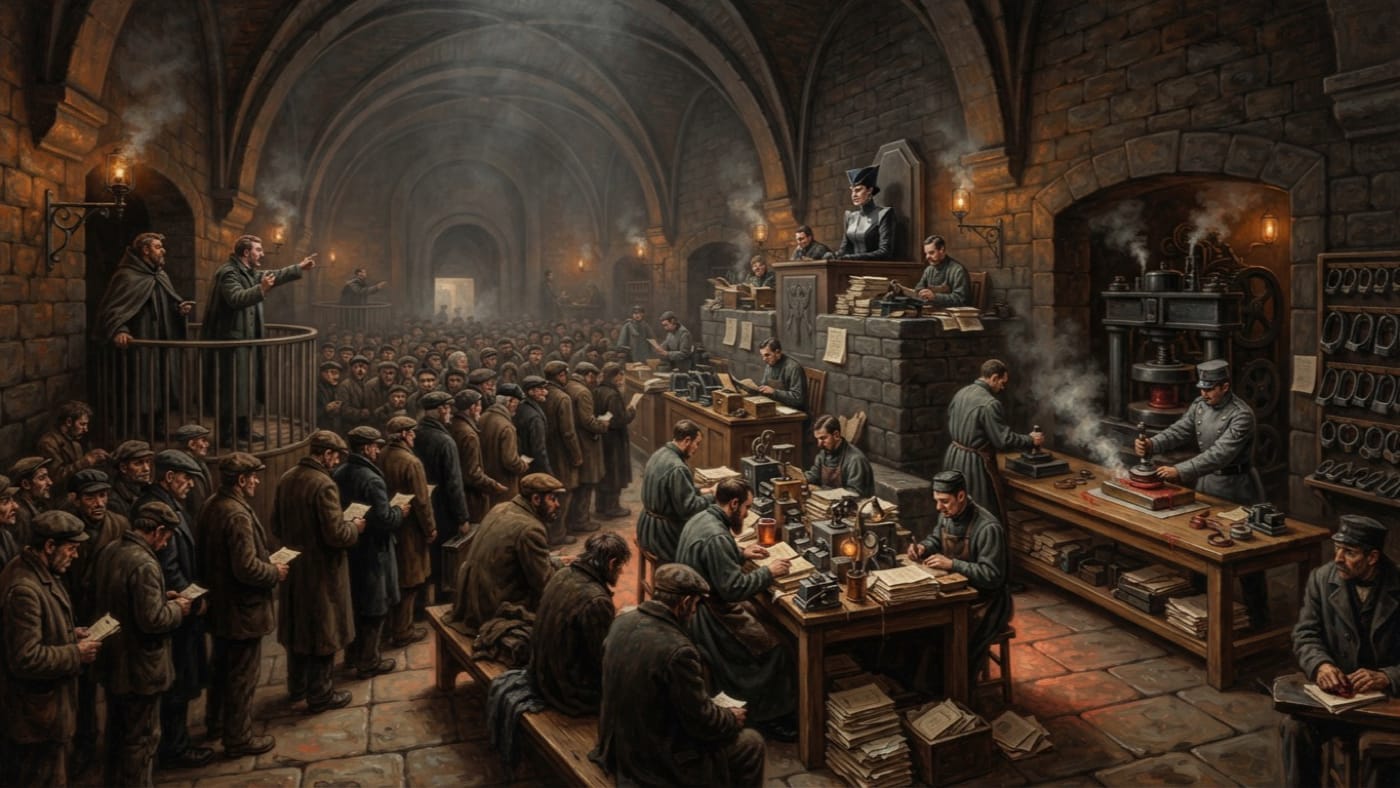
#On the Hall and Its Approaches
"Stand Correct. Move When Named." (Directorate motto, painted in black above the Hall door)
The Gate Nine Hearing Hall is a room. I insist on the point because the Queue Road has spent a century teaching its travellers to mistake rooms for fates. Gate Nine is the whole clearance complex, the largest court and reclassification hub on the Road, with its lanes, yards, rate boards and back offices. The Gate Nine Court is the tribunal seated inside it, a bench with loyalties. Gate Nine Commons is the labour yard next door and smells of chalk and bodies. The Hall is the stone box in which the Court hears cases. It is where a petition stops being a hope and becomes a docket.
It is reached the way all Gate Nine business is reached, which is slowly. Travellers cross the Waiting Fan, where they are divided by paper and condition, and then enter the Appeal Throat, a roofed passage lined with witness boxes, confession slots and tariff boards. They arrive in the Hall already sorted. The building is cold stone. Its square paving has been polished by boots, knees and handcarts, and it is warmer than the season permits. The Directorate attributes the warmth to packed bodies. It attributes a great deal to packed bodies.
The air smells of hot wax and sweat. The wax belongs to the seals. The sweat belongs to everyone else.
#On Being Heard
Before he can be heard at Gate Nine, a petitioner must show that he exists in the correct order. Desks along the approach compare his bell-card sequence against his name, his name against his cargo, his cargo against his witnesses and his witnesses against his confession. Then they set the whole sorry bundle against his minute account. The Hall fully recognises only his paper: Bell-Mark Slips, Minute Permits, Lane Reclass Tokens, a Witness Certificate if he could afford one and a Throughput Assignment if somebody else could. The Appeal Docket is issued last and read first.
Three authorities touch that paper, and the bench is only one of them. Director Othmar Vell's Permit Directorate sets the price bands from which every minute is reckoned. Clerk-Prime Yoren's Time Clerks' Collegium keeps the ledgers and decides which entries it will recognise. The Court rules only on what the other two have made legible. A man may win his appeal and still lose his passage because a Collegium clerk declined to see a mark that was plainly there. I have seen it done with an eyebrow.
The economy under the docket is simple enough for a child, and Road children learn it before their letters. Waiting earns minute credit. Credit can be sold, and a merchant who buys enough of it passes faster. Debt comes from elsewhere: a missed mark, a failed audit, a penalty or a lane reclassified after entry. Debt compounds, and debt left unpaid ripens into compulsory labour or erasure to the Null Verge. Plenty of the Hall's petitioners owe nothing at all. They bring cargo disputes, quarantine questions and names spelled two ways on the same slip. The benches are sorted by category of appeal, and the category is the first verdict anyone receives.
Mistress-Court Sera Nox presides on formal appeal days. She is perfumed and she does not bend. Hers is the only scent in the Hall that comes from neither labour nor fear, and that is why she wears it. She controls appeal approvals. Everything else in the room, from clerk and bailiff to rented witness and warm stone, waits on her nod.
#On Wax, Witnesses and Collars
The Hall keeps a witness ring where the bench can see it. The ring is stocked from Stamp Court Row, home of the Witness Rental Houses, and the largest house answers to Mother Venn and Garrik Two-Names. They are a cartel, separate from the Court, and they rent memory by the statement. A coached witness will recall a lane mark, a debt paid or a cousin's honest face. For a better client he will recall the opposite. The Appeal Whisperers of the Row draft the confessions. Their sentences are pious in cadence and hollow in doctrine, and they pass, because no clerk at Gate Nine has sat the examination that would catch them.
Confession is the Hall's true coin. A petitioner who confesses may receive a mercy ruling, which can mean a lighter reclassification, labour in place of erasure, or negligence entered where fraud was threatened. The mercy is genuine, and so is the receipt. The booths beside the courts index every admission by timestamp. A man's words this spring can then be laid beside his words next year, and the gap between them sold to whoever holds his debt.
A judgment spoken from the bench is ceremony. A judgment pressed in wax in the stamp room is law. The Candlewick Palatinate supplies the wax, and the clerks keep it hot at their elbows so that no ruling need wait for a flame. When the stamp falls, Bailiff Dorn's oath-collar men move. On heavy days the Hall has seen mass collaring: debtors fitted in rows, then walked out to the Commons and the labour assignments beyond, which include barricade hauling, latrine cleaning and ledger copying for the lucky ones with a hand. Dorn handles collars like stock on a jeweller's tray. I have watched him size a neck by eye.
#On the Floor Beneath the Hearing
By A.S. 178 the Hall's presses had become a nuisance worth an Engineering commission. Stamps landed out of true and presses shuddered. Cooling wax developed fine radial fractures, so a ruling could crack before it set. Table legs trembled. Ledger margins hummed when left alone, which no clerk wished to report and every clerk reported.
Bureau of Engineering Team Gamma-9 drilled for the cause. At about forty-two feet through Heartlands limestone, the bit broke into a chamber that appeared on no plan. It had dressed hexagonal walls and a ribbed vault. A basalt slab lay on its floor with six channels cut outward from the centre, and above it a vertical wheel some twelve feet high was turning. The survey belongs to its own record, and the installation to its own entry. For this plate it is enough to know that the Hall's floor is a ceiling seen from below, and that something under it moves.
Report One went into the Bureau of Shadows deep archive under a hyphenated filing sequence that no decent registry would accept. The drill aperture was sealed within forty-eight hours, publicly on grounds of structural instability, and the Hall resumed its sittings. Report Two, filed A.S. 194, recorded three grey-robed maintainers at the axle. Six days later the Minute Drift received its Category Two classification. Report Three, A.S. 199, recommended continued non-disclosure pending Phase Nine. Its fourth sentence is withheld from me, and I have stopped asking Records to pretend otherwise.
The Bureau of the Hourglass assesses what happens near the Hall as extraction, which is a separate matter from mere slowing. The assessment is theirs and I record it as theirs. Holding a report is a different thing from commanding a machine, and Shadows has never claimed to do the second.
Public posture on the A.S. 178 Gate Nine survey: maintenance incident resolved.
Corrected. A resolved maintenance incident does not send its report into Shadows custody under a non-standard sequence, and it does not leave the Hall's stones warm and trembling in A.S. 201. The aperture was sealed. The incident was filed. "Resolved" is withdrawn.
#On the Closed Gate and the Present Sitting
In the spring of A.S. 200, minute prices on the Road doubled without any published decree. More debt brought more appeals. More appeals brought more confessions to the booths and more collars to Dorn's trays. That autumn Gate Nine closed for sanitation and the Hall closed with it. Hearings stopped, though debts kept compounding. Within three days bodies were stacking in the Barricade Maze, where the queue had no lawful way forward and no way back. I hold no count of deaths inside the Hall and I enter none.
As of A.S. 201 the Hall is in session again. The assessment is Amber, which in the house dialect of the Bureau of Doctrine means every office knows something is wrong and none has chosen a posture that would cost revenue. Prices have not fallen back to what they were before A.S. 200. The Fan fills, the Throat narrows and the benches take their categories. Stamp Court Row keeps its witnesses brushed and ready, and the booths keep their hours. The wax sits hot at the clerks' elbows. Sera Nox hears what reaches her. The stamp room presses what she approves and a good deal she never sees. The floor is still warm. Nobody at the gate has entered a cause for it, because that column does not exist.