
#On the Substance and Its Issue
Fume paper is reactive parchment. Every Purity Fume-Inspector of the Ninth Mark is issued it along with the ledger-lantern, the ash vials, the wax seals, and the stitched nose-mask that turns a human face into a Bureau instrument. It is made by the Bureau of Engineering's Scriptoria annex. Of the annex I shall say nothing further, since Engineering has said nothing further to me, and I do not enjoy being the only party in a correspondence.
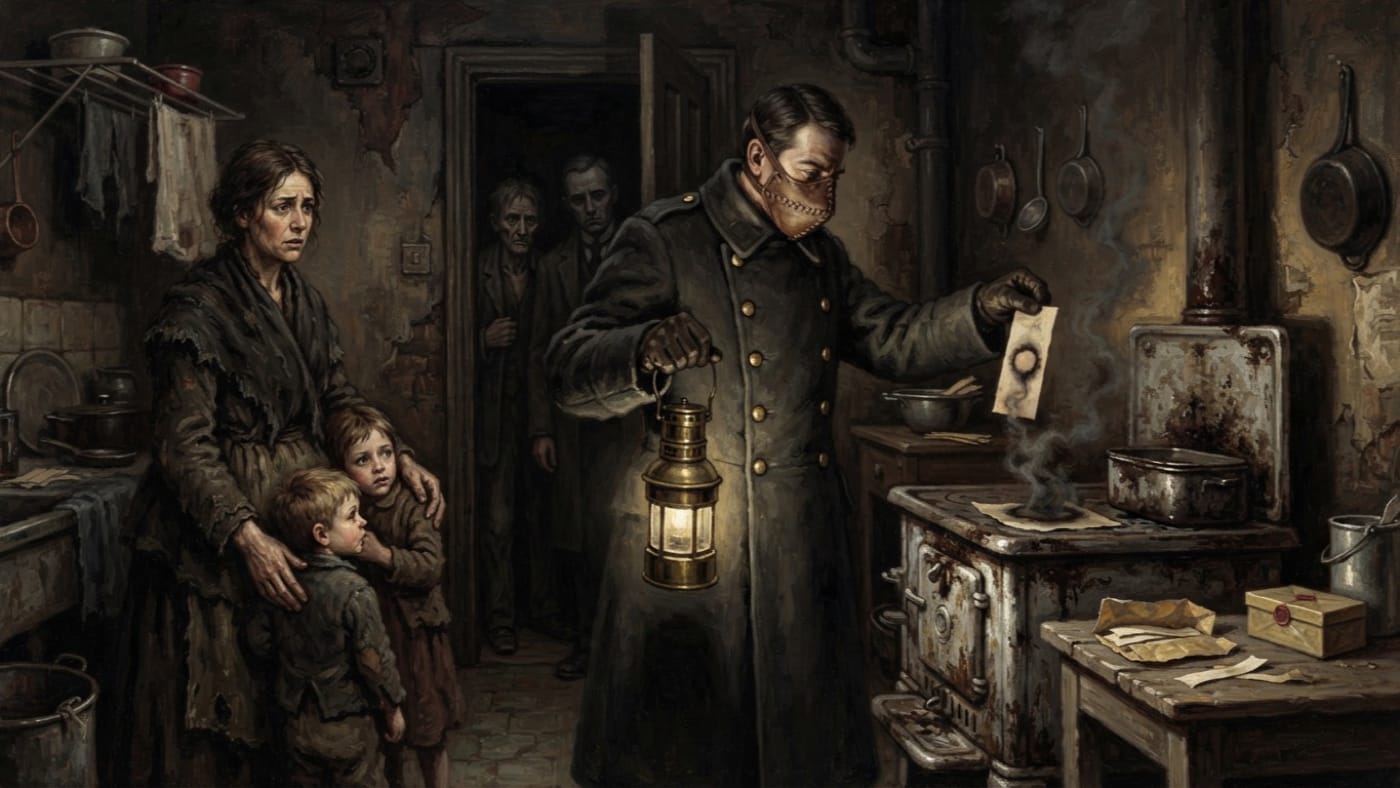
Observe it at work. A tenement kitchen in a furnace ward, on the dawn sweep, with the bread queue still forming below. The stove is warm. The woman of the house swears it was lit with sanctioned coal. The room stinks of wet soot and boiled cabbage, and of something acrid underneath both. The inspector draws a strip from the oilcloth packet, holds it a hand's width from the flue, and waits while the lantern hisses. Nobody speaks. The children watch the paper because the adults are watching it.
Then it blooms. A dark ring spreads from the edge toward the centre, slow as a bruise, and the woman's oath becomes a matter for Records.
That is the whole substance of the thing. A pale strip goes near smoke and comes back with a mark. Everything else in this tract concerns what the state does with the mark.
#On the Authority Given to a Strip
The Bureau of Purity's earlier institutional reforms, including its first Index work, belong to A.S. 80, long before anyone thought to make smoke answer questions. The strip's present authority comes from a later and colder settlement: Operational Directive 14 of A.S. 143 / 1853 CE. That directive constituted the Ninth Mark and standardised entry, seizure, and citation in every district where it was obeyed.
A.S. 143 was the Year of Ash Rain. Maldrake's fires in Thrace filled the eastern sky and ash fell for months. Crops failed and the Ninth Bell Famine followed. Sanctioned fuel vanished into military channels, and black diesel walked into the kitchens. Directive 14 gave inspectors the right to enter. It did not tell them what they had found once inside.
The Index of Prohibited Emanations, compiled after the directive, supplied that language: forty-seven items, with black diesel at Item One and "air of suspicious warmth" at Item Thirty-Nine. The Index names the offence and the paper shows the stain. Neither can stand in a tribunal alone, which is why the Bureau issues both.
#On the Blooms
Four readings are taught in the field. Every inspector learns them before learning how to lie about them.
Dark rings mark petroleum distillates. Black diesel is the commonest, and lamp-cuttings and coal-oil of doubtful origin answer in the same dialect. Ruddy spirals mark animal fat: gutter tallow, kitchen grease cut into chapel wax, the widow's candle made from the widow's supper. Grey feathering marks wax adulteration, the soft smudge left by a devotional taper padded with something cheaper than devotion. Greenish freckles mark demon-glass residue. An inspector who sees them seals the room before doing anything else.
These four are field readings. They are not a chemistry. Hold a strip over a stove that burns diesel and tallow by turns and it will ring and spiral and blur into a muddy grievance that two senior officers will read three ways. Old soot in a flue answers for last winter's crimes as readily as for this morning's. Bitter incense fogs a strip. A damp filter cloth, a sweating hand, or a gust from the stairwell has spoiled many a sample, and none has ever spoiled a career.
What the paper cannot read matters more than what it can. It shows what burned. It cannot say who owns the stove, who sold the fuel, whether a licence sits in the drawer, or whether the household had any choice that week between diesel and death. Permission is a filing condition. Ownership is a question for Records, and guilt is a question for the tribunal. The strip is a witness that cannot be cross-examined, and that is its entire charm. The household, for its part, could not give a damn about the chemistry. It wants to know whether the stove stays lit.
A Ninth Mark instructional slate states: "A positive bloom constitutes proof of unlawful combustion by the occupant."
Corrected: a positive bloom constitutes a material observation. It becomes proof of anything once it has been classified under the Index, shown to witnesses, sealed, entered, and filed. An unfiled bloom is a stained scrap and will be burned with the others at shift's end.
#On Making the Sample Evidence
A smell cannot be shown to a crowd. A strip can. The inspector raises it in the lantern's light so that everyone can see the ring with their own eyes: the household, the neighbours on the stair, and whatever witnesses the Ninth Mark has brought along. Witnesses are chosen with care. One who can be frightened, paid, or reassigned is worth three who cannot.
Then the paper goes into a vial. The vial is stoppered and sealed in hot wax. The strip is witnessed twice, entered thrice, and carried to tribunal in its paperboard case like a saint's finger in a cheap reliquary. Ash from the hearth goes into a second vial, so that stain and residue may back each other up. The fume-affidavit follows, and its copies go to Records. Until that affidavit is filed, the diesel in the kitchen does not officially exist. Once it is filed, the stove may stand cold for a year and the diesel will go on existing in the archive, which is the only place the Bureau cares about.
Any step can be tampered with, and every step has been. Ash vials are switched between kitchens. Diesel rags are planted behind a stove so the strip will have something honest to say. Strips are smoked beforehand in the inspector's own annex and carried to the door already guilty. A bribed sample is cleaner than a true one, because the man who paid for it has arranged its cleanliness. Masking incense works the other way. So do contraband smoke-lenses cut from demon-glass, which some inspectors swear sharpen a reading and every Purist swears corrupts it.
#On the Readings That Keep a District Warm
Three schools carry the same paper.
The Clean-Lung Purist reads every bloom as a sentence already passed. A ring means seizure, seizure means a cold kitchen, and a cold kitchen means a corrected household. He tests every flue on the stair and files every result, and the district soon learns how many children a ward can bury in a February. His paper is the most accurate in the Ninth Mark. His districts are the likeliest to riot.
The Twenty-Percenter tests the same flues and reads the same rings. Then he decides which of them happened. A strip from the kitchen that feeds the stairwell's infants goes back into the oilcloth packet and burns with the scrap at dusk. A strip from the baker who has grown too prosperous goes into a vial. The custom he serves is oral and approximate. Something near a fifth of the district's contraband heat is left to burn, and the rest feeds seizures, records, fines, and the public lesson. No citizen holds that arithmetic in writing. Every citizen in a furnace ward can feel it on the stair.
The Stagehand cares little which flue is guiltiest. He cares where the crowd can stand. He raises his strip at the market fountain, or in a doorway at Ninth Peal, at an angle the third floor can see. The chemistry of the bloom is the same. The audience is the point.
All three live off the trade of the distillers. Black diesel keeps lamps lit, kitchens hot, furnaces turning, and engines moving when sanctioned supply fails. It also poisons, explodes, and fouls the lungs, and the paper detects it honestly. The Purist uses that honesty to empty a ward, the Twenty-Percenter to price one, the Stagehand to light a stage. The hidden pipe that feeds four stoves goes uncited. The spur left there deliberately for raiders is found with great ceremony.
#On Paper That Writes
Sometimes the bloom does not settle into a ring, a spiral, a feather, or a freckle. It runs in lines. The lines form strokes, the strokes fall into spacing, and an inspector in a warren kitchen finds that the strip has begun to look like a page.
It happens in districts where scripture-smoke is reported, where diesel fumes have been seen arranging themselves into letters above a lamp. The Bureau calls scripture-smoke atmospheric condensation, non-doctrinal. It has given no separate explanation for the paper, and it has not said whether the two share a cause. I decline to say it for them.
The street goes quiet. A well-trained inspector does not read the strip aloud, or at all. Script-Interpreters are summoned for such strips. Whatever they conclude is filed where field officers cannot reach it.
FIELD RETURN — WARREN DISTRICT, ███████████ Strip 3 of 5. Bloom: linear, ███████ characters. Witnesses present: ██. Witnesses reporting legibility: ██. Content: NOT TRANSCRIBED. Disposition: Seal. Report. Forget.
As of A.S. 201 / 1911 CE, fume paper remains standard issue in every district the Ninth Mark patrols. The kitchens still smell of wet soot. The strips still go into the oilcloth at dawn, and the scrap still burns at dusk.