
#On the Commission's Station
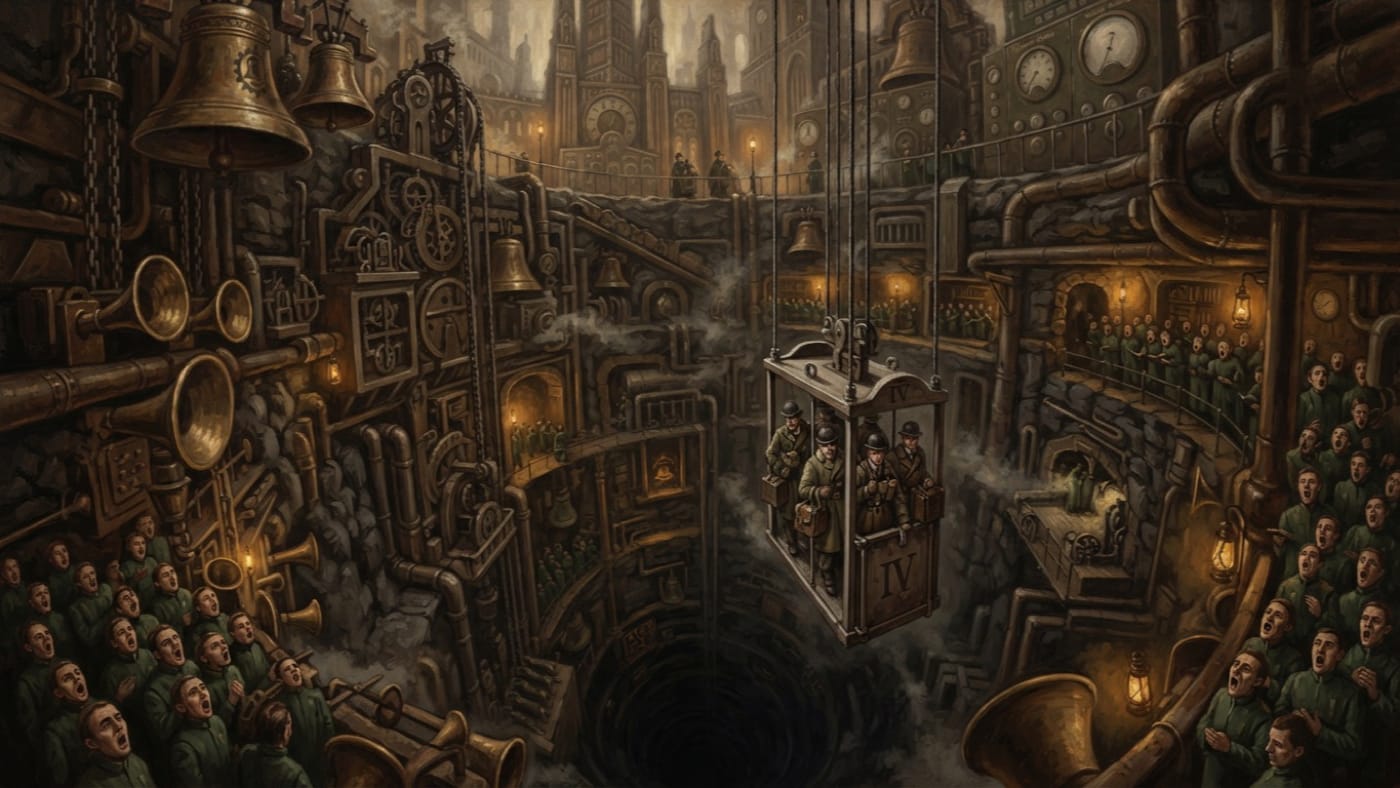
This Codex files the Fourth Commission of the Bureau of Bells as a faction, which is a kindness. A faction has opinions. A commission has a warrant, a seal, a stipend and a list of persons who will be blamed. As of A.S. 201 / 1911 CE, the Ledger can lawfully state two things about it. It descended into the works beneath Bastion-Irongate. It has not returned.
That is the whole record. I have read it more often than its length deserves.
The title carries a number, and the vulgar reader will want to count backward from it. He will invent three earlier commissions and give them three earlier fates, arranged in a pleasing liturgical ascent. The Codex declines. A number on a warrant proves that the clerk could count. It records nothing of what the clerk counted.
The Commission is no standing order either. It keeps no rule this office has registered, wears no habit and preaches nothing. Bells sent it to look at something. Its formal remit is not before me, and I have not been told when it was chartered, when it went down or when it was expected back up. Those dates stay blank. Blank vellum is the most honest thing in any archive, and an archive needs very little of it.
#On the Sound Under Examination
The Bureau of Bells was constituted as an Office in A.S. 52. In the century and a half since, it has ruled on who may make noise, at what hour and in what key. Its bell-masters are ordained. Its peals are scheduled. Its Bell Codex governs provinces that have never seen a bell-master's face, and those provinces wake at his Matins anyway.
From Strasbourg's Bell Codex of 231, entire provinces live their days by rhythms of sanctioned peals.
Corrected: the current Bell Codex was ratified in A.S. 115. Two hundred and thirty-one is a year the Synod has not yet had the pleasure of reaching. The clerk responsible was confident, legible and wrong by more than a century. In Records this is called a career.
At Irongate, Bells found that its jurisdiction had grown teeth. The Gasket Choir is a bell rung with human throats. Its continuous calibrated chant is driven through brass baffles and channels cut in black basalt. It reaches the pressure doors, gasket housings, bolt seats and valve plates, and it keeps a hollow mountain from becoming a solid one. Bells classes the Choir as a Category Three Harmonic Anomaly. The Bureau of Engineering calls it acoustic bracing. The Bureau of Doctrine calls it obedience made audible. Each office is correct about whichever limb of the animal it happens to be holding.
The stakes were settled in A.S. 94. A pressure inversion stilled the wind in the gorge, and the cliff went quiet for nine hours. The seals crept. The Third Lung came down and killed three thousand people, and digging them out took eleven months. Continuous chanting became mandatory and has stayed mandatory, in three eight-hour watches with emergency extensions. The Choir Nave stands beside the sealed wound like a confessor beside a deathbed, though it is noisier than any confessor I have employed.
A Bureau that claims sovereignty over sound cannot comfortably keep a sound it does not understand. The Choir works, and nobody in any office can tell you entirely why. Anyone who inquires into it is inquiring into the thing that holds the roof up. You do not test a load-bearing hymn by stopping it. I am told this is why such inquiries go downward, toward whatever the singing is pressed against.
#On the Descent and Its Limits
Irongate is cut into both cliffs of the Danube's Iron Gates gorge near Orșova, a Zone Four bastion with the river grinding between its halves. Above lie the Transit Spine, the lungs, the Nave and the gauge boards. Below lie the Underchords: maintenance crawls, smugglers' hollows, mould, lamp oil and rust. Masonry seals off what the Great Hush took, and official diagrams mark it SOLID ROCK. Surveys no longer agree with the corridors they claim to describe. The Dead Gallery lies down there too, and it grows by measurements no surveyor can reconcile.
I set these things down because they are below Irongate, and the Commission went below Irongate. I do not set them down as its route. The record does not name its destination, so I do not either. It holds no final message, no recovered journal, no lamp found guttering at a junction and no knocking in measures of seven. The Codex prints what it holds. Here it holds a verb and that verb's negation.
Nonreturn is a narrow word, and I am keeping it narrow. It does not mean dead. It does not mean deserted, transformed, captured or martyred. It does not mean finished. A commission that fails to come back up the shaft has failed to come back up the shaft. Anything beyond that is commentary, and commentary in this matter is reserved to persons with better evidence and worse judgment than mine.
#On Jurisdiction and Interest
Every office at Irongate has a stake in what the Choir is. None of them needs a stake in what happened to the Commission in order to have one.
Bells wants understanding, because a Category Three anomaly that someone understands stops being an anomaly. It becomes a procedure, and procedures can be transferred to other Bureaus. Engineering wants the gauges to stay acceptable. Any finding that changed the prescribed harmonics would mean reissuing every hymnal and reseating every seal, and Engineering has never once been given the budget for every. Doctrine wants its sermon to stand. If the mountain could be held some other way, then obedience is no longer load-bearing. After that it is merely obedience, and much harder to preach to a man with ice-lung.
The Choir Magistracy sits closest to the matter. Under Cantor Ys Varr it issues the pressure hymnals, licenses the voices and prosecutes silence. Through the Transit and Breath Office, a worker's licence decides where he sleeps and how much heat, bread and work he gets. A body of learned outsiders who understood why the sound works might also come to understand that the licence could be renegotiated. That thought is possible. It is not recorded as anyone's motive, and I record it only as a feature of the terrain.
Commandant Hadrik Sorn of Tunnel Command has said that the mountain has no preference, only weight. I have found no remark from him about the Commission, and I will not attribute one to him for the sake of symmetry.
The Hush Court admits motive. The Codex does not. These interests explain why people at Irongate would care very much about the answer. They are not evidence of who prevented it from coming back.
Two parties complicate the reading, and they deserve their proper attributions. The Counterkey Circle is made up of unlicensed and discarded singers. They write alternative harmonics in grease on the basalt and speak by tap and silent sign. They claim the prescribed harmonics are sufficient but costly, and that this cost keeps the Magistracy indispensable. That claim belongs to them. The Codex records no meeting, bargain, betrayal or arrest between the Circle and the Commission, and I will not furnish one.
Morwen, who presses Irongate through corrosion, imitation and grievance, is named for nearly every absence in Zone Four. The Bureau of War suspects her of working through the Circle. The Circle denies it. Her methods are the theft of voices and the slow wearing-away of who a man is. That makes her a convenient explanation for a missing body of listeners. Convenience, however, is evidence only in the Bureau of Tithes. She stays where the record leaves her, on the far bank of the argument.
#On the Present Account
As of A.S. 201, the Gasket Choir is still singing. The Nave runs its three watches and its emergency doubles. Ice-lung thins the pool of usable voices each quarter, and the Breatheries take the remainder with mint paste and bleach. Counterfeit licences pass from hand to hand beneath the Magistracy's boots. The Dead Gallery keeps growing. The pressure gauges remain acceptable, to use Engineering's word. That word was chosen because nobody in that Bureau will put good in writing.
The Fourth Commission of the Bureau of Bells has not returned from its descent.
All of these statements are true at once, and none of them causes the others. Third Watch takes its marks when the river fog leans against the tunnel mouths. Somewhere above the baffles a clerk keeps a column open beside an entry no one has amended. The chant goes down through the channels into the stone, toward wherever the Commission went, and comes back as pressure on a dial. Nothing else has come back with it.
I have no finding to publish, no rescue to announce and no successor commission to bless. When those exist, someone with a seal will tell me, and I will tell you as if I had known all along.