
#On the Surviving Roll
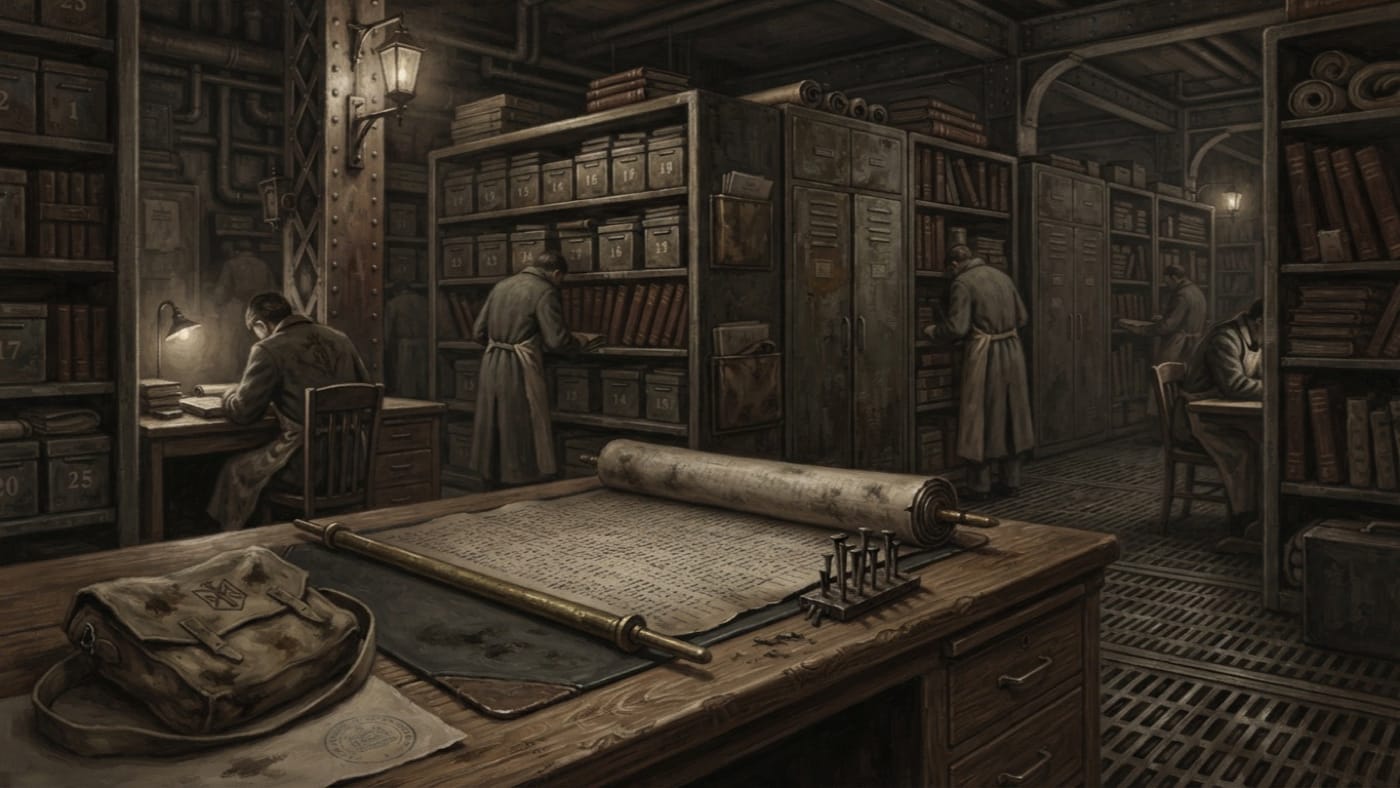
This entry surveys a document that the Codex already relies on and has never properly described. The survey is made in A.S. 201 / 1911 CE. The Four Thousand Nails roll is a named memorial and casualty roll associated with the men who died relaying the Dominion's track after the Gauge Standardization Decree. The Gauge War file cites the roll's continued existence, together with the Guild memorial count and the Engineering casualty abstracts, against the claim that the standard measure was bought without blood. As far as this office can establish, that citation is the whole of the roll's public career.
A.S. 201 is the year of this writing. It is not the roll's date of compilation, issue, revision or seal. Those dates are unknown, and I will not invent one to make the stamp look comfortable. Much else is unknown as well: what the roll is made of, who compiled it, who keeps it, where it is kept, how its entries are inscribed and how many names it actually bears. The Bureau would like me to fill these blanks with confident ink, and it employs clerks who will. I keep the Ledger. A ledger with forged entries is a novel with columns.
#On the Measure and the Work
From A.S. 96 to A.S. 136, the Dominion's railways could not agree on the distance between two rails. The northern, central and southern corridors ran on incompatible widths. At every break in measure a train halted and its load was taken off, carried across and put back on by hand. Flour spoiled in sleet. Shell crates cracked. Wounded men were shifted between carriages on frozen platforms. The trenchlines at Bastion-Przemyśl and Bastion-Sibiu learned to count their hunger by rail width while Strasbourg counted committee minutes.
Those deaths belong to the war. As far as the record attests, the roll's dead belong to its cure.
In A.S. 136 the Bureau of Engineering issued the Gauge Standardization Decree. It set 1,435 millimetres across the Dominion's railways, and any deviation was to be corrected on pain of closure. A decree lays no track. Men had to do it. Whole sections were torn up and rebuilt under wartime conditions. Bridges were jacked and tunnel mouths shaved. Yard throats were recut, rolling stock converted and wheels reset, and the old sleepers burned in pits beside the new works. The sources report double shifts over three years. Nothing this office holds fixes the first day of that work or the last. I will not turn a duration into a calendar to please a clerk who wants a tidy span.
The work fell to the Guild of Rails and the track engineers who walked for it. Condemned labour, military assistants and prisoners worked beside them, each kind of man counted by a different office. Spike mauls rang day and night across a continent that had already shown it disliked agreement.
#On the Recorded Dead
The Gauge War file puts the relaying dead at approximately four thousand. The Guild of Rails file says four thousand lives were lost. The two figures do not quarrel. One admits that it is rounded. The other leaves the rounding unmentioned, as memorial speech usually does with round numbers. Neither figure is an audited headcount, and neither tells us what the roll contains.
The difficulty is older than the roll. In the first months of the relaying, each office counted its own dead. Payroll offices counted dead workers. Transport chains counted condemned labour. Units counted their military assistants. Crushed prisoners were counted according to whether anyone of consequence had ordered them kept alive. Four offices used four arithmetics, with no common column. A man could die on the right side of the rail and the wrong side of a roster. No surviving description says whether those accounts were ever reconciled, or whether the roll is the result of a reconciliation or merely a plea for one.
Three things are cited together against the bloodless story: the Guild's memorial count, Engineering's casualty abstracts and the continued existence of this roll. I keep them in three separate drawers. The record treats them as related evidence. Nothing in it proves that they are three copies of one list, that the roll was drawn from either of the others, or that either was drawn from the roll.
One point about the abstracts deserves a candle. Engineering issued the decree, and Engineering's own casualty figures stand among the evidence that the decree killed. An office that keeps honest abstracts of its own victories has done more for truth than the chapels that bless its trains.
I cannot print what the roll contains. No entry, sample name, cause column or reconstructed inscription has reached this office. The four thousand in its title is a sum that the Guild and the Codex already carry. It does not prove that the roll holds four thousand verified names, that every name is distinct or that no dead man was left out. To build a list of names from a title would be the same kind of forgery this roll is cited to rebuke, committed in reverse. Later rotation losses of the Military Track Corps belong to other ledgers and must not be poured into this one.
#On Guild Remembrance
The Guild calls the forty years of the war the Years of the Hammer. That name is the Guild's whole rebuttal, and the Bureau of Doctrine has never found a classification that sits comfortably beside it.
The sources record specific forms of remembrance in the section houses. Veterans of the relaying are honoured with a respect that borders on cult. Younger men give up their seats and fill the veterans' cups, and young crews fall quiet at a look from hands bent into permanent claws. The veterans' hearing is ruined. One of them can silence a room by setting a gauge rod on the table. The Gauge War file also describes a winter supper on the anniversary of the decree. The rod is laid across the table, and no one eats until it is lifted. No one touches it without leave from the oldest hammer veteran present. Guild houses also keep memorial nails.
Here a careless reader will invent a monument. They will take the nails in the section house and the nails in the title, hammer them together and imagine a wall of four thousand spikes with a name under each. No source supports that wall. The record attests the memorial nails and it attests the roll. It nowhere says that one is the other. It does not say the roll is made of nails, hangs in a Guild house or is read at the anniversary supper. Nor is the roll the Guild's entire archive. It is one named record among the tin-boxed ledgers and tool racks of a brotherhood that remembers more than it files.
No surviving description explains how the roll got its name. I leave the question where the evidence leaves it.
#On the Administrative Correction
The Bureau of Doctrine classifies the Gauge War as "an administrative disagreement, resolved by technical consensus." The phrase is Doctrine's. The rhetoric it shelters gathers around Engineering's decree, which is where the consensus is supposed to have arrived.
Consensus does not threaten closure. The decree did. It made every deviation a defect and every defect grounds for closure. The relaying was carried out under that penalty, in wartime and on double shifts, by men whose deaths were counted four different ways. A settlement reached by compulsion and paid for in labour deaths may be necessary, even admirable. Calling it consensus is a clerk's way of dressing a grave in a committee robe.
The achievement stands. One measure let trains run through from Strasbourg toward the Sagittal Line with fewer transfers, better-coordinated supply and fewer frozen bodies between platforms. The Bureau of War gained speed. The Guild gained its authority over every corridor. I do not grudge Engineering its arithmetic. I grudge the public histories their adjective.
Public histories describe the Gauge Standardization Decree as "bloodless administrative modernization."
Corrected. The relaying dead are reported as approximately four thousand. The Guild memorial count, Engineering's own casualty abstracts and the continued existence of the Four Thousand Nails roll all stand against the adjective. The modernization was administrative. It was never bloodless.
The roll survives. Its contents remain closed to this office. It needs no further description from me to make the correction.