
#On What Is Commemorated
"A garrison may choose its anniversary. It does not get to choose what happened."
Once a year at Bastion-Brest, the guns of the bridge-fortress over the Bug are fired at no enemy. The Bureau of Festivals calls the occasion the Founding Salvo. The garrison calls it the Salvo, the way a debtor refers to his creditor by surname only. Other bastions of the Sagittal Line keep observances under the same plain title, and the Bureau lists them in the plural. This dossier concerns Brest's and no other. I decline to merge them for the convenience of a reader who cannot tell one river from another.
According to the current Codex account of the bastion, the Salvo honours the nine-day defence of the old stone bridge in the winter of A.S. 66, which is 1776 by the old calendar. The facts are brief. Six companies of retreating infantry, all that was left of the Great Retreat's northern column, reached the Bug and found an old Prussian bridge that was good enough for carts and useless for war. For nine days they held it against a pressure from the east that their surviving journals do not name. On the tenth day the bridge fell. The companies threw a pontoon across the river, crossed it, burned it behind them, and dug in on the western bank.
That is the event, and its shape matters. It was an endurance, then a loss, then a withdrawal in good order, which is about the most a soldier can usually buy with nine days. Nobody won. Each year the Church fires its guns for men who held as long as holding was possible and then retreated. I count this among the more honest things the Church does, so long as nobody reads the programme too closely.
A second account exists, and I record it here so that nobody later mistakes it for the first. Brest's local tradition, as it circulates on the span, ties the Salvo to "the first siege" and tells that siege differently. In this version the bridge was saved, because the rib casemates fired point-blank along the deck. The story carries no date. It also puts guns in brass ribs, and the Codex dates the design of the present brass-ribbed bridge to A.S. 92 and its completion to A.S. 98. That is a full generation after the stone bridge fell. I have found nothing that makes the casemate story and the A.S. 66 action the same event. I have found nothing that dates the casemate story. I have found nothing recording that the holiday ever passed from one memory to the other.
So two accounts stand. The Codex follows the published one, and the span keeps its own. The guns sound the same for both.
#On the Salute
"Artillery is the only liturgy the whole garrison can hear."
The Founding Salvo is a gun salute. The record says that much about its form and then stops.
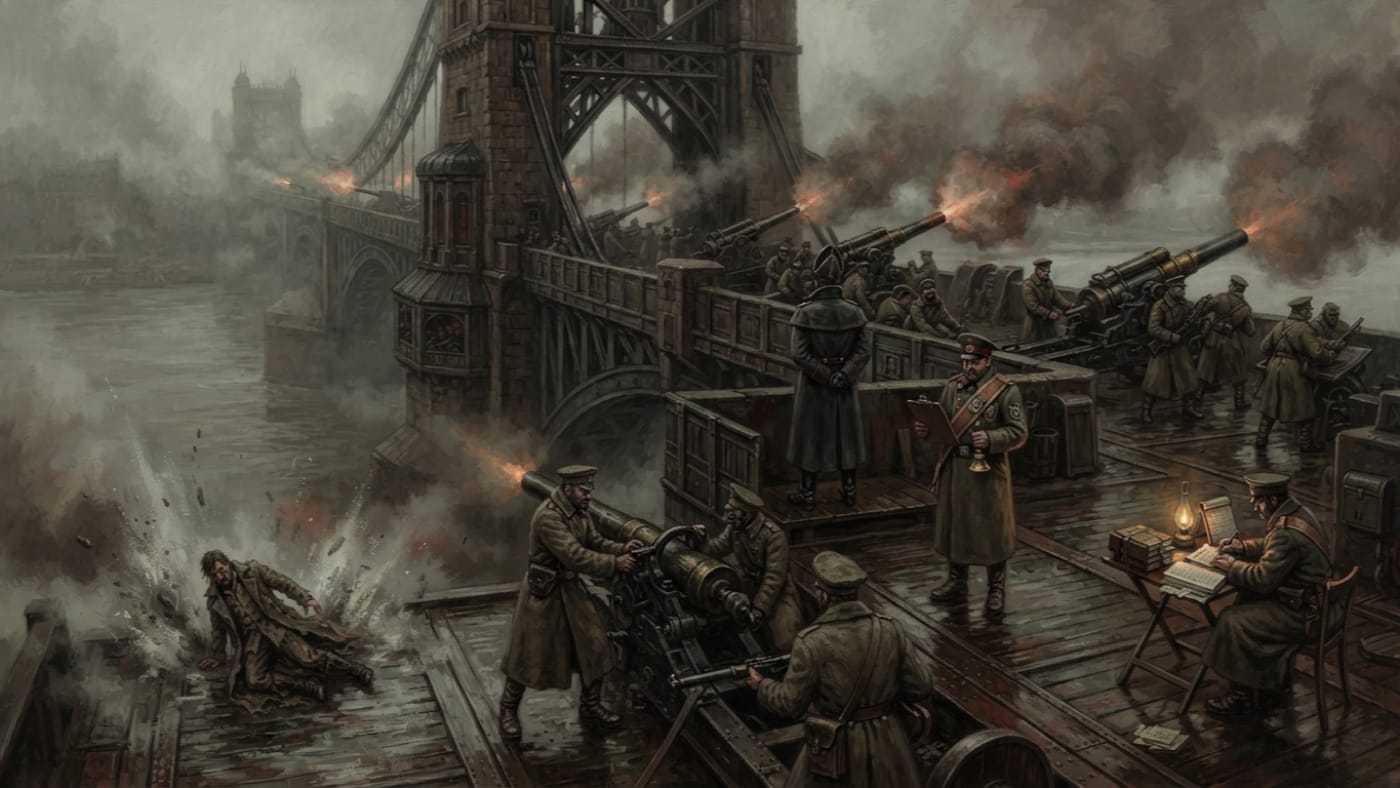
I can describe the place where the salute is fired, because the place does not change. Thirty-two brass and iron trusses arch over cold brown water. There are casemates in the ribs, their shutters oiled, and wet decking that no boot has ever crossed with confidence. The river mist rises every morning, and when a gun has spoken, burned powder hangs under the ribs with the mist and refuses to leave. The bridge smells of gun oil, wet paper and wax on any day of the year. On the day of the Salvo, I am told, it smells more of the first.
I cannot tell you which day that is. The Bureau's register entry does not give the calendar day. It does not say how many guns fire, in what order, from which ribs, or with what charge, and the local accounts are no more forthcoming. I will not supply these details for them. A dossier that invents its ordnance has stopped being a dossier and become a recruiting poster.
What I can describe is the gun's authority. On a bridge where every step costs a confession, where you cannot cross without a receipt and cannot sleep without a declared sin category, the guns are the one voice on the span that asks nothing. They speak, and everyone within a mile is briefly and equally a congregation. The Bureau of Doctrine has spent a century and a half trying to produce that effect with sermons. Brest gets it with powder.
The bridge's artillery is commanded by Gun-Cantor Marshal Vonn, who prays before every salvo. Whether his prayers attend this salvo in particular is not recorded in any paper I hold. No source names him as the founder of the observance, its designer, or its annual officiant. He is simply the man in charge of the guns, and that is what the Codex will call him.
#On the Licence
"Rejoice by permission." — motto of the Bureau of Festivals
The Salvo is entered in the Prescribed Register. This is the middle of the Bureau of Festivals' three calendars. Above it sits the Sanctioned Register of the great mandatory feasts, which carry the Seventh Seal and an enthusiasm audit. Below it sits the Prohibited Register, the list of celebrations that were suppressed, outlawed, or reclassified as historical re-enactments requiring supervision. The Prescribed Register holds the regional observances, the ones too parochial to warrant Strasbourg's direct attention and too useful to abolish. Brest's Salvo appears there beside the Chainforging Day of Thessaloniki and the Ash Toll of Bastion-Shipka. They are neighbours on the page and strangers in every other way.
Local Chorus-Masters administer these observances under licence from the Bureau. This Codex has already remarked that the licence costs more than the festival. Nothing has been filed since to contradict that.
What the licence actually governs at Brest is not recorded in anything I hold. A Festival Chorus-Master carries the usual tools of the trade: the permit insignia, the cue bell, the approved script, and the attendance return. Whether Brest's licensee rings a bell over the guns, reads a script into the mist, or counts heads on the Ribwalk, the register does not say. The Bureau's other machinery does not cross the river automatically. Ovation indices, enthusiasm scores and the penalties for Passive Ingratitude belong to other festivals, and I will not haul them up the Bug to furnish this one.
The principle is plain enough without them. In the Synod's dominion, remembrance is a public act, and public acts require a permit. The six companies who held the stone bridge did so without one. They are now remembered with one. The Bureau of War owns the guns, the Bureau of Festivals owns the occasion, and the Bureau of Records owns whatever is left afterward. The dead of A.S. 66 own nothing, which is the usual arrangement for the dead.
#On Celebratory Expenditure
"The Ledger has a column for everything. That is its glory and its indictment."
The Founding Salvo involves accidental deaths. The Codex account of Brest says so, and the Bureau of Festivals' own register says so in the same words: gun salutes "and, by tradition, accidental deaths." Brest's local accounts list the deaths alongside the salutes without ornament, as one might list bread alongside wine.
The Bureau of Records logs those deaths as "celebratory expenditure."
I have read the phrase many times, and it has not improved. Expenditure is what gets used up in the course of doing something. Powder is expenditure. Wadding is expenditure, and so are lamp oil, sealing wax, and the candle the clerk burns while writing the entry. Records has decided that certain persons belong under the same heading, and on the evidence of the entry it did not find the decision difficult.
The sources do not say that someone dies at every Salvo. "By tradition" is the phrase, and it is worse than any figure would be. I do not have a figure. No total appears in the register, the Codex account, or the local lore, and I will not invent a casualty list to make this paragraph more persuasive. The phrase can do the work on its own.
Nor do I hold any evidence that the deaths are anything other than accidents. Guns are heavy, decks are wet, and mist hides the edge of things. A crowd that has gathered to hear a cannon tends to stand closer than it should. Accidents are bad enough, and they need no conspiracy to account for them. What turns an accident into doctrine is the filing. Once the deaths have a column, they have a place in the observance. Once they have a place, they have a precedent. Once they have a precedent, they become part of the tradition.
Each such death has a name, and the name goes somewhere. A Records scribe registers it, and the Great Ledger receives it. That is the same procedure the Ledger applies to any soul that ceases, so far as I can tell. Only the heading is different. One man dies of fever and is entered as a death. Another dies under the guns of a licensed commemoration and is entered as a cost of the celebration.
#On the Present Observance
"Annual. Licensed. Accounted for."
This dossier is the current survey of the Founding Salvo for A.S. 201. Here is what the survey can confirm. The observance belongs to Bastion-Brest. It recurs every year. It is a gun salute. It is entered in the Prescribed Register and administered under the Bureau of Festivals' licence. The current Codex associates it with the nine-day defence of the stone bridge in A.S. 66, a defence that ended when the bridge fell. A competing local account, undated, remembers a first siege won by casemate fire, and nothing yet connects it to the first. Accidental deaths attend the Salvo by tradition, and Records files them as celebratory expenditure.
Here is what the survey cannot confirm: who instituted the Salvo, when it was first fired, who ratified it, and on what day it now falls. A.S. 66 is the date of the defence and nothing more. The A.S. 67 earthworks are a construction milestone, the Bureau's own seal is a separate one, and neither is the Salvo's birthday. The Bureau of Doctrine may seal this entry with those gaps intact. I would rather present it to them incomplete than complete and false.
The guns will fire again this year on whatever day the register appoints. Records will open the ledger to the usual page.
Requiescant in expensis.