
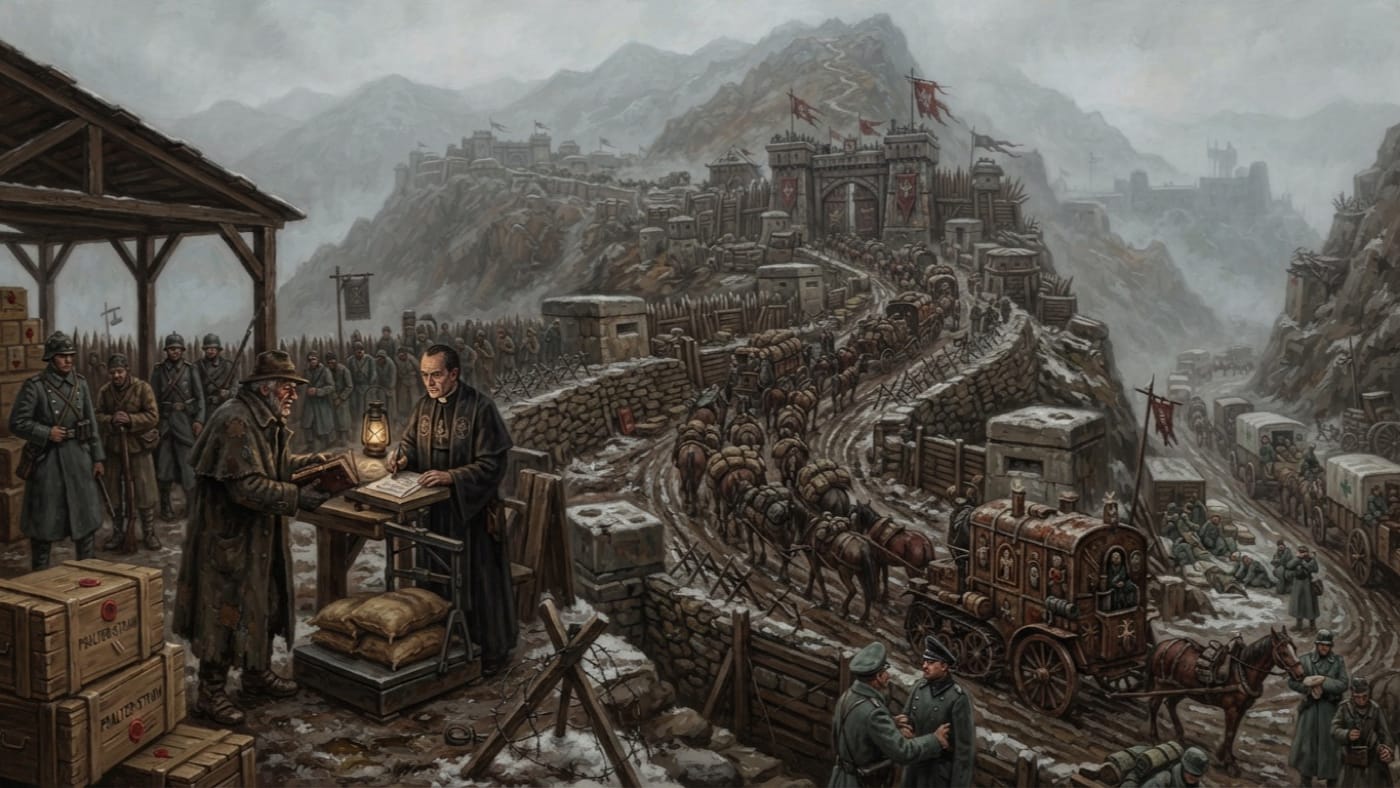
At the west-bank yards of Budapest, on any morning the Creator permits, a mule string stands loaded and does not move. The grain has been weighed. The relic-crates sit sealed in psalter-straw, and the chrismole drums sweat in the river damp. The string is waiting for a number, and that number is a Zone.
The Forward Supply Zone is the Bureau of War's name for the country where freight stops being commerce and becomes evidence. It is defined in one place only: a parenthesis. Standing Order 77-A, issued by the Logistics Directorate, addresses "Convoy Factors operating within the Forward Supply Zone (Zones 4–7)". With those four numerals the Directorate drew a theatre without drawing a map.
#On the Designation
Lay the parenthesis against the Zone Map and it starts to lie.
Zone 4 is the Sagittal Line itself, a spine of bastion and trench running north to south from Königsberg on the Baltic, through Brest and Przemyśl, Sibiu, Irongate and Shipka, down to Constantinople at the Bosphorus. Zone 5 is the contested strip east of the Line, the Grey Miles, where salvagers walk and the dead walk with them. Zone 6 is the Charnel Lands, where the Great Deceiver's generals keep house and surveyors' chains come back shorter than they went out. Zone 7 is the southern coast: Adriatic and Aegean lanes, pilgrim roads, and harbours where supply arrives by hull instead of hoof.
So the four numerals cover one fortified country, one contested, one damned and one wet. They are not four rings of Synodal possession. A Factor who reads "Zones 4–7" as "four Zones held by the Church" learns otherwise at roughly the speed of a mule.
Zone 3 lies outside the parenthesis altogether. That is the Forward Heartlands: Bohemia, Moravia, western Hungary and the Dalmatian coast. Yet nothing enters the Forward Supply Zone that was not first stacked, counted and argued over there. Budapest stages the Carpathian freight, and the Dalmatian quays load the sea lanes. In practice the Zone begins when a Zone 3 quartermaster hands the manifest to a man he does not expect to see again.
I have asked the Bureau of Records for the instrument that established the Zone. I wanted a survey, a perimeter, a founding decree, or a headquarters with a door one might knock on. Records produced the standing order, and the standing order produced the parenthesis, and there the search ended. The Forward Supply Zone has no governor, no capital and no boundary stones. It exists wherever a Factor is required to account for his expenditure.
#On the Instruments of Passage
Three instruments govern movement into the Zone, and none of them founded it.
The first is the licence. The Bureau of Tithes made the Caravan Factor lawful in A.S. 134, which is to say taxable. His licence lets him carry goods upon the Designated Routes and obliges him to show seal, ledger and knotted route-cord at every tithe-gate. The second is the Bureau of War's forward-zone permit. It admits him past the point where Tithes's appetite for revenue yields to War's appetite for shells. The third is the order.
The wording above is the revision of A.S. 199. I will not swear that the instrument of A.S. 172 said the same thing in the same words, and neither will Records, which is unusual modesty for Records. Neither year is a founding. Convoys had been grinding forward since the Line first became defensible, around A.S. 65–68, for generations before anyone thought to number the ground under their wheels.
What the order does is jurisdictional. Inside the parenthesis, the grain a gate-sergeant takes becomes Operational Facilitation: entered, countersigned and auditable. The same sack left unlogged is personal enrichment, and personal enrichment is prosecuted. The sack weighs the same either way. Only its theology changes.
#On the Delivery
Take a consignment of no particular name, bound for no particular week.
It is assembled in Zone 3 at a tariff-chapel, where the weighers pack and tally every sack. Each relic-crate is weighed against its bell-stamp certification. The Bureau of Bells assigns the consignment its arrival credit, a window measured in tolls instead of hours. The Factor files a route-plan. The plan is a document of great dignity and no predictive value.
Rail carries the freight east from the Budapest yards for as far as the rails remain trustworthy. In the Carpathian corridor that stops at the Turda ridge-gates, or earlier if a bridge has rotted between surveys. There the cargo goes back onto mules and wagons, and the route-plan goes into the Factor's coat, where it can do no further harm.
From there the road is a procession of jurisdictions. At each checkpoint chapel the convoy recites the Creed, and recites it correctly. The Bureau of Oaths requires the Factor's sworn testimony to be witnessed by a licensed Witnesser, though the nearest one is often a day's march behind. Pilgrims share the narrower passes, and the Bureau of Pilgrimage treats any road a pilgrim has walked on as partly its own. Somewhere behind the convoy, the Bureau of Purity waits to ask about the hands. "Hands" is the manifest's word for labourers attached to the cargo. They are technically freight, legally invisible, and occasionally families whose names have been struck from the Great Ledger.
Acceptance happens at a bastion granary or a trench commissary below Przemyśl or Sibiu. The quartermaster weighs, inspects the seals and reconciles the manifest: weight tallied against weight delivered, name counted against name arrived. A convoy one bell-credit late loses its ration priority. A convoy short one relic-crate loses its seal authority. A convoy that cannot reconcile its numbers is charged with weight sacrilege, which holds that a gap between the Ledger and the sack is a lie told to Creation itself.
#On Delay and Discrepancy
Every hazard in the Forward Supply Zone eventually turns into arithmetic.
In the Carpathian saddles, Syrion's fog drifts west out of the Shipka theatre and settles. The Factors call it singing weather. It hums until harness buckles work loose and mules sit down in the road. A convoy caught in it halts, keeps silence and waits. Waiting makes it visible, and visible convoys draw Black Ledger raiders. Some days they draw something worse: the Rot-Oxen, the enemy's own reeking supply-beasts, near whose passage iron weeps rust and bread darkens in the sack. Nobody has explained how they do it. The auditor at the granary does not weigh fog, and he does not weigh proximity to abominations. He weighs bread, and the bread is short.
The stamps then begin to quarrel. Bells records the convoy as late. War records it as permitted. Tithes records it as owing. Purity wants to know why the manifest lists six hands and only four walked in. Each Bureau is correct within its own folio. The Factor stands in the space between the folios and signs whatever he is given.
At Shipka the delay takes stranger forms. Freight crawls up the marsh spur along a single reed embankment, and hospital carriages crawl back down it carrying the broken westward. A train can arrive on time by its own chronometers and days late by the bastion's bells. Which reckoning governs its arrival credit is a question the Bellwardens answer at length and the quartermasters answer with whatever is left in the stores.
The southern lanes of Zone 7 fail by tide and quarantine instead of by ridge. Freight that lands at the Saffron Bastion on the Adriatic, or passes the harbour-chains of Thessaloniki, waits under yellow flags and fever cordons. The hazards differ. The Supplementary Manifest is the same.
Factors once called the whole sequence of gates, gifts and countersignatures the bribe chain.
STAMPED ERRATUM (Bureau of Records, 4th Revision, A.S. 200): "All references to 'bribe chain' in Transit Factor operational manuals are hereby amended to read 'devotional facilitation sequence.' The Bureau reminds all personnel that the Synod does not recognise the concept of bribery, only the concept of insufficient documentation."
#On the Present Application
As of A.S. 201, the Forward Supply Zone remains what the order makes it: a place where expense must be confessed. Granaries along the Line draw down against bell-credits that ridges and fog have no intention of honouring. Trench kitchens cook what reconciles and throw out what does not. Factory yards wait on chrismole that is somewhere in a saddle, keeping silence.
Then there are the names. Every manifest that crosses into the parenthesis carries some: Factors, drovers, cleric countersignatories, and hands. When a discrepancy reaches audit, the Bureau does not prosecute the fog. It prosecutes whichever of those names sits closest to the shortfall. Very often that is the cleric, who was "nearest available" because he was the only one there.
The Directorate has never defined the Forward Supply Zone beyond its numerals, and it never needed to. Wherever the parenthesis reaches, a sack of grain has a confessor.