
#On the Form's Application
Form 71-M is the instrument by which the coastal administration of Calais records that a person may be spent. It attaches to the Undertide Divers, the Black Lungs of the Chalk Redoubt. I have found it attached to no other corps in the coastal registers, and the Divers did not ask for the distinction. The published notices say it plainly: the Divers are expendable under Form 71-M, and expenditure under Form 71-M is authorized. The Bureau rarely says anything plainly. When it does, read it twice.
The excerpts available at my level of clearance do not say what the form waives, forfeits or excuses. I decline to invent clauses for the pleasure of condemning them. The surviving record shows the form in use. It shows a corps sent into the sea caves, boat tunnels and Undertide approaches beneath the cliff, with the cost entered before the descent rather than after it. Other offices count their dead. The coast budgets for them.
#On the Recovery That Preceded It
The coastal record dates the activity of Form 71-M from A.S. 71. That was the year of the Great Breach, when Channel entities came in through the sea caves and drowned hundreds before an improvised bell-choir drove them back. Anyone reading a Calais ledger should handle that date with clean gloves. The Church did not number its years until the constitutional settlement of A.S. 90, which established the formal Synod and applied the calendar backward. Whatever was written on the wet quays in 71 was written by early coastal organs under local authority. The Synodal letterheads now attached to their acts were added later by people who stayed dry. The year is the coast's own retrospective reckoning. The surviving record does not say who first inked the form, in which office, or on what day.
It does say that bodies lay in vents, cisterns and locked rooms after the water withdrew, and that someone was sent down to fetch them. By A.S. 74, when the Teeth rose from iron, chalk-lime and Undertide bone, the fetching had become permanent duty. By A.S. 84, after the ratification of the Salt Tribunal, every dive produced a ledger entry. An emergency improvisation became an occupation, the occupation became an entry, and the entry needed a heading. 71-M is a heading.
Early Calais annals record the first expenditures of A.S. 71 as "freely offered by the faithful of the quays."
Clarified. Of the six named participants in the first recovery, two were under sentence, one had been promised remission of salt debt, and the bell-rigger was too drunk to be asked anything. The annals now read "offered." The Bureau regrets the adverb.
#On the Descent
Authorization travels down a rope. A form may declare a Diver expendable, but it cannot tie a knot, test a bell or haul.
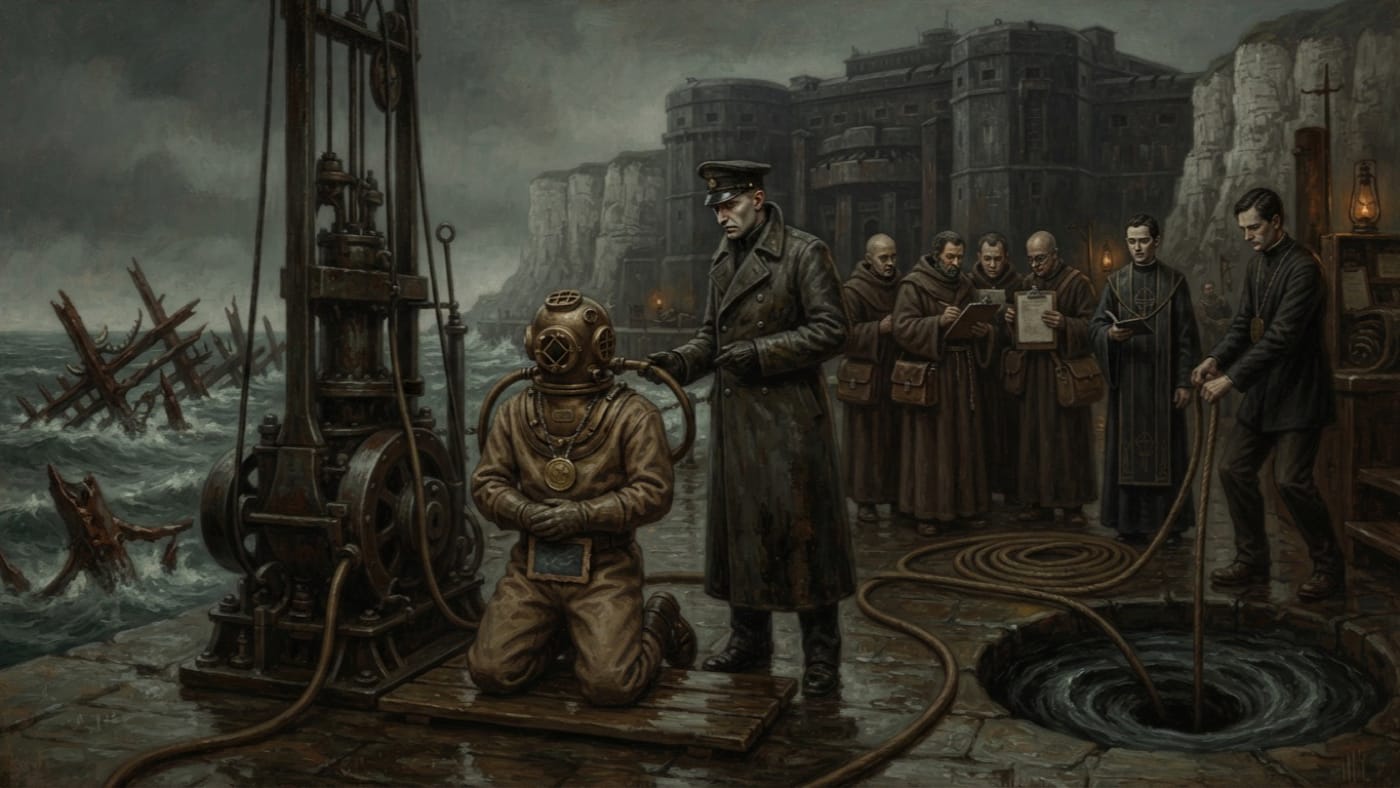
I am careful with the name of the published extract of the Coastal Annex 71-M dive protocol. No one has shown me that the Annex and the Form are the same sheet of paper, and shared numerals have misled me before. The extract requires that the rope be witnessed and named aloud before immersion. The bell must be tested by the surface rigger and by an observer from the Gunline Choir. The knife is salted, and silvering is optional. The lamp must be sufficient for the descent. Sufficiency for the return is left to the Creator.
Before any of this, the Diver kneels at the pump-rig while a Quarantine Warden inspects eyes, gums, fingernails and the name-token. The token hangs inside the waxed canvas against the sternum, stamped with legal name, dock name and nearest kin. Brass throat plate, weighted boots, rope bell, lamp cage, chalk slate: the Diver touches each in turn, and the rigger answers each touch. Since the Choir's certification in A.S. 92, the throat plate has carried an emergency bell-line to the surface. A trapped Diver can signal on it in patterns the riggers swear they can read through stone, surf and the vinegar-sour panic of the pump crew.
The cave itself demands separate paper. Opening a sea cave without writ is one of this coast's red lines, and the Diver Writ is its own document with its own stamp. The kelp-green cord at the collar tells the quay which corps is going down. The form has already told the ledger.
#On Body, Token and Sealed Absence
The Annex recognizes three returns: body, token or sealed absence. Each opens a different book.
A body goes to the Undertide Pens below Salt Tribunal Row, where it is called quarantined and is held. A returned body ought to be the simplest of the three. It is not. Bodies come up swollen, salt-burned, faceless, or in a condition Doctrine prefers to call ambiguous. Then the token against the sternum speaks for the face that cannot. Identification is made from a stamped disc because the sea has edited the original.
A token that comes back without its body is itself quarantined. The paper does not say why, and the wardens do not explain themselves to visiting Hieromnemons. The reasoning is not hard to guess. A brass disc that spent a day where its owner remains is no longer clean evidence of anything. The return of a token proves that a token returned.
When neither comes back, the name goes into the casualty ledger and the Script Wall watch book. Sealed absence is the third category, and the published text says least about it. It does not describe what is sealed, by whom, on what threshold, or with what legal effect. I have searched. No page I have seen treats it as a certificate of death or an order to stop looking. The Annex simply counts absence as a kind of return, which tells you more about this coast than any clause could. Calais has found a way to file a person who is nowhere.
The Pens keep their own arithmetic. As far as I can establish, it belongs to the wardens and not to the form. A recovered Diver is held three nights, seven if they heard bells below, and thirteen if their name appears on the Wall while they are already in the room. A lost Diver's name often appears low on the Script Wall within seven nights, below the surf line, where readers must kneel to pronounce the final letters. Often. The coast does not promise it, and I will not promise it on the coast's behalf.
#On the Knowledge Brought Ashore
The form accounts for the Diver. It does not account for what the Diver knows, and there the coast's authority runs out of rope.
Diver-Captain Sain records depth, current, visibility, rope length, lamp duration, salvage condition, casualties and sound anomalies. Records would envy her precision if it were permitted envy. The measurements reach shore. The working maps stay folded in oilcloth under her cot. When the Salt Tribunal asks for copies, it receives water-damaged duplicates with the key tunnels missing. A Diver who comes up reports first to the corps table, then to the Chapterhouse, and to the Tribunal only if compelled.
The coast therefore holds authority to spend the Diver and no reliable title to the Diver's knowledge. Seal-Justice Corvin Hald wants the maps. Commander-Prior Sabelle Morn wants more divers, more pump leather and more bell-riggers. The Gunline Choir wants Sain's tone notes. The Grey Keel Syndicate already knows some of the caches in the boat tunnels and asks nobody's leave. Every one of these authorities needs information that comes up only by rope, from people it has filed in advance as expendable. No one has yet drafted a form that compels a drowned woman to hand over her charts. I expect the Tribunal has a clerk working on it.
#On the Present Application
The survey of A.S. 201 finds the Black Lungs understrength and the form in daily use. Inland chalkscript, reported since A.S. 199, has multiplied dive orders. Every new name on a doorframe raises questions about the ground under the house. Lamp-oil shortages lengthen the Night Readings, and on long reading nights the coast reports more movement below the Teeth. Whether one causes the other is a question for the Bureau of Alchemical Standards and the Choir. Both have opinions, and neither dives. The correlation is reported. I record that it is reported.
Divers are kept ashore at night. They go down by day, once the Reading has ended. The rope is witnessed, the token is stamped and the chalk grit is still on the kneeling-board. The quay watches the green cord go under, and somewhere a clerk leaves the return column blank in vinegar ink.