
#On the Form and Its Authority
"Write the hour. Stop writing." — Masonry Corps yard summary of Form 14-M(c), credited to nobody who still works the yards.
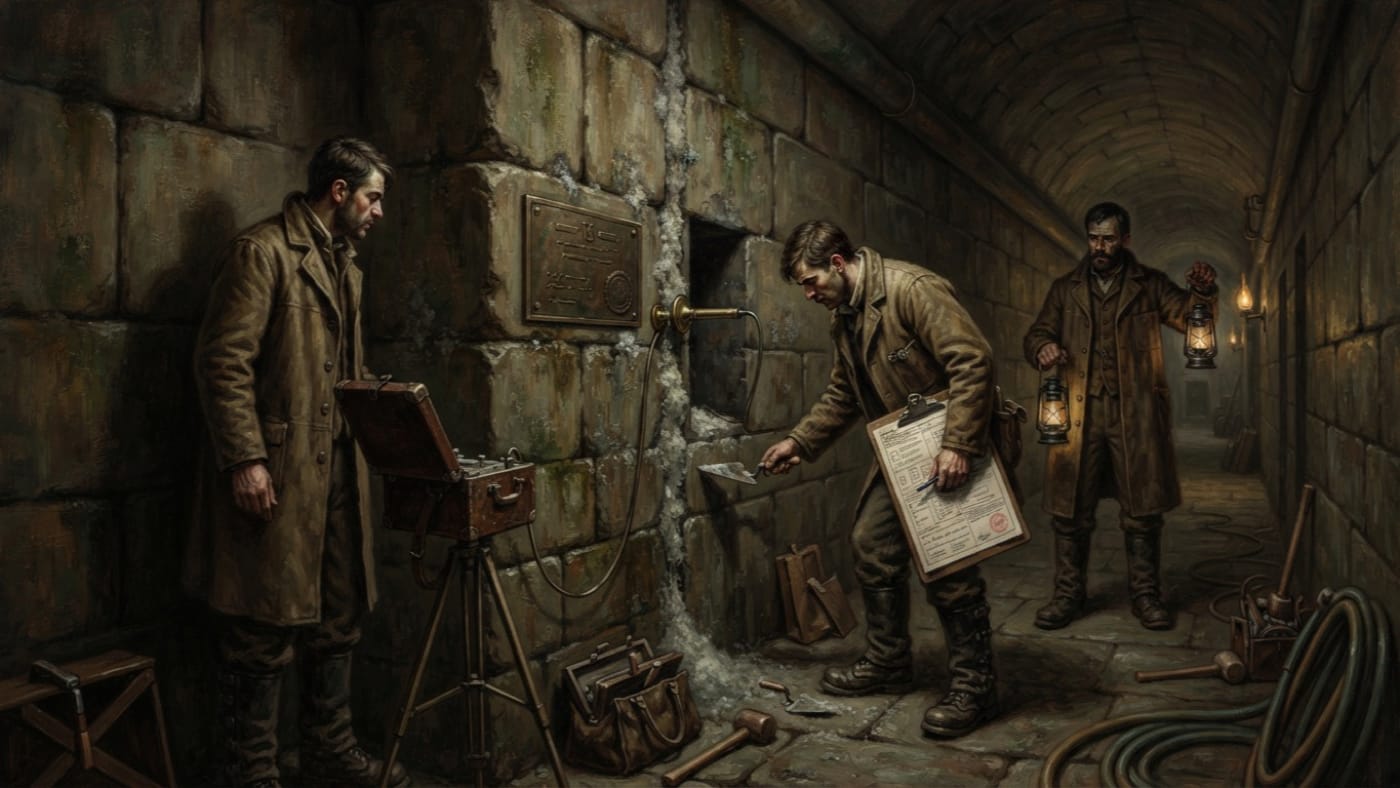
Form 14-M(c) is the paper a mason fills in when a wall makes a noise it was sentenced not to make.
Standing Order 14-M governs how the wall is made: writ, posture, niche, mix, plaque, stamp. The form governs what happens afterwards, when the finished work offers an opinion. The Bureau of Doctrine owns both instruments and keeps them in separate drawers, for the same reason a surgeon keeps the saw and the shroud apart. The Order sentences. The form reports. Neither one confesses.
The A.S. 199 revision of the Order put the form's duty into public language. A mason who encounters immurement-related acoustic phenomena files Form 14-M(c), applies hush-powder to the affected seam, and refrains from speculating in writing. Read those three clauses as one sentence and you will see how well it was built. The Bureau requires a record of the sound and forbids the man who records it to account for it. The wall is entitled to a docket. The mason is entitled to a pen with its tongue cut out.
I decline to expand the letter or the parenthesis. Readers who want them explained have mistaken a form for a riddle.
#On the Sounds That Required a Record
Doctrine did not draft a reporting instrument for walls because it enjoys paper. It does enjoy paper. It drafted one because the walls kept reporting first.
The older precedent is Târgu. In A.S. 128 thirty-one soldiers were sealed into a single wall for collective hesitation, and the wall recited the Creed until bombardment interrupted it. The Murmur Line received a classification as a Category Two Spiritual Anomaly, quarterly inspection and no further action. Prayer from masonry could be filed as a devotional embarrassment, and an embarrassment has a drawer.
The Demon-Listening Incidents of A.S. 158 had no drawer. Three niches on the southern curtain of Bastion-Przemyśl, above the western Carpathian passes, tapped First, Third and Fifth Peal six to fourteen months after sealing. A thief stood in one, a deserter knelt in another, and a heretic sat folded into the box. Three sentences had been carried out by three crews, and all three plaques were in order. Nobody found a breath-thread, a reed slit or a plaque-air channel. The Bureau of Bells confirmed the cadence as metrically exact, and that phrase has since cost several careers.
Doctrine sent an assessor whose name remains sealed, and his report was sealed after him. Within the month the binding mix was revised to include the additive the masons call hush-powder. The assessor was reassigned to the Paper Mines of Ulm.
Mark the order: incident, seal, mix, Ulm. Forty-one years passed before the A.S. 199 schedule told masons in plain print which paper to reach for. Przemyśl created the need, and the later revision wrote the duty down.
Doctrine memorandum on the A.S. 158 Przemyśl tapping: "auditory hallucination among front-line personnel, subsequently attributed to shell-concussion."
Withdrawn, A.S. 201. The Bureau of Bells confirmed metrical exactitude, and hallucinations do not keep time. Shell-concussion is relieved of a charge it carried for forty-three years without complaint.
#On Classification and Conduct
A.S. 199 gave the Bureau three baskets.
Prayer-adjacent sound is Residual Devotional Emanation. Non-prayer-adjacent sound is Demonic Interference. Sound during business hours is Administrative Noise. The Standing Order commentary limits the third basket to cases where no senior witness is present. A Master Sealer who walks into the corridor can therefore turn clerical noise into demonology just by standing there. Master Sealers do not enjoy having this pointed out.
The baskets sort paper. They say nothing about what is inside the wall, and the Bureau has taken pains to keep it that way. A wall that taps out the Creed at noon belongs in two baskets at once. The schedule names no precedence, and a clerk who writes one into the margin will be asked where he got his theology.
The form sits inside an inspection regime already crowded with mallets. Tap-walks run the corridor and acoustic probes are set against the seams. Inspectors check plaque edges for bloom and gaps, take cores of the lime, and compare paired mason signatures against the revised completion logs. Along the Murmur Line, acoustic response is recorded by bell-hour, the only clock a wall has ever been seen to respect. The plaque already carries name, charge, hymn-line and seal imprint. The completion log already carries the hour, the mix grade and the mason's stamp. An inspector who arrives with Form 14-M(c) has the condemned man's file in his satchel before he unstraps it. The form records the moment that file stopped being complete.
Its rules of conduct survive in a training extract that the Bureau sealed and the yards learned by heart:
FORM 14-M(c) — SEALED TRAINING EXTRACT If the wall taps in bell cadence, do not answer. If the wall prays, record the hour and withdraw witnesses. If the wall uses the mason's name, cover the plaque before reading further. If the sound proceeds from a niche certified empty, ███████████████████████████████.
Each line is sound advice. The first prevents conversation. The second prevents a congregation. On the third I will say only that "before reading further" assumes the mason will want to read further, and whoever drafted it knew masons. The fourth line is sealed in every copy I have handled, including my own.
#On the Mason and the Witness
A.S. 163 outlawed solitary sealing and made paired working compulsory after the business at Bastion-Irongate, which Doctrine has classified and I shall not reopen. The A.S. 199 commentary kept the pairs, and the form inherited them. Two Sentence Masons hear the wall. Two masons decide whether they heard it. Two hands are on record when the hush-powder goes into the seam.
This is the form's cruelty and its wisdom. It turns the sound into a fact with signatories. A mason who files has admitted being present at an event the Bureau declines to explain. A mason who does not file, and is later found to have stood beside a wall that kept time, has committed an omission in front of a witness. The second man is always the witness, and sometimes he is also the informant. The Masonry Corps calls this safety.
The factions read the form the way they read everything, through their own guilt. Pure Sealers once held that any wall that answered was hiding a vent, so a filed form accused some Breath-Giver's sleeve. Breath-Givers held that a channel carried air and nothing else, so a filed form was Sealer superstition. Przemyśl broke both readings with three walls that had no vents and kept perfect time all the same. Today each faction files grudgingly and suspects the other of filing gladly.
Hush-powder sharpened the quarrel. It dulls the response of a treated seam, leaves a grey bloom at the plaque edge and chokes narrow mercy channels. A Pure Sealer applies it as instructed and feels vindicated. A Breath-Giver applies it as instructed and listens to hear whether his reed still hisses. Both men invoke Saint Karron over the same trough.
The ban on speculation protects the folio. A mason may write down the hour and the seam. He may not write what he thinks the seam was doing, because a mason's theory, once filed, becomes Doctrine's problem, and Doctrine already has enough problems in Ulm.
#On the Standing Application
As of A.S. 201 the three Przemyśl niches remain sealed. Their plaques are inspected quarterly, their seams are treated, and their corridor closes at Ninth. The full cadence has not repeated in public since the first hush application. The words "in public" are official, and I would not put much weight on them.
This year Doctrine withdrew the old memorandum that blamed shell-concussed soldiers, and inspectors moved Form 14-M(c) back to the top of their satchels as if the A.S. 199 schedule were news. The correction did not change a word of the form. It changed who could be blamed for filling one in. A tired sentry who heard things was a medical matter. A wall that keeps time is a Doctrine matter, and the man who heard it is now a witness instead of a patient.
The Bureau of Engineering still describes hush-powder as a mineral additive for winter durability, and the formula remains under Seal Obsidian. The Bureau of Medicine lost a diagnosis this year and has not asked for it back.