
#On Their Nature
"A furnace needs no argument. It needs a draught." — Drax, marginal gloss on a Bureau of War dispatch
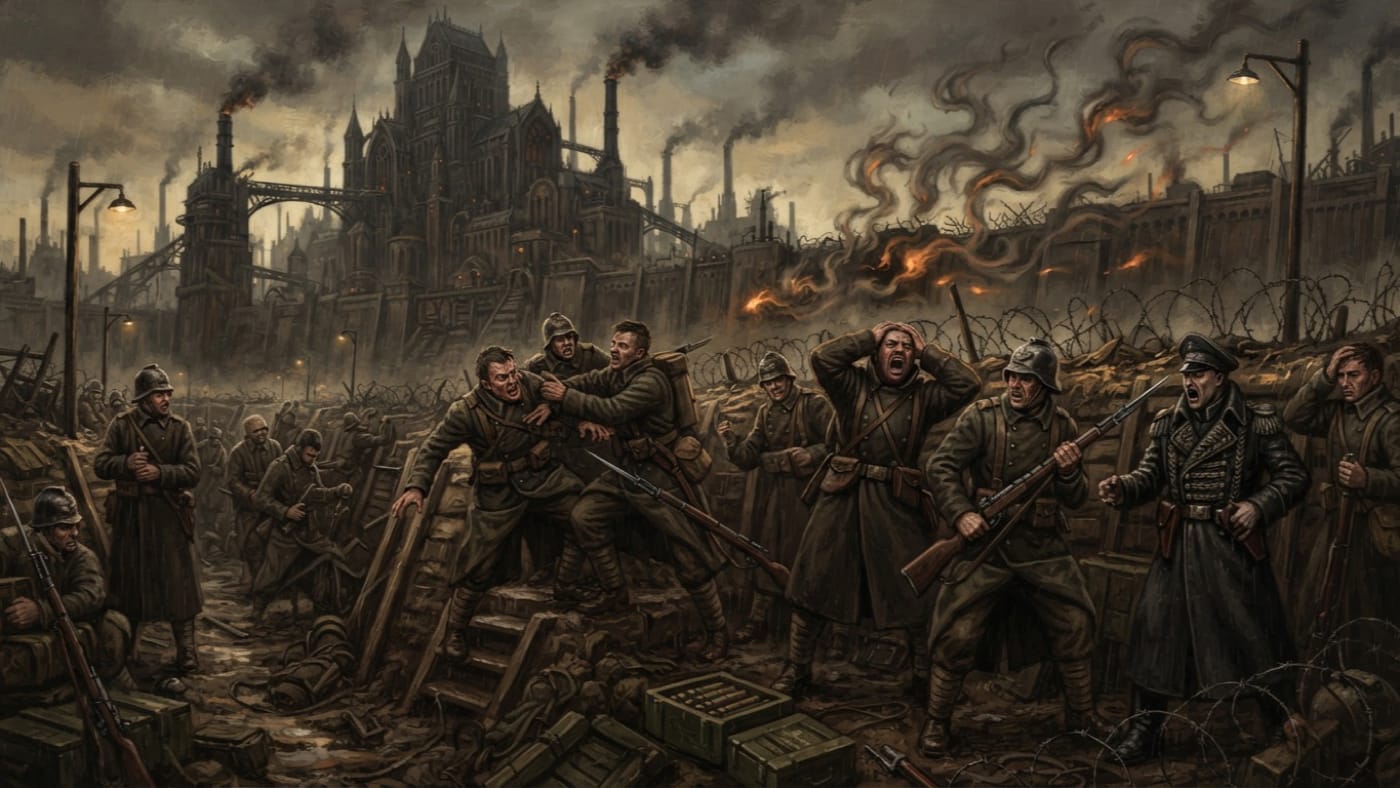
Flame-Tongues are demons of Maldrake, Sin-General of Wrath, and of all his servants they are the only ones whose principal instrument is a sentence. The Hammered break walls, and the Ember-Soldiers march through the breach. The Flame-Tongue speaks, and its speech is violence: words that wound, words that burn, words that stoke rage in whoever hears them.
The Bureau of Doctrine files them as Wrath's equivalent of the influence-demons kept by the other Sin-Generals. The office is the same. The delivery is louder and cruder, at a pitch no confessional screen was built to stand behind. Where the servants of other Sins whisper, a Flame-Tongue screams. When the fighting starts, it feeds.
That is the whole of the certified description. Barracks talk has embroidered the name with tongues of literal fire, mouths that scorch the air and breath that blisters paint, and the Bureau has certified none of it. The dossier records no anatomy, no size, no span of life and no method of destruction. What it eats when it feeds, and by what organ, the dossier does not say. Whether the thing is flesh to be shot or smoke to be endured is a question the Bureau of Doctrine has declined to settle. I decline with it. A Hieromnemon who invents a jaw for a demon will be required to defend the jaw before a tribunal.
#On Their Speech
The method is provocation, and provocation is older than the Sundering. Any sergeant knows the craft. So does any tavern-keeper. A Flame-Tongue practises it without fatigue or shame, and it never has to live among the people it insults.
It does not argue. It finds the wound that is already there and presses on it with the whole weight of its voice: the stolen ration, the petition returned unread, the friend buried under a clerk's misspelling. It names the wrong and the man responsible, and then it names the remedy. The remedy is always the same. Strike now, strike first, strike everything within reach.
By Doctrine's account, Wrath's influence-demons work as companions in anger. Each is the face in the crowd that agrees you have been wronged, and it warms a grievance over a season. The Flame-Tongue dispenses with companionship. It stands on the parapet of the quarrel and bellows, trying to raise in an afternoon what the quieter servants tend for months.
Read uncharitably, the Bureau of War's field reports describe the effect as weather. The voice sounded and the men fought. I have read those reports with all the uncharity they deserve. The Church teaches that no demon of any Sin-General can override a man's will within Synod territory, and I am paid to defend that teaching and in this case also believe it. Nobody is possessed, and no hand is compelled. A Flame-Tongue can make violence feel overdue, righteous and even pleasant, but it cannot pick up the bayonet. Every man who answered it answered with his own arm. The Bureau of Purity has never troubled itself to love the accused, and it relies on this doctrine every time it signs a sentence.
This Codex's entry on Maldrake states that "around a Flame-Tongue, the fighting always starts."
Read with the Bureau's usual disregard for qualifiers, that sentence implies compulsion, and Doctrine permits no such implication. The fighting starts often. It starts because men start it. There have also been fights that did not start, though the Bureau of War has never kept a column for them.
#On Those Who Listen
The Flame-Tongue does not have to manufacture grievance. The Synod produces grievance in bulk, under seal and in triplicate.
Its audience is the wronged: the oppressed who have swallowed their anger too long, the protector who would do anything for the people in his keeping, the griever who wants someone to blame. Among these are the men who have been hurt again and again and were never once permitted to hurt back. A congregation of the merely cruel would bore it. Cruelty is already spent, and the creature has no use for a fire that has burned out.
The Church has never condemned anger. A sergeant who watches his men go hungry because of a quartermaster's thieving ought to be angry. A chaplain who tells him otherwise ought to be posted somewhere cold. Anger that sees a wrong and wants it righted sits within the Creator's ordinance. Wrath is anger that has stopped checking whether the wrong is still there.
The Flame-Tongue's art lies in that boundary. One thieving quartermaster becomes the commissary, and the commissary becomes the regiment. The regiment becomes everyone who failed to stand up, and in the end it becomes everyone. Each step feels like accuracy. One man's fury is then taken as proof by the man beside him, and one brawl gives the next a reason. The creature does not have to persuade the twentieth man, because the first nineteen persuade him for it.
For the benefit of over-zealous Lictors, I state this plainly. A man who shouts at his captain after a Flame-Tongue has been heard on the wire is a man who shouted at his captain. Long corruption is the work of years and of many choices: warm scars, hands locked shut, the ember behind the eyes. The dossier nowhere attributes it to a single hearing, and neither shall any tribunal that cites this entry.
#On Their Place in Wrath's War
Maldrake's domain is Thrace, north and west of Bastion-Constantinople. His territory runs through the Iron Wastes, the Eternal Forges, the Burning Trenches, the Crucible Cities and the Char Fields that never cooled. Constantinople anchors the southern end of the Sagittal Line at the Bosphorus, where it faces both Maldrake and Kargath, and it has spent its history learning which of the two is knocking.
Within that war, the Flame-Tongue does not serve as an assault formation. The Hellbow Legion supplies the weight, the Forge-Beasts the iron and the Ember-Soldiers the numbers. A host of Wrath never lacks fury. The Flame-Tongue's concern is where its voice carries: across the wire, along the approach and into the ears of tired men who have just been told their relief is postponed.
Wrath cells do operate inside Synod territory, but they are human work. They are built from grievance, sometimes visited by an influence-demon and answerable to no confirmed chain of command running back to the Forge-Pyre Bastion. The Flame-Tongue is not their officer. A physical demon deep in Synod lands is a major event, and a Flame-Tongue in a rear-district tavern would be reported to me before the tavern-keeper had finished sweeping up.
Maldrake's public emergence dates to the Sundering, on 1 November A.S. 45. No record states when the first Flame-Tongue screamed.
#On the Countermeasures
No rite in the manual is aimed at the demon. Every measure the Synod has developed against a Flame-Tongue is aimed at the men who hear it, and every one of them works partially, which is the Bureau's word for sometimes.
Discipline protocols impose rigid command: no action without orders and no violence without authorization. In theory, structure contains rage. In practice, a soldier forbidden to answer an insult gains a new grievance against the man who forbade him, and the creature is glad to supply the words for it.
Cooling rituals use cold water, ice, snow and slow breathing before battle. They help with small anger. They do nothing against the deep kind, and the deep kind is what a Flame-Tongue is hunting.
Rage fasts are periods of enforced pacifism, with no violence permitted even in defence. Men who cannot keep the fast are confined until the urge passes, and some never come out. Their containment became permanent because their rage never faded.
Confession is offered on the theory that rage spoken aloud is rage released. Theologically, the Bureau of Doctrine has never settled whether this is true. Practically, it sometimes helps, and sometimes the penitent leaves the screen with a fresh grievance against the confessor.
The Doctrine of Cool Hatred teaches soldiers to kill demons from duty and not from hatred, coldly and without passion. Against a Flame-Tongue the Doctrine has one virtue the other measures lack: a man who does not need to hate has less for the creature to fan. Watching a comrade die makes cool hatred nearly impossible. The Doctrine is taught regardless.
Men showing the physical marks of long corruption are executed under Synodal policy, and the Bureau calls this mercy. Doctrine has never called it proof that the man was beyond repentance. The Church holds every soul short of the grave to be reclaimable. The Bureau executes regardless, and that belongs to a different ledger.
#The Ratification
The Bureau of Doctrine ratifies the following. The Flame-Tongue is a demon of Wrath in Maldrake's service. Its sole certified instrument is speech, and its certified appetite is for fighting, by means the Bureau does not specify. No soldier's plea that "the demon made me" shall be admitted in mitigation before any tribunal of the Synod. Where a soldier heard the creature and held his fire, that restraint shall be entered in the dispatch, in a column the Bureau of War is hereby instructed to create.