
#On the First Sentence
"The Creator is." — First Catechism, Article One
A child can say the First Catechism's opening sentence before it can lace its own boots. The child can say it before it can spell its own name or find Strasbourg on a map, and long before it can ask what the sentence costs. That is the sentence's design and its whole cleverness. It has a subject and a predicate and then it stops. It names no deed, gives no reason, makes no promise and does not admit that anyone might ask a further question. You cannot refute it, because it claims nothing that can be checked. You cannot misunderstand it, because it offers nothing to understand.
The Bureau files the sentence as Article One and gives it the status Ratified in Perpetuity. I have pressed that phrase into more wax than any clerk now living, and it means exactly what the Bureau needs it to mean on the day the seal comes down. This survey does not certify who first wrote the sentence, which assembly first sealed it or how many articles followed it on the original leaf. A reader who wants those facts may apply to the Bureau of Records in writing, in triplicate and without much hope.
My office is the interpretation of the sentence. Interpreting is more dangerous than authorship. An author may die and be forgiven, but an interpreter has to go on being correct.
#On the Lesson
The sentence is taught at the age of five. In the Catechism Schools of the Dominion, from Calais to Constantinople, it is repeated every morning before arithmetic and before geography. Both of those subjects are only commentary on the Covenant anyway, so nothing is lost by putting the sentence first.
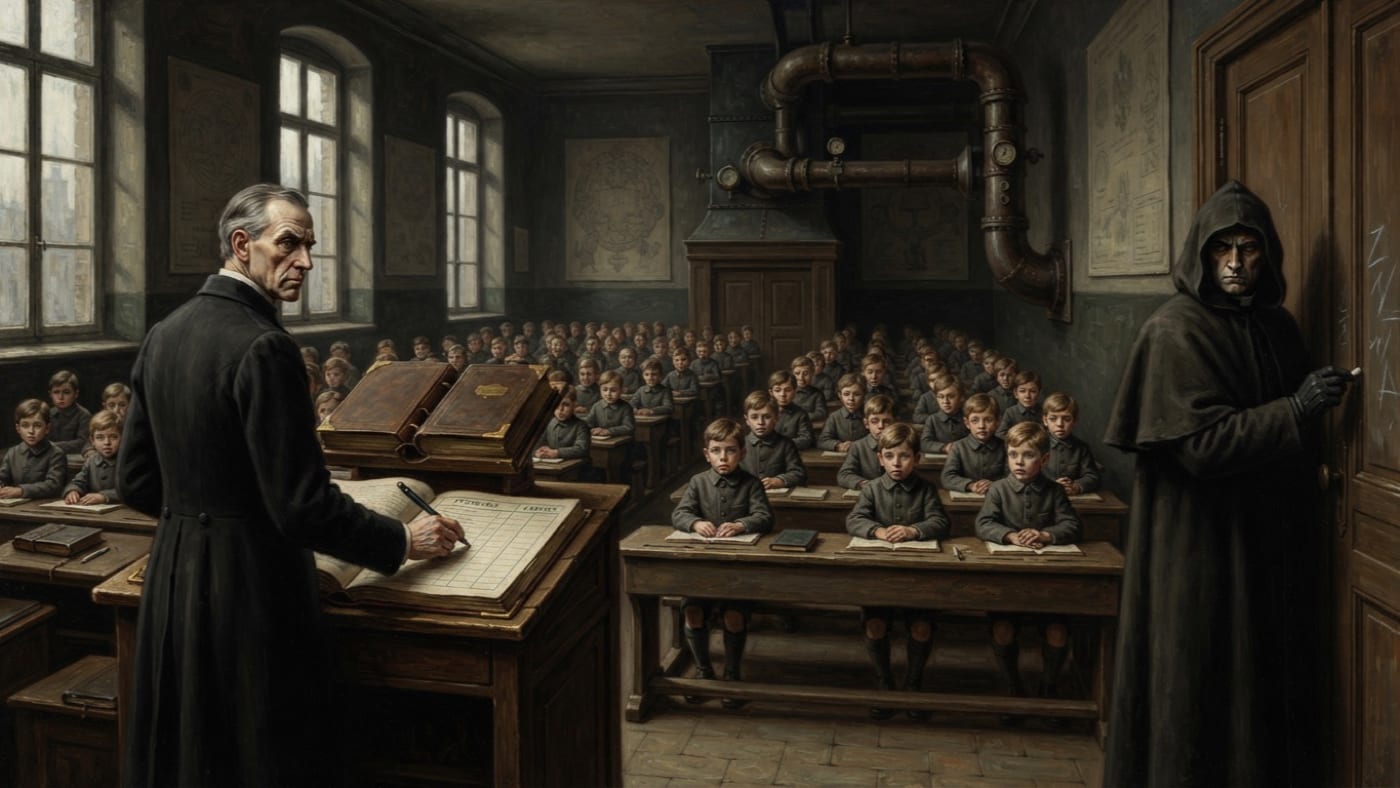
I know the room. There is chalk dust on the windowsill and iron-gall ink in wells drilled into the desks. The instructor's teaching copy lies on the lectern. Its spine has cracked open at the first leaf, and the gilt there has been rubbed off by forty years of instructors' thumbs. Thirty children sit in ordered rows and wait for a hand to rise. When the hand rises, thirty voices give the answer. The instructor does not listen to the words, which are never wrong. The instructor listens for the one voice that comes a breath late.
Afterward the children copy the sentence. They copy it on slates and then on paper, and paper is expensive, so the copy has to be clean. The Lore Book's chroniclers record children who copy until their fingers bleed ink. I have seen the copy-sheets. The chroniclers did not exaggerate. They were too fond of the word bleed, but they did not exaggerate.
The lesson has two halves, and only one of them is written on the board. The child learns that the Creator is. The child also learns what a question is for. Someone in authority asks it. The answer is already known to the asker. The child gives it in the asker's words, at the asker's pace, and the asker approves. By the age of six the child has learned this transaction completely, and it will serve the child at the confessional screen, the ration hall and the court-martial for the rest of its life.
#On What the Sentence Permits
The sentence says that the Creator is. It does not say where He is, why He is silent or when He will speak again. The Bureau of Doctrine supplies those answers as commentary, which can be amended. Article One cannot be amended. The whole arrangement depends on that difference, and every instructor is trained to keep the two in separate drawers.
The catechetical responses that Doctrine teaches with the sentence run like a litany. Who made the world? The Creator. Who sustains the world? The Creator. Who will save the world? The Creator. Then the litany meets the one question a five-year-old will eventually ask, and it gives its famous answer: When? That is not a permitted question. This survey does not certify that litany as a numbered part of the First Catechism. It is the commentary that hangs on the opening sentence the way a censer hangs from its chain.
Doctrine has given two explanations for the Silence. The Doctrine of Divine Withdrawal was established at the Second Doctrinal Congress in A.S. 72. At that date the Church still governed through a provisional council, eighteen years before the Concordat of Strasbourg gave the Synod a constitution. The Bureau now files that Congress's acts as though the Bureau had been in the room, and I file them the same way. Withdrawal teaches that the Rationalists broke the means by which divine speech reached the world, and that the Creator therefore withdrew His active presence.
The Fourth Doctrinal Congress met in A.S. 104, after the settlement and after both founders were dead. It ratified the Doctrine of the Inaudible Voice, which holds that the Creator does speak, in a register the faithful have not yet learned to hear.
One doctrine says He left. The other says He stayed and we are deaf. Children learn both by the age of nine, and in the same week they learn not to compare them aloud. The Doctrine of Perfect Faith joins them in the end: the Creator will intervene when faith is perfect. The Bureau gives no date for that, and none will be given, because the question of when has already been answered.
Miracles are filed in a separate drawer. The reliquary of Saint Aldebrand blazed at Vienna, and fourteen thousand soldiers saw it. Article One does not say who lit it. Doctrine says who did, under a separate seal, and that seal can be broken and reapplied as needed.
#On the Correct Answer
A lesson that is never examined is only a rumour. The Synod does not leave its first sentence to rumour.
Doctrine Street-Vicars walk the school lanes in the morning, when the children are still warm from recitation. They stop a child at the gate and give the first half of a line, and the child gives the second half. The Vicar listens for cadence more than for content. The content is never wrong, and cadence is the only part a frightened child cannot rehearse. A teacher whose pupils recite sloppily may find a chalk mark on the doorframe by noon. The mark reads watched. It is not a punishment. It is information, written where everyone can read it.
The Doubt Auditors work further from the street. They hold the school's recitation logs and compare them with confession abstracts and ration-hall tallies. They look for drift in a child's choice of words, in the timing of an answer, and in anything the child leaves out. Their slogan is Questions are knives held politely, and they do not consider the description unkind to knives.
The First Catechism has no penalty clause that I can certify. None is needed. A child who asks when is not punished by the Catechism. The child is noted. The note goes to a clerk, the clerk files it with Records, and Records keeps its motto, Nothing is forgotten. At twenty-two the child applies for a post in a provincial chancery. The application is set beside the file. The file has kept the question in the child's own handwriting, complete with the question mark.
Silence is also recorded. An Auditor's variance checklist has a column for hesitation, and nobody has ever successfully argued that hesitating before the word is was a matter of breath.
Purity has a stake in this as well. The Bureau of Purity's Standing Order 7-A dates from A.S. 92 and was renewed in A.S. 187. It classifies every heresy concerning the divine nature as first-order prohibited. Order 7-A is not part of the First Catechism and does not quote it. It sits beside the Catechism the way a constable stands beside a lectern, and the children notice the constable.
#On Perpetuity
Ratified in Perpetuity is a claim about one sentence. Everything Doctrine has hung on that sentence since then has been revised, reclassified, retroactively clarified or sealed. The sentence stays the same, and the explanations around it change, and that is how the Bureau intends it to work.
The positions on the origin of the Great Deceiver are an example. Doctrine has held a First Position, then a Second, and now holds a Third. Each was taught as settled in its day. Each was taught next to the opening sentence in the same rooms, and each was presented as if it rested on that sentence's authority. Not one of them touched the sentence itself.
Some clerks cite the Catechism Third Revision of A.S. 104 in this connection. That revision belongs to another text and to its own entry. Its relation to the First Catechism is unproved, and I decline to prove it here.
An earlier draft of this survey listed Bureau of Doctrine Memorandum 19-H (A.S. 187) among the amendments to the First Catechism.
Corrected. Memorandum 19-H reclassified the Fourth Position on the Adversary's origin as non-existent. It altered the commentary and did not alter Article One, which no memorandum alters. The Fourth Position, as the Bureau has always held, was never a position.
#On Present Application
It is morning in Strasbourg in the two hundred and first year, and the bells of the Line are three hundred leagues to the east. A hand rises at the front of a classroom near the Cloister of Concord. Thirty voices give the sentence. The instructor's ledger is open to the day's page, with one column for attendance and one for cadence. A Vicar waits at the door with chalk in a gloved hand.
One voice comes in a breath behind the rest. The instructor writes a single letter in the cadence column and does not look up. The Vicar puts the chalk back in a pocket. The sentence has been said by thirty mouths. The lesson in how to answer has been received by twenty-nine of them, and the thirtieth now has a file.
I have inspected the room. The teaching copy is sound and the ink is fresh. Nobody asked when. This survey certifies the First Catechism as taught and as recited, and it certifies that the question of when remains closed.