
#On the Assessment
Final Assessment is the Bureau's name for the moment a person stops owning things and becomes one. The phrase classifies an outcome. It names no rite, tribunal or demon. A reader who goes looking for its founding decree will find a drawer of correspondence in which three offices use the phrase as though each had coined it.
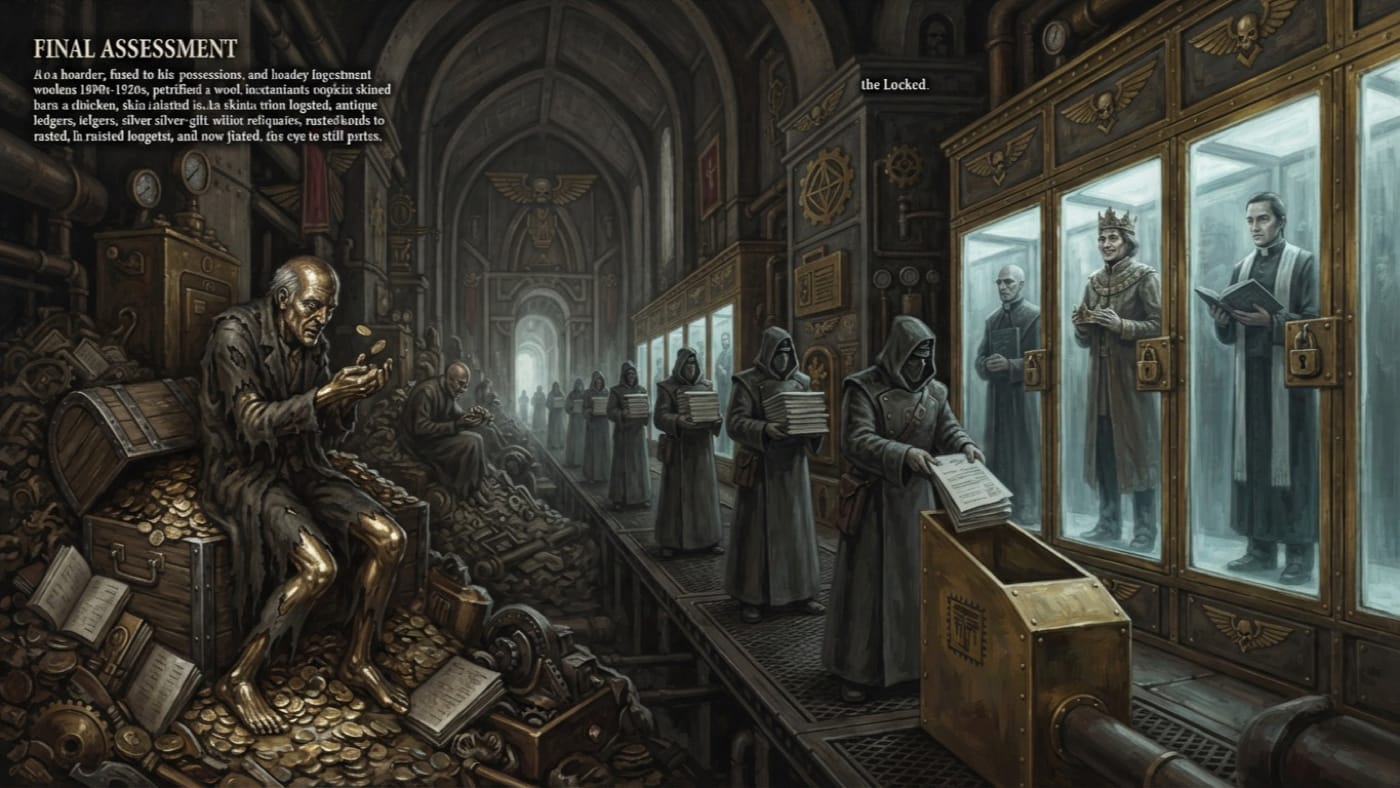
The record holds two expressions of the outcome. The first is the hoarder described in the published file on Velmora. His skin has taken a metallic cast, his joints have stiffened toward permanence and his eyes have glazed like cabinet glass. He is rooted among the possessions of a lifetime of good bargains. He is aware. He wants more. He can acquire nothing further. The second is the Locked, visitors to the Vault of Ten Thousand Keys who found what they entered to find. They now hold it behind glass, alive, their eyes moving and their lips shaping words the case declines to carry.
One suffers wanting. The other appears to suffer nothing at all. The Bureau files both under one heading because the ledger cares about the line it ends on, and both ledgers end on the same line: item retained.
#On the Price of Having
Every case the Bureau has examined began with a gift that worked. The wealth spent. The appointment came through. The landlord forgave the rent, the rival's warehouse burned, the inheritance cleared probate within a week. Velmora's agents do not trade in counterfeit. The Bureau's older pamphlets taught soldiers to bite every coin, which was precisely the wrong lesson. A false gift can be caught at the tooth. A true gift passes every test the Bureau of Tithes has devised and then asks, very quietly, for another.
The second acquisition follows the first because the first answered a question its recipient did not know he was asking: what am I worth? Each later purchase answers it again, a little louder. Gold is only the commonest currency of that question. Knowledge serves as well, and so do vindication, safety, a dead wife's voice, a rank once denied, and proof that one's enemies were fools. The famished widow and the comfortable magistrate reach the same counter by different streets. Poverty protects nobody; I have read the Debt Warren depositions. Wealth damns nobody either, a point the Bureau of Tithes makes at every budget hearing with suspicious warmth.
What alters is the use of things. Love is entered as an asset. Friendship is reconciled quarterly. The victim begins to appraise without intending to, pricing a chalice before he has noticed it is a chalice. His fingers curl as though around coin. Releasing a held object takes effort, then deliberate effort, then assistance. His speech settles into terms and counter-terms.
None of these signs, singly or in company, constitutes Final Assessment. They are symptoms in a living man. He can still be argued with and confessed. A sister with more sense than he has can still drag him bodily out of his counting-house.
#On the Forms of Collection
The hoarder and the Locked share an outcome and differ in experience. The Bureau's habit of blurring them has produced at least one memorandum I would be ashamed to have written.
The hoarder goes slowly. The skin tarnishes and the joints set. Possessions begin to adhere: first a ring that will not leave the finger, then a casket that will not leave the lap. At the last he is rooted, counted and valued, and he knows it. His want continues at full pressure with no outlet. He is a strongbox that can feel its own lid.
The Locked go quickly by comparison, and observers saw every appearance of consent. The Bureau's account of the sequence is brief. The visitor accepts sufficiency and stops resisting the room. He holds the object, a Keymaster passes behind him, and the case closes. Expedition lip-readers recorded the same phrase again and again: I found it. The faces show joy. An A.S. 147 account describes a Treasure-Locked man in the robes of a pre-Concordat Macedonian prince, gripping a crown too small for his skull and smiling. An Answer-Locked chaplain holds a treatise whose title changes between observations. The parent file keeps the full taxonomy. I keep my nerve.
The difference governs everything after it. The hoarder starves inside his hoard. The Locked are filled to the brim and fixed there. Doctrine supposes that the Vault learns the exact shape of each visitor's satisfaction and closes the glass upon it. That is an interpretation, and Doctrine should be held to the word.
One caution more. Velmora's long-serving mutated servants also harden, accumulate, and settle into immobile living vaults, and they go on acquiring. A metal skin proves service. Only cessation proves collection.
Early War summaries classified the Locked, and by extension every Velmoran terminal state, as "prisoners immobilised by demonic force."
Corrected in part. The confinement is physical and real, and the summary stands on that point. Its explanation of why the Locked stand still is withdrawn. So far as anyone has observed, what holds them is desire fulfilled and then fixed.
#On Valuation and Custody
Velmora's dominion prices people as a matter of routine administration. In the Assessment Halls, skills, remaining years, loves, secrets and obligations are itemised and entered. Demonic Assessors look at a man and gather his numbers. Ledger-Keepers record every transaction in books of impossible length. Collectors want one particular thing, such as a summer afternoon or a magistrate's certainty, and they trade fairly for it. Keep these demonic Assessors apart from the cult rank of the Ten Thousand Keys that borrows their name. Keep both further apart from the Synod's own tithe assessors, who merely look at a man and gather his numbers.
No source establishes that a Final Assessment must pass through any of these hands. Acquisition happens wherever Velmora's agents trade. Custody is the narrower question: what becomes of the person once acquisition is complete.
In the Vault, custody has a grammar. The published file on the Locked renders Final Assessment as the exact valuation of a soul's wanting, expressed as room, case, object and lock. The room is the category of desire and the case is its measure. The object is the wanting answered. The lock records that the answer is final. This is Doctrine's reading of what the expeditions saw. It does not follow that every terminal victim stands in a case, or that a hoarder fused to his strongbox in some Wallachian merchant house was valued by the same instrument. A hoard is custody without a curator.
The Vault lies deep in the Gilded Chasm. Velmora's domain runs through Moldavia, Wallachia and the eastern Romanian lands. Her pressure falls westward across the Transylvanian Alps on Bastion-Sibiu, the Synod's anchor on that reach of the north–south Sagittal Line. The cases stand far from the garrison. The temptations do not.
#On the Bureau's Verdict
Every office got what it wanted from that ruling, which is how one recognises a settlement. The Bureau of Medicine holds that the Locked persist in a suspended biological condition. That position keeps them within Medicine's jurisdiction without requiring anyone from Medicine to approach them. The Bureau of Doctrine holds that they are sacramental inversions, living reliquaries of completed greed, which supplies its preachers with a century of sermons. The Bureau of Records keeps them on the roster until death is certified. Death will never be certified, so the roster grows.
For the hoarder, the record is thinner. The Velmora file reports seven terminal cases classified by the Bureau of Rites and listed as "under observation." Seven is that circular's figure and nothing more. It is no census of Velmora's harvest, and it does not count the Locked.
The recovery prohibition covers both forms. Its stated rationale is that opening a case, or prying a hand from its prize, may enter the rescuer into a fresh chain of custody, with the Vault recording a second party to the original bargain. That is the Bureau's hypothesis about an enemy that prefers legal instruments. No successful recovery of a Locked person appears in any record available to this office. I will not draft the procedure for the next sentimental subcommittee to attempt.
The Church teaches that no demon can take the will, and that a man who has made a pact, served a cult and been mutated may still choose otherwise. Doctrine's language of exact valuation must be read beneath that teaching. A fixed body is evidence of custody, and custody belongs to the flesh. Whether the soul behind the glass has stopped choosing, nobody outside the glass can say. Repentance remains possible. In the Vault its fruit would be silent, and it carries no promise that the skin will soften or the case will lift.
#On Present Application
The Synod's defences are partial, and the Bureau prints them as complete.
Contract readers in the Bureau of Records search agreements for buried clauses. They are rotated every two years for reasons the Bureau of Medicine declines to itemise. Doctrine promotes the tithe as inoculation, on the theory that a man who gives freely cannot be bought. Whether that theology holds, or merely balances the Bureau of Tithes' projections, remains unsettled, and I have raised my own tithe in case. The Mark of Poverty removes the votary from the economy of transaction, and from every useful post along with it. The Value Fast strips soldiers and citizens of their property for fourteen days. It thereby produces, on a published schedule, exactly the desperation Velmora's agents prefer.
None of these reverses a Final Assessment. At best, they starve the second acquisition before it can answer the question the first one asked. A closed case receives no petitions.