
#On the File's Standing
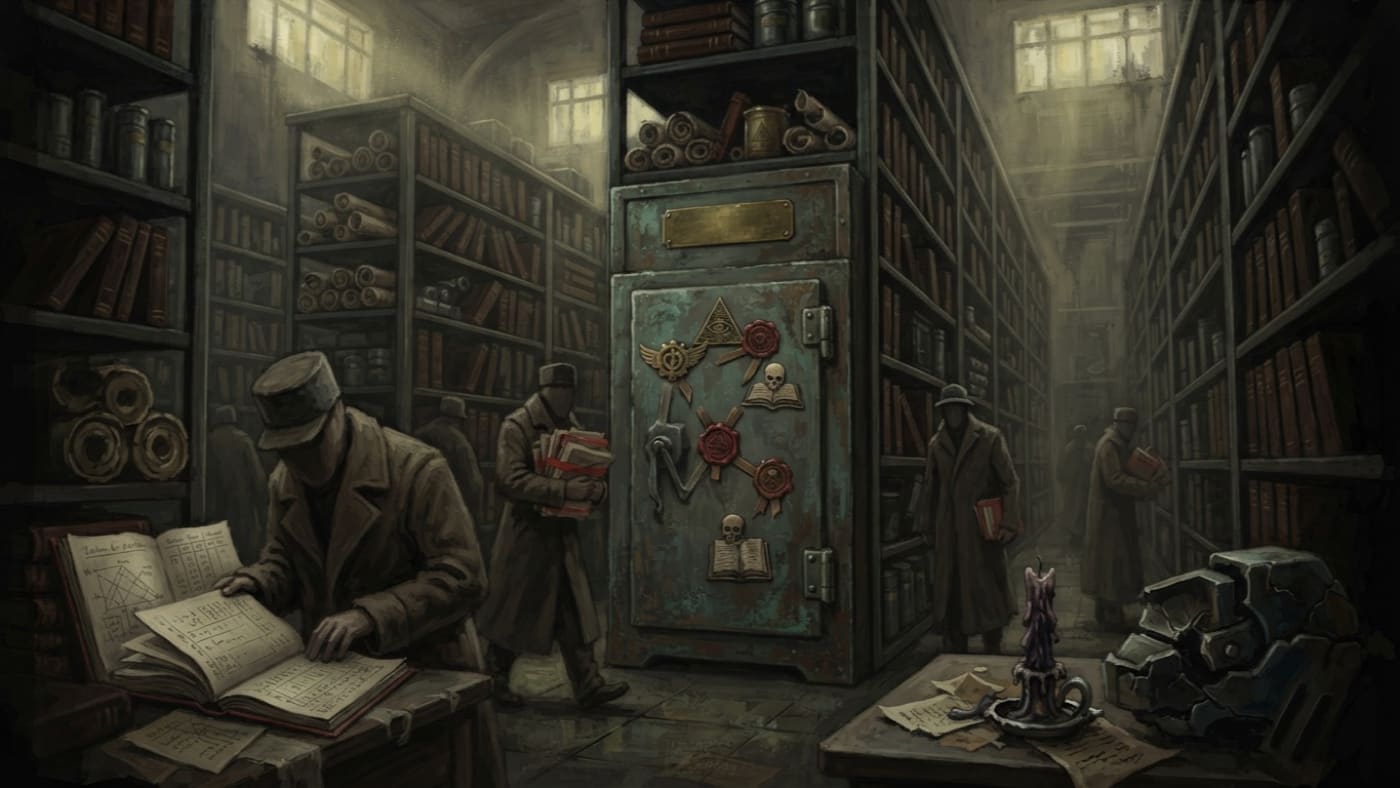
File 88-K/Shrine is the private name of a public catastrophe. The Collapse at Prague Gate has a public category, enemy action with contributory technical irregularity. That category is printed in hazard tables, recited at Dome-entry drills and copied onto condolence forms. The file is what the category refers to when someone holding the correct seal asks what it means.
Three Bureaus have a hand on it, and none will admit to holding all of it. The Bureau of War supplied the incident classification. The Bureau of Silence supplied the lower-hold extract and controls which words may leave it. The Bureau of Doctrine decides which contents become teaching, and in what order the teaching contradicts itself. As of A.S. 201 the file is active. In practice that means it is consulted, cited and amended at the edges. It does not mean the file is closed, and still less that anyone understands it.
The designation 88-K says nothing about a year. Clerks who think otherwise are moved to indexing, where their arithmetic can do no further damage.
#On the Failed Measure
The sequence is short, and Doctrine likes it short. In A.S. 147 a Pilgrim's Ladder pattern shrine-platform, whose registry is still disputed, met a Silence Dome on the Prague Gate approach during an escort and crowd-correction movement. The file keeps two accounts open: the Dome fell upon the platform, or the platform drove into the Dome. A pattern vessel is a copy of the prototype and is not the prototype. I say so for sentimental readers who like to picture the original Ladder burning at Prague. The file does not say that, and I decline to say it on the file's behalf.
A shrine-platform keeps its cadence by one sovereign sound. Since the Cadence Reforms the metronome bell has governed, one toll to one volley. The Cadence Caller turns the choir's measure into orders for the guns. Choir Runners carry cue-slates between hymn-gallery and battery. Gun-side and choir-side keep separate counts, and every discharge goes into the shot-ledger at once, with its authorising seal. The Shrine-Deck Crew are taught that an uncounted shot is a sin with legs, and they believe it more firmly than most catechumens believe anything.
Inside the Dome the hymn-vox lines failed first. Then the Runners' slates stopped matching the Caller's board. The bell was seen to strike. The file records a dispute over whether a toll nobody hears counts as a toll in law. It also records that the mortars did not wait for the canonists to finish. They fired out of phase, and several shells fell into the lower holds, where the pilgrims had been put for their own safety.
#On the Lower-Hold Extract
The extract is the shortest part of the file and the part everyone asks to see. It records witnesses, an object and a notation. It explains none of them. The Bureau of Silence has refused every invitation to explain, including mine, which was beautifully worded.
The pilgrims below were the kind of survivor the Bureaus find least convenient. They were close enough to see and far enough from any station that no duty bound them to report. Their testimony survives as numbered fragments. The extract does not say how the numbers were assigned, or what became of the fragments between them.
BUREAU OF SILENCE — FILE 88-K/SHRINE, LOWER HOLD EXTRACT Witness fragment 17: "The bell was below us." Witness fragment 22: "Our candles bowed east, then down." Witness fragment 41: "The machine answered itself." Recovered object: relic-candle fused through thumb bone; flame absent; wick warm after fourteen hours. Restricted notation: third voice detected in ███████████████████ interval before second internal detonation. Classification of phenomenon: ████████████
The bell hung on the upper deck, and so does every bell on every platform of the pattern. The candles had been secured as doctrine required. The thumb belonged to someone. The extract does not say whose, and nobody asked the families about the thumb. Somebody touched that wick for fourteen hours, or came back to it often enough to swear to it. The extract gives the result and leaves the clerk out.
The notation is the part the Bureau of Purity reads twice. It is tied to an extra harmonic heard during sustained off-cadence discharge. Any further detail sits behind the black bar, and Silence pays for the ink.
#On the Competing Findings
Every Bureau that touched the file left an explanation behind. Purity said sabotage. The Bureau of Engineering said hymn-jam interference. War said enemy action. Orison said acoustic severance. Silence offered no explanation, took the useful papers, and took them first.
Engineering's case was the dirtiest and the strongest. It followed the failure from the hymn-vox through cue-lag and recoil desynchronisation to the contradiction between bell and indicator, station by station. Several diagrams were confiscated because they were persuasive without permission. Purity's case had the elegance inquisitors favour. The platform behaved as if hostile intention had touched it, intention implies an agent, and an agent can be arrested. Doctrine then printed the competing explanations side by side. Two incompatible accounts, aligned neatly, can pass for balance with a grieving public.
File 88-K/Shrine records the Prague Gate collapse as enemy action exclusively.
Revised. Enemy action remains affirmed. Friendly cadence failure is admitted and classified as contributory sanctity drift. The earlier entry is kept in the file because Doctrine never throws away a sentence it might need again.
The bell has three dispositions and no settlement. War certifies that it was not melted. Orison certifies that it was. A clerk of the Bureau of Records deposed that it stayed audible inside a sealed crate for three days. That deposition now sits on a shelf whose existence I officially do not know about. All three statements stand in the file. Each one carries a seal, and no seal outranks the others.
The recovery order shows what the institution valued first. The shot-ledger came first, then the Ordnance Deacon's seal kit, then the hymn-vox housings. Pilgrim identity remnants came fourth, and only where they could be administratively separated from platform debris. The order does not prove that everything listed was recovered. It does prove that the ledger was the first thing anyone went looking for.
#On the Permitted Instruction
A sealed file is useless unless something leaves it. What leaves 88-K/Shrine is safety doctrine, cut down to fit the drill-book.
Shrine-platforms now carry doubled hymn-vox lines, so that one Dome cannot silence both. Cue-slates are colour-banded, so a Runner can see a mismatch before reading it. Cadence Callers learn silent transfer by flag, lantern, rail-tap and emergency hand measure, so the bell's sovereignty can outlast its voice. Pilgrim holds are segregated from powder work and fitted with additional fire doors. Ordnance Deacons may suspend pilgrimage carriage when the acoustics are uncertain. That last authority irritates every office that measures holiness in miles covered, and Doctrine regards it as the most valuable sentence the file ever produced.
Each reform appears in the Processional Arsenal hazard tables with the Prague Gate citation and none of the extract. A Battery Steward learns that cue-slates once contradicted the board. Nobody tells the Steward that the candles bowed.
The Bureau of Silence also controls the vocabulary. The notation in the extract may not be named in public instruction. The approved substitutes are acoustic artefact, stress echo, panic-harmonic and disputed crew report. Instructors use them with the sullen precision of men reading out someone else's confession.
The crews already have their own rule. They do not hum between tolls. Before Prague Gate, officers called that deck folklore and used it to keep Deck-Rats quiet. The file has made no correction to the superstition and never will, because any correction might lead to more humming. Silence has ruled that a useful fear is better left where it is.
#On the Active Holding
These matters remain open, and the file keeps them open on purpose. The platform's registry is disputed. Nobody has settled whether the Dome came to the platform or the platform went to the Dome, and the broader lore disagrees about what raises such a Dome at all. Nobody has settled whether an unheard toll governed the guns. There are three bells and one bell. The casualty count has no final figure. The second internal detonation is preceded by an interval that is still black. Whatever the Great Deceiver had to do with Prague Gate, Purity has asserted it and nobody has entered it as a finding.
The file still authorises a good deal. It supplies the canonical example for every shrine-platform failure lecture. It justifies the redundancy now written into Dome-entry drill. It gives a clean-collared instructor the authority to tell soot-stained crews what silence does. The crews already know, and they listen politely. They chew wax, touch the bell frame and keep their mouths shut between tolls.
Of all Synodal records, the file is least likely to be closed. Its value lies in what it never finished saying. A finished explanation would assign fault. The open file assigns drills.