
#On the Fifth Seal
The Fifth Seal of Faith is the Seal of Purity. Clerks recite the domains of the Seven Seals in whatever order flatters their own Bureau, and I once heard a Records man put Purity sixth with a straight face and a damp collar. His list changed nothing. Purity is Fifth because the Inner Circle says so, and the Inner Circle has never asked a Records man for anything except copies.
A Seal is a domain of superior authority. Newcomers take it for a stamp, a charter, or the Bureau itself. In fact all three borrow their force from it. The Bureau of Purity does the administrative labour beneath the Seal: inspection, seizure, custody, and sorting the faithful into the clean and the pending. Its holder, the Hierarch of Purity, sits among the Vicarii Orbis in the Inner Circle at Strasbourg, robed in white and crimson. The white sigil of the Fifth Seal is carved on her chair.
I will state the difficulty once and plainly. The Seal commands the cleansing of impurity, and no instrument of the Church has ever told me what impurity is. The commands are enforced every hour. The category remains under review.
#On Its Establishment
Purity did not begin at a council table. Burning, branding, and the confiscation of bad books and worse songs were habits of the Church long before anyone gave them a Seal. Around A.S. 80 / 1790 CE those habits were gathered into a developing Purity apparatus, and the Index Damnatus took recognisable shape. The list grew, its custody hardened, and a staff learned to read what it was forbidden to repeat.
The Concordat of Strasbourg of A.S. 90 / 1800 CE settled the formal Synod, and the Seven Seals with it. That is the constitutional year of the Fifth Seal, and this tract is filed under it. Both founders were in the ground by then. Kratz died in A.S. 88, and Augustinus had gone before him. The Concordat inherited a great deal of administrative architecture from their decades of labour. Neither man sealed the Fifth Seal, sat at the table that constituted it, or lived to see it chaired.
The Council of Mainz in A.S. 93 / 1803 CE ratified the structure and acclaimed the first Hierarchs under it. In the same year the armed campaign of the Witch-Hunts of Toulouse gave Purity its reputation and its permanent field functions. Temporary cleansing teams became standing officers, and improvised censors became Inquisitors. The Lore Book says the Bureau was "born in fire" at Toulouse. Founding rhetoric is permitted its bonfires. The fire consolidated what Strasbourg had already constituted.
The Council of Mainz created the Seven Seals and with them gave Purity its Seal.
Corrected. Mainz ratified a constitution that Strasbourg had settled three years earlier. The Seals were already seated when Mainz rose to applaud them. The clerk who wrote the original line has been reassigned to a parish that has never heard of either city.
#On Its Jurisdiction
The Lore Book sums up the division of labour in a single line: Doctrine defines truth, and Purity enforces it. The line is accurate the way a map of Strasbourg is accurate. It leaves out every alley where the real business happens.
Purity's writ covers forbidden speech, proscribed texts, condemned relics, songs, names, contaminated appetite, and any sensory or symbolic form classified as unclean. Prague burned a vintner for selling wine that was insufficiently sacramental. Bruges exiled three generations of stonemasons over the symmetry of their grotesques. Incense has been indexed by flavour. A child's rhyme sung at the wrong pitch can reach a Purity docket by evening.
Doctrine argues from category: what a word means and what precedent permits. Purity argues from contact. A word may be lawful while its speaker is contaminated. A text may be orthodox while its binding is suspect. One utterance can be cleared by Doctrine in the morning and seized by Purity in the afternoon, each Bureau acting within its own claim. The Hierarch of Doctrine and the Hierarch of Purity conduct this rivalry with the patience of two families feuding over a single pew. The Bureau of Records keeps both rulings and reconciles neither. Reconciliation is above its Seal.
The two Bureaus keep separate books. Doctrine's Index Claritatis is the vocabulary of the permitted, revised weekly. Purity's Index Damnatus is the register of the prohibited. A clerk who confuses them in correspondence will have his error explained by both Bureaus, separately and in contradictory terms.
#On Its Instruments
A prohibition issued in Strasbourg means nothing at a ferry-house forty miles down the Rhine until it arrives. The Seal's authority travels as freight.
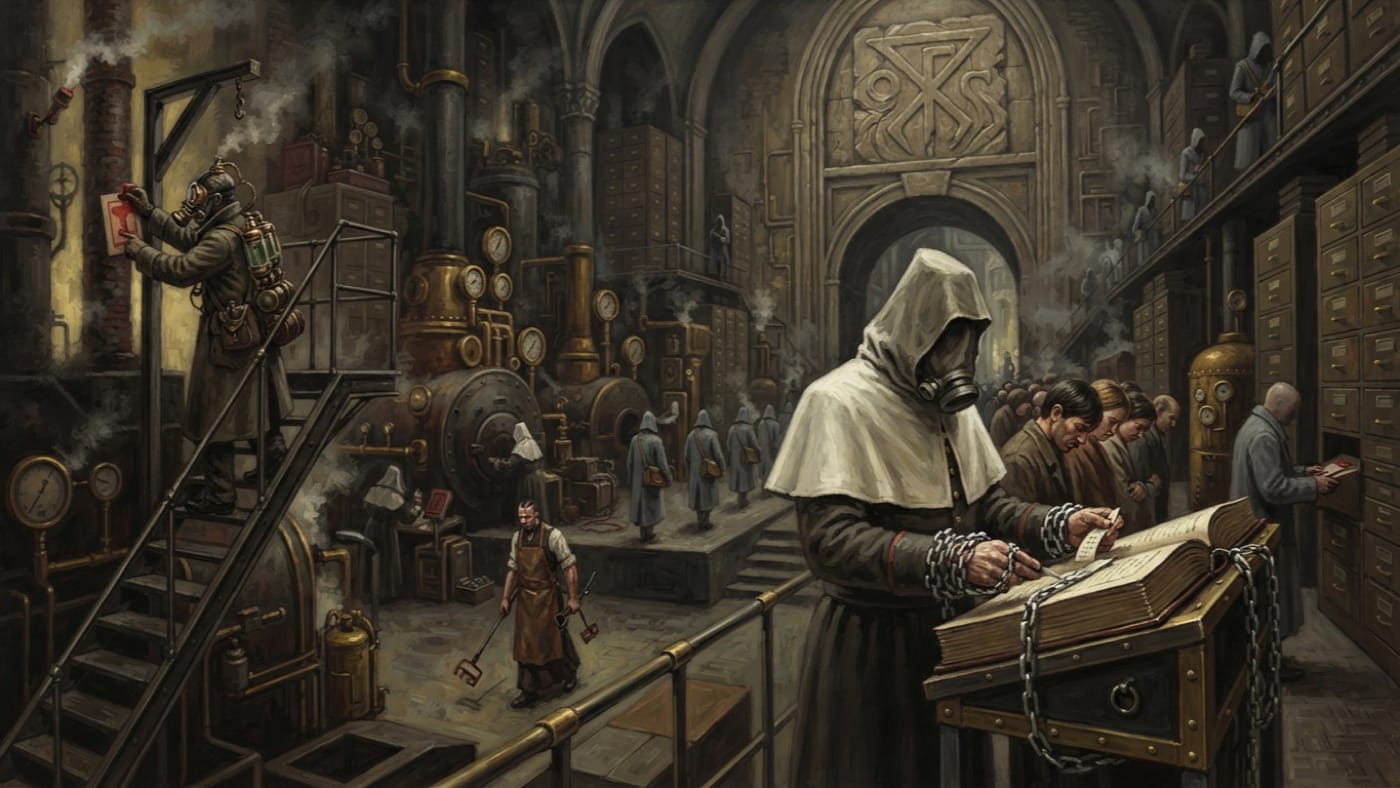
It starts in custody. The master Index lies chained beneath Strasbourg, in the Vault of Silences beside the Ashen Cloister. The Cloister is the Bureau's seat, three streets east of the Basilica of the Ledgered Saints. The Hierarch's chair stands elsewhere, and the Seal does not require her to stand beside the book. Gloved Inquisitors turn its pages without reading them. In the ordinary course, revisions leave that custody weekly. Field personnel also receive daily Errata and correction strips. The master book is not rewritten each dawn. The strips are.
Each revision is sealed into a packet with wax, cipher and stamp, and handed to the Index Runners. These are grey-coated, wax-cuffed couriers whose pocket strips are valid for one day only. They deliver to gatehouses, ferries, orphanages, shrines, and the back rooms of print districts. The Runners exist because a ban that arrives late is only a rumour, and the damned learned early to outrun rumours by changing their names and crossing water. Counterfeit packets once filled the cells with wrongful arrests, and in the panic that followed the seals were made stricter and the Runners were audited. A prohibition has to be authenticated before anyone can obey it. Even Purity concedes that much.
At the receiving end stands the White-Mantled Inquisitor, in a starched mantle and an ash-filtered hood, with a glass chain wrapped from wrist to wrist. He recites the day's Errata at dawn and compares the market's language against the current strip. He seizes sources, traces how the words travelled, takes recantations, and files the corrected account. The chain frightens shopkeepers, but its real purpose is to frighten the Inquisitor. A chip in the glass implies unlogged contact, and unlogged contact is the reason the chains were made mandatory in the first place. The Chalkling listens, the Mantle Examiner raids, and the page is corrected.
Where speech proves insufficient, flesh is consulted, and the Lictors inscribe confession where it cannot be mislaid. Where flesh is not available, there is still the air. The Fume-Inspector walks the bread queues sniffing hearth smoke and files affidavits on the state of a district's chimneys, so that a kitchen can be convicted on the evidence of its own breath.
#On the Definition Still Pending
Eight years before my A.S. 201 survey of the current Hierarch, I asked her what constitutes impurity. She looked at me for eleven seconds. Then she asked whether I had submitted the question in triplicate, and pointed me to the ninety-day processing period. I submitted it in triplicate. The submission remains active, and it remains unanswered.
I record this once, as evidence and not as grievance, though I doubt the distinction will survive the reader. Over those eight years the Fifth Seal has not paused once to wait for my reply. Runners ran. Inquisitors seized. Fume-Inspectors stamped chimneys clean or condemned them. Records filed it all, pale and punctual. Enforcement has never waited on definition. A Mantle Examiner does not need to know what impurity is. He needs to know what is on today's strip, and today's strip has always been sufficient for a seizure.
Silence is a filing status. My question has been neither acquitted, nor denied, nor answered by implication. Anyone who reads a secret definition into the Hierarch's silence is inventing doctrine, and inventing doctrine is Doctrine's privilege and nobody else's. Doctrine has its categories, which Purity accepts when they are convenient and supplements with contact when they are not. The Creator has presumably formed a view of the matter. The Bureau has not been copied on it.
#On the Present Application
As of A.S. 201 / 1911 CE the Fifth Seal has a holder. She is a woman, seated and active, and her public name is withheld from the annual ledgers. I do not know when she took the chair or whom she followed. The Bureau will not tell me, and the Bureau is right, since I would only put it in a tract. The Seal works through her without her needing to be seen. Strips go out before Prime, Runners pass without ringing their bells, glass chains click along the market streets, and chimneys are sniffed and filed.
Purity's jurisdiction remains enforceable, and the category it was founded on remains pending. Strasbourg has kept this arrangement for one hundred and eleven years without visible discomfort. It is either a triumph of administration or the most elegant evasion in the history of the Church. I have been instructed to certify the former.