
#On the Designation
"The Bureau of Engineering has classified the structural data. The Bureau of Mercy has classified everything else." — Dossier of Hierarch Augustinus of Mainz, "The Siege of Mainz"
This entry is a survey of a name, conducted in A.S. 201. I state its scope at the door so that no reader mistakes the vestibule for the nave. The Codex holds one surviving reference to the Fifth Ratification. It is a single redacted sentence in the dossier of Hierarch Augustinus, which records that certain construction particulars "remain sealed under the Fifth Ratification." That sentence is the whole of the public evidence. I have built this tract on it the way a canonist builds a commentary on one verse: by reading it more slowly than its author wrote it.
Junior clerks are flogged for forgetting the difference between a named sealing instrument and an authenticated, accessible text. A named instrument is a designation that appears in a record and does work there, since it explains why a passage is black. An authenticated text is a document a surveyor can lay on a desk, collate, and cite by clause. For the purposes of this Codex the Fifth Ratification is wholly the first kind. Its formal full title is unestablished, and so are its legal series, its ratifying authority, its original wording and its date of issue. "Fifth Ratification" is the short designation the dossier uses. I keep it exactly as written, with the care owed to a relic whose reliquary has gone missing.
#On the Sealed Construction Record
The redacted passage withholds three separate subjects. A clerk who files them together as "the construction secrets" has never had to cross-index anything.
The first is composition: "the exact composition of the mortar." The dossier does not say that mortar was secret in general, or that every foundation of the period used one mixture. It says that one exact composition, used at one place, is sealed.
The second is the site. The dossier names a place and then blacks it out, so the bar sits where a proper noun would sit. The authorized record attaches Augustinus to Mainz, which makes Mainz the first city a careless reader will write into the gap. The gap refuses it. A redaction bar has a length but no spelling.
The third is the contributors: "the number of volunteers whose ████████ contributed to the foundations." Here the dossier withholds a count, and then it withholds the thing being counted. What those persons contributed is sealed, and so is how many of them there were. "Volunteers" is the dossier's word, and I report it as the dossier's word. The passage does not say whether it describes their condition or the Bureau's taste in vocabulary, and this survey cannot settle the matter.
The exact composition of the mortar used at ████████ and the number of volunteers whose ████████ contributed to the foundations remain sealed under the Fifth Ratification.
What the passage does attest is narrower and colder. Something was built, and its mortar had a composition worth sealing. Its foundations received contributions from persons numerous enough to be counted and particular enough to be withheld. Between the reader and every one of those particulars stands an instrument that has a name and nothing else on public record.
I do not reconstruct the bars. A theologian who decodes a seal by guessing has only forged a second document and signed it with his own vanity. I reserve my vanity for documents I have actually read.
#On Engineering and Mercy
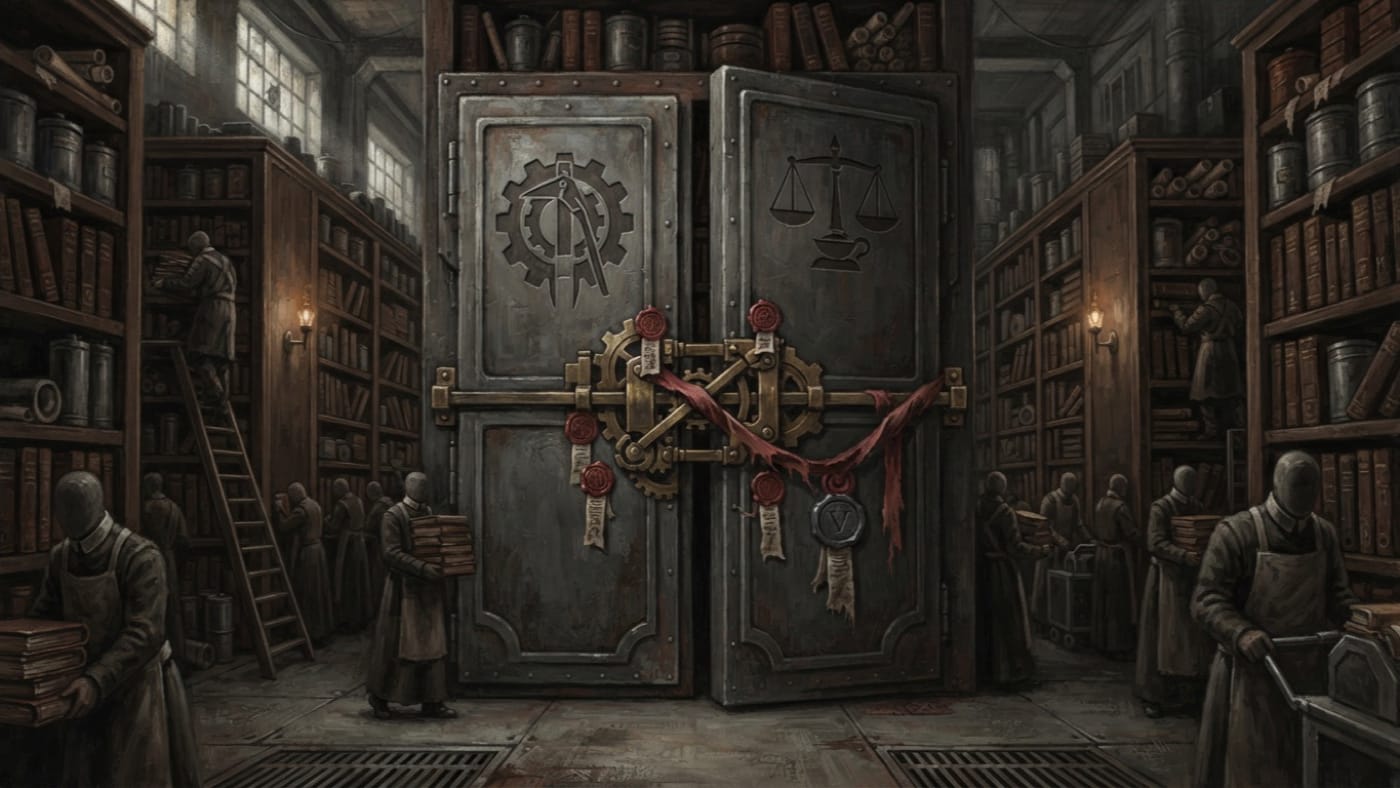
The dossier divides the sealed material between two Bureaus in two sentences. That gives two offices and one boundary, and the boundary deserves more attention than either office.
The Bureau of Engineering measures, surveys, specifies and files the physical world. Its published tract dates its formal constitution to A.S. 92, after decades of practical works, and places its seat at the Foundry Archive on Strasbourg's eastern canal. That context makes the first sentence intelligible, because load, composition and foundation are exactly the data Engineering keeps. It does not make the Foundry Archive the home of the Fifth Ratification. Where the instrument physically rests is unestablished, and the canal offers no testimony.
The Bureau of Mercy keeps the hospitals, the orphanages and the records of care, which amount to the Church's ledger of bodies that were tended. That gives "everything else" a considerable appetite. Whatever was not structural went to the office of tending. The dossier does not say what that remainder contains, and I will not furnish it from Mercy's general reputation, however tempting that reputation makes the exercise.
Three drawers must stay shut against one another:
- Classification is the act of marking material restricted.
- Custody is the duty of holding it.
- Ratification is the act that gave the instrument its force.
The dossier attests the first two for Engineering and Mercy and says nothing about the third. Neither Bureau's hand on the material proves that it enacted the seal. Nor does it prove that both Bureaus enacted it jointly, or that the instrument ranks above or below any other law of the Church. Two custodians at a door tell you who holds the keys, but they cannot tell you who forged the lock.
Engineering took the stone and Mercy took the rest. Between them they left nothing on the table for the reader, which is what tidy custody looks like.
#On Chronology and Attribution
The dossier sets the redacted sentence beside its account of the wartime foundations and relief works that grew up around Augustinus before the Sagittal Line became defensible, around A.S. 65–68. It places the standardisation of the marrow-tax system, around A.S. 68–72, as a later and separate stage. The formal Synod arrived only with the Concordat of Strasbourg in A.S. 90. Those are three stages with three kinds of authority: improvised works, regularised practice and constitutional settlement. The sealed foundations belong to the dossier's account of the first stage, but the Fifth Ratification itself is pinned to none of them.
Augustinus died before the A.S. 90 settlement. The dossier holds that boundary, while the exact day of his death stays sealed under arrangements of its own. For this instrument the consequence is simple arithmetic. If the Fifth Ratification was issued after his death, he did not sign it. If it was issued during his lifetime, no surviving record shows that he signed it. Because the date is unknown, it is equally unknown whether the sealing came before or after his burial. I will not put his pen to an undated page.
The ordinal is the trap. "Fifth" tempts a clerk to count back to four predecessors, to assume a fifth Congress, or to read the number as a year. The word supports none of these readings. Clerks who rank ratifications like rungs on a ladder will look for the Fifth among the rungs, but the Augustinus passage names no rung at all. The Common Allegiance of A.S. 55 is a binding of dioceses with its own pages and its own protected form, and the designation cannot borrow either. The Concordat is a constitutional settlement made after the founder's death. No construction decree within the Codex's reach names the Fifth Ratification. The word sits in one sentence of one dossier, and that is where I leave it.
#On the Present Documentary Status
This survey can record the following:
- a designation, the Fifth Ratification;
- a sealing function, attested in one passage;
- three withheld subjects;
- a custodial division between Engineering and Mercy, as the dossier states it.
This survey cannot record the instrument's text or its full title. It cannot name its ratifier, its date, its clauses or its place of keeping, nor any condition under which its seals might be lifted. No release is recorded here, and no amendment. I have not inspected the original, and I will not pretend that the original has inspected me.
That is the complete file. It is short because the evidence is short. An archivist who stretches a file beyond its evidence commits the one sin the Ledger cannot absolve, which is invention passed off as diligence. The black bars in the Augustinus dossier remain the correct length, and each Bureau keeps its half. The name endures, sealed and attested, its text unread.
The entry is filed under the designation the record gives it, with nothing added and nothing decoded. The foundations stand, and what they cost remains a sealed quantity.