
#On the Congress
The ledger has room for a body. It has none for what the body felt. — marginal maxim of the present writer
In A.S. 198 the Fifth Compliance Congress was asked to add one column to the attendance return, and it refused. The column would have entered emotional context beside a household's absence: a record of the circumstances of feeling under which a family failed to stand at its open window when the Sky-Sermon came down from the horns. The surviving notice gives the proposal and its defeat. It does not give the wording, the author, the formula, the venue or the count of hands raised against it. I will not supply them. I am a historian and not a novelist, whatever the Bureau of Records says about my expense claims.
The return matters more than the congress. A sector's attendance return becomes its Choir Rate. The Choir Rate becomes a ration modifier, a curfew hour, purple wax on a stairwell door, and a compulsory assembly sermon in a square that smells of damp wool and boiled cabbage. There is a stomach behind every figure on the sheet. A new column would have given that stomach standing to argue.
The Choir Rate has never admitted a personal circumstance. It counts bodies, tokens, windows and tone. Everything else is the citizen's private affair, and the citizen's private affair is the Church's least favourite subject.
#On What the Ledger Already Admitted
The Choir Rate has never admitted a personal circumstance.
Corrected. It admits several, so long as each arrives as a category. Work duty, illness, funerals and war service enter excuse adjudication every day. What the Choir Rate refuses is a circumstance that arrives as a feeling.
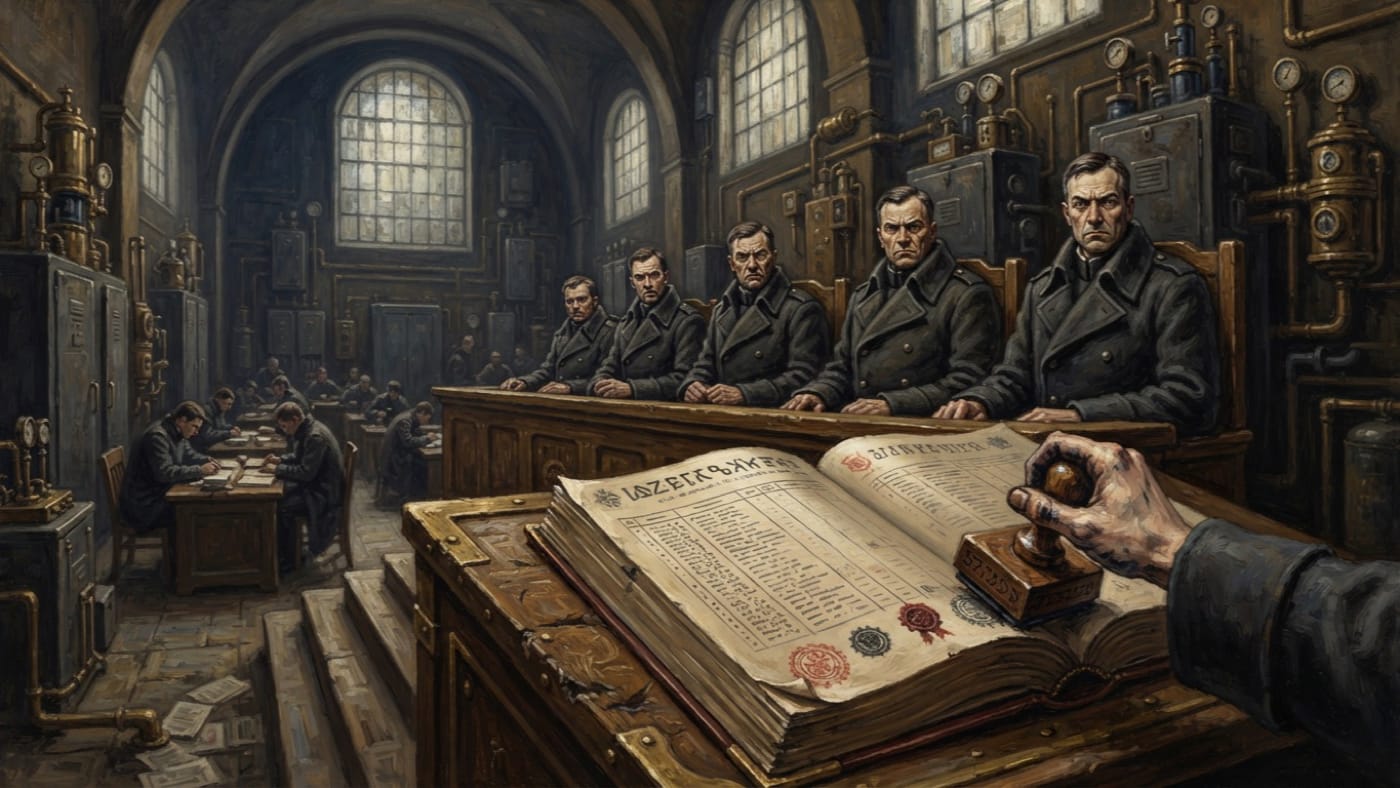
The mechanism deserves description, since the congress was asked to tamper with it. During the listening window a Sky-Sermon Attendance Auditor walks the stairwells with chalk, a tally cord and a portable receiver tester. Open windows are counted. Receivers are tapped and checked for the correct tone. Households present sermon tokens or stamped slips. An absence is logged, then sorted: approved, suspicious, or heresy-adjacent. In the late afternoon the excuse slips come in, and the adjudicator's cuffs go blue-black to the wrist.
A funeral is an excellent excuse because it can be checked. It has a date, a corpse, a burial roll and a priest's seal. The adjudicator lays the slip against the register and stamps it. The household is excused for that window, the Choir Rate is spared the absence, and the machinery carries on as if nothing had died.
Grief has no burial date. It goes on after the funeral, through the next window and the one after that. A receiver tester cannot measure it, and no register will confirm it. The funeral excuses an afternoon. Nothing on the form excuses the month that follows.
#On the Proposed Column
What follows is my reading of the known proposal. It is not a reconstruction of the debate, which I do not have.
Consider any stairwell in any sector. A household buries a son. The funeral slip covers the burial window. The next week the mother does not open the shutter. The week after, the father stands at the window while the receiver hisses, and his mouth does not move. The token is presented but the tone is wrong, because nobody in the room has touched the receiver since the coffin left. Under the existing return this household slides from approved to suspicious, and from suspicious toward a ration downgrade. If the sector's figure falls far enough, it slides toward purple wax on the shared door, which the neighbours will blame on the bereaved.
An emotional context column would have recorded the reason. That was its offence. Once grief is recorded, it becomes something an office has to weigh, and anything an office has to weigh can be found heavier than the penalty.
Every office with a stake objected, each for its own reasons. Tithes draws real advantage from ration penalties in districts that are already hungry, and a column that slows penalties slows Tithes. Records receives every new column as a new cabinet, a new cross-audit and a new way for a clerk to misfile a heart. Purity holds that sorrow left unattended goes quiet, and that quiet is where heresy grows. Doctrine had the oldest and neatest objection. If grief can excuse the Orison, then the Orison has been admitted to be something a grieving soul might reasonably avoid. Attendance is allegiance. A column that let sorrow outweigh attendance would have let sorrow outweigh allegiance, and no congress of the Church could sign its name under that.
There was a quieter danger too. The Mercy Counters already soften figures street by street, through fraud that is small and deniable. A lawful column would have turned that fraud into procedure. Mercy kept in a drawer can be punished. Mercy kept in a column has to be audited, and auditing it would have meant admitting it exists.
#On the Fourth Congress's Precedent
Twenty-seven years earlier, at the Fourth Compliance Congress of A.S. 171, the Signal Methodists proposed a Signal Condition Index to sit beside every Choir Rate ledger. It had six measures: Horn Reach, Relay Integrity, Receiver Function, Shrine Uptime, Weather Impedance and Deadzone Risk. Their scheme would have delayed some penalties until an engineer confirmed the fault, and would have flagged deadzones for review before any branding. The motion was defeated. The Methodists are now officially nonexistent, and their vocabulary turns up in maintenance appendices with no attribution.
The two proposals must not be confused, and the Bureau would like them confused. The Fourth Congress asked whether the sermon arrived. The Fifth asked whether the listener could bear to hear it.
The Methodist question had an answer that could be inspected. An Orison Signal Engineer can climb to a cracked horn, open a logbook and write down the fault in plain ink. The trouble with the Methodists was that their evidence was good, and good evidence about equipment leads to budgets, procurement and the offices that starved the hornline of copper. The Fifth proposal pointed in the opposite direction, inward, where no engineer climbs and no log is kept. Nobody certifies a sorrow. Nobody stamps a widow clean-carrier.
Some in the corps call every such proposal Methodist. That is a slur, not a genealogy. I have found nothing showing that the authors of A.S. 198 inherited anything from the expunged faction of A.S. 171, whether membership, method or a single shared pen. The resemblance lies in the result.
#On the Return Unaltered
The column was rejected. The attendance return left the Fifth Compliance Congress with exactly the columns it had when it arrived. The excuse categories stayed where they were, funerals still among them, and grief stayed outside, in the stairwell.
Nothing in the sector offices changed afterwards. Auditors still walk the window rounds with chalk on their knees and testers in their coat pockets. They still check slips against burial rolls and are still told, in training, to count the stairs and ignore the stories. Rations still move with the Choir Rate. Purple wax still lands on doors whose households had better reasons than the form allows. The Auditor who reads a bereaved family's absence as plain absence is not being cruel. He is reading the return correctly, which is worse, and also what he is paid for.
In A.S. 201, three years on, the parent account of the Signal Methodists files the Fifth Congress in a single line: different proposal, same coffin. I am content with that. The Choir Rate may admit a body, a token, a window, a tone and a stamp. It may admit a funeral, provided the funeral comes with a seal. It may not admit grief, and since A.S. 198 it has had a congress's refusal to point to whenever anyone asks again.